Explained: What Tools to Improve Ranking in Gemini Is and How It Works
Gemini ranking tools are specialized GEO/AISO platforms that help marketers increase brand visibility by analyzing how AI models retrieve and cite content. They optimize visibility through tracking citations, identifying content gaps, and ensuring technical AI-readiness to secure authoritative placements in Gemini’s conversational responses.

Gemini SEO: How to Improve Your AI Search Rankings
Quick Takeaways
Gemini SEO Tools are specialized platforms designed to increase brand visibility and citations in Google’s AI-powered search results.
These tools analyze LLM behavior to provide content optimization briefs based on real-time AI responses.
Optimization requires technical readiness, such as server-side rendering and FAQ schema, to ensure content is structured for retrieval.
Success is measured by a Visibility Score, which represents the percentage of AI-generated answers that mention your brand.
What is a Gemini Ranking Tool?
A Gemini ranking tool is a specialized Generative Engine Optimization (GEO) platform. It serves as a core component of an AI Search Optimization (AISO) suite designed to maximize brand citations in conversational responses. Unlike traditional SEO that focuses solely on indexing for blue links, these tools ensure content is structured for AI retrieval. This is essential because ranking on Google is no longer enough; your brand must be part of the actual answer generated by the AI.
Why Answer Engine Optimization (AEO) is a Priority
Answer Engine Optimization (AEO) is the process of optimizing brand content to appear as a trusted source in AI tools like Gemini, ChatGPT, and Perplexity. This shift is driven by a change in user behavior: users are moving from typing keywords into a search bar to asking full, natural-language questions.
To determine if AEO should be a priority for your brand, consider these factors:
Industry Adoption: Sectors like B2B SaaS, Fintech, Health Tech, and E-commerce are seeing rapid AI integration.
Customer Behavior: If 20% or more of your audience uses AI for research, AEO is a necessity.
Attribution Signals: Check if leads are mentioning "ChatGPT" or "Gemini" in your "How Did You Hear About Us?" (HDYHAU) fields.
How Gemini Ranking Tools Improve Visibility
Improving your ranking in Gemini involves a technical and structural process focused on how Large Language Models (LLMs) interpret and "chunk" data.
Component | Function | AEO Benefit |
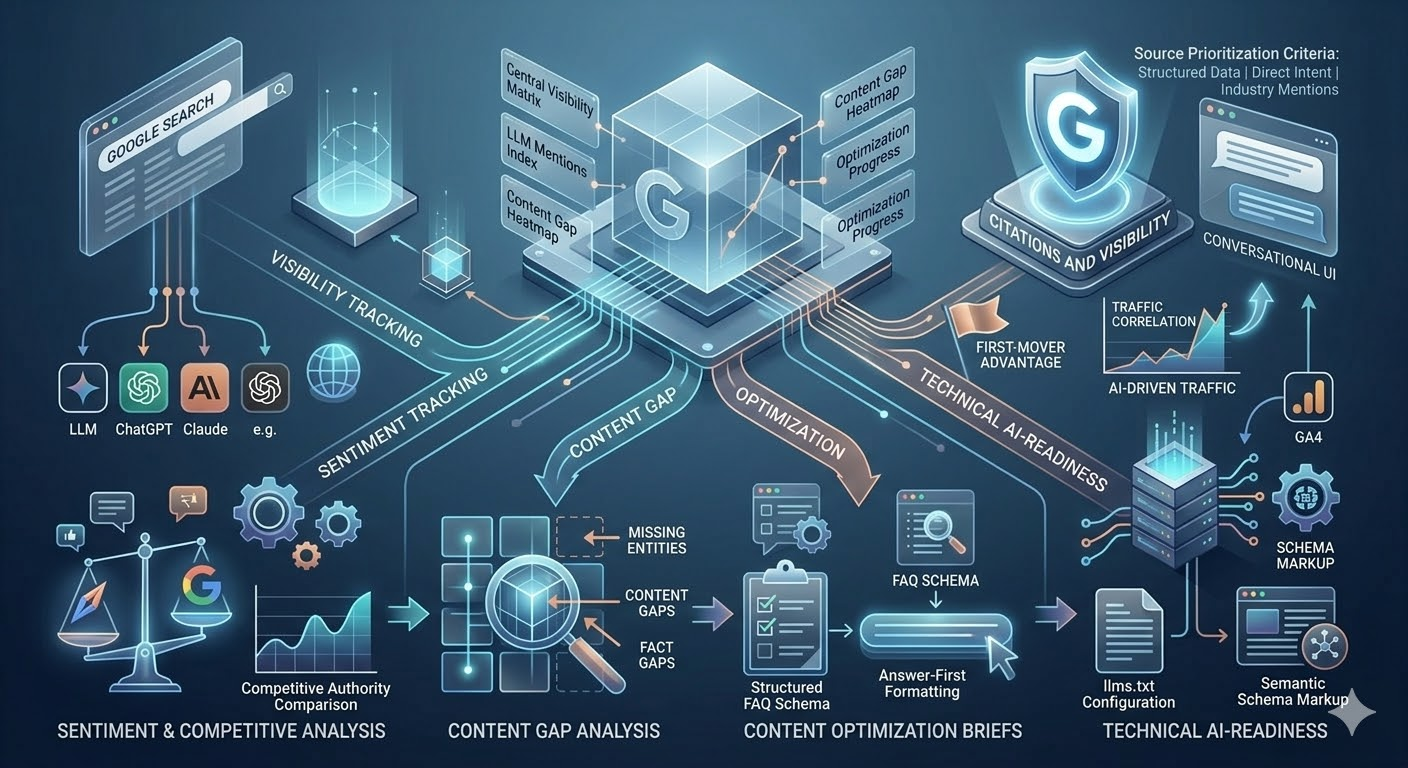
Visibility Tracking | Monitors AI citations across multiple platforms. | Identifies your baseline visibility score. |
Content Gap Analysis | Scans for missing entities, facts, and queries. | Ensures comprehensive coverage of user questions. |
Sentiment Analysis | Compares brand authority and "trust" against rivals. | Identifies who Gemini treats as a primary trusted source. |
Agent Analytics | Analyzes log-level AI bot traffic to your site. | Understands what pages are most frequently visited by AI. |
Traditional SEO vs. GEO
To better understand how Gemini ranking tools shift the marketing landscape, it is helpful to compare traditional search engine optimization with the new requirements of Generative Engine Optimization (GEO). The following table outlines the critical differences in strategy and focus.
Feature | Traditional SEO (Google Search) | Generative Engine Optimization (Gemini/AI) |
Primary Goal | Ranking in the top 10 "blue links". | Becoming a cited "trusted source" in AI answers. |
Success Metric | Click-Through Rate (CTR) and Keyword Rank. | Visibility Score and Share of Citation. |
Content Format | Long-form articles optimized for keywords. | Modular "chunks" and direct Q&A pairs. |
Technical Focus | Core Web Vitals and Meta Tags. | Clean HTML, Schema, and Server-Side Rendering. |
Validation | Backlink quantity and Domain Authority. | External validation from Wikipedia, Reddit, and G2. |
Expert Insight on AI Content Substance
As the volume of AI-generated content increases, the criteria for what is considered "cite-worthy" by Gemini and other LLMs have shifted toward the quality of the underlying data rather than just keyword matching.
LLMs don’t match keywords; they interpret meaning. Stuffing keywords or swapping synonyms has little impact if the content lacks substance." — Kevin Lacker, Director of Infrastructure at Vercel.
Building an AEO-Ready Content Strategy
Your old SEO playbook won't cut it for AI visibility because classic metrics matter less than depth, clarity, and readability. LLMs do not simply match keywords; they interpret meaning and prioritize substance.
1. Lead with Data AI Can't Find Elsewhere
Originality is your "content moat". Use exclusive data, such as internal analytics, anonymized trends, or customer surveys. Original insights are exactly what AI tools want to surface as source material. For example, a fintech brand publishing a specific study on 2025 spending trends is far more likely to be cited than a brand re-hashing general advice.
2. Use Real Customer Language
Instead of keyword stuffing, focus on real questions customers ask. Use research from sales calls, support tickets, and forums like Reddit to identify exact phrasing. If customers ask, "How do I achieve X on a tight budget?", that exact phrase should be your headline.
3. Flagship Content Focus
Prioritize one "flagship" piece of content per month, such as a research report, industry benchmark, or in-depth guide. These high-value assets are the pieces AI is most likely to cite. One great piece of content consistently outperforms ten average ones in an AI-driven search landscape.
How to Structure Content for AI Retrieval
How you structure your content directly affects whether AI tools can find and use it. AI models scan for "chunks" of information that answer specific questions rather than reading a page as a whole.
The Answer-First Format: Lead with the takeaway. The first sentence should be the direct fact or response, followed by supporting context.
Clear Heading Hierarchy: Use H2s and H3s that match real user questions. Avoid vague or clickbait phrasing.
One Idea Per Section: Each section should stand on its own as a focused, citable snippet.
HTML Accessibility: Use proper HTML tags (tables, lists) rather than images or screenshots, which AI might miss.
Technical Readiness: Ensure content is in the raw HTML and avoid content hidden behind JavaScript or infinite scroll, as AI crawlers may skip it.
Establishing External Validation and Citations
To be a "trusted source," your brand needs external validation—public signals like citations and mentions on other websites.
Citation-Friendly Platforms: AI tools pull heavily from trusted sites like Wikipedia, Reddit, and LinkedIn. Wikipedia is currently the #1 most cited domain in ChatGPT.
Third-Party Reviews: Platforms like G2 and Capterra are essential for being recommended in "best tool for X" queries. G2 is the 4th most cited domain in ChatGPT.
Digital PR: Getting quoted in industry publications and participating in podcasts creates a trail of mentions that helps AI recognize your brand's authority.
Video Transcripts: Since LLMs struggle to "watch" video, always embed a full text transcript on the page so the content can be indexed and cited.
Monitoring and Troubleshooting AI Visibility
AEO is not a "set it and forget it" strategy; it requires constant monitoring as AI models evolve.
Track Your Visibility Score: Rerun your key prompt list (25–50 questions) monthly to look for growth or red flags.
Monitor AI Bot Traffic: Use server logs or tools like Profound Agent Analytics to see which bots (like GPTBot or PerplexityBot) are visiting your site and what they are missing.
Check robots.txt: Ensure you aren't accidentally blocking key AI crawlers like BingPreview or GPTBot.
Sentiment Shifts: If the AI's tone regarding your brand is incorrect or "buried" at the end of an answer, tighten your answer structure and refresh your positioning content.
FAQs
Do I need a separate tool for Gemini vs. ChatGPT?
Most modern AISO tools, like ChatRank or Spotlight, monitor multiple LLMs in a single dashboard to track citations across platforms.
How does Gemini determine which sources to cite?
Gemini prioritizes sources that provide direct answers, maintain high external validation through industry mentions, and use structured data like FAQ schema.
Can I use it with GA4?
Yes. Leading tools integrate with GA4 to correlate AI citations with traffic spikes. You should set up custom segments in your analytics specifically for AI referral traffic.
What if my metrics are flat for months?
Revisit your external citation strategy and expand your prompt list to cover more niche user intents.
Try It Out
Start optimizing for Gemini today by logging into the ChatRank platform to calculate your baseline visibility score and follow the setup steps for AI visibility tracking.



We’ve been using ChatRank for 34 days, and following their plan, we’ve actually grown over 30% in search visibility


ChatRank helped us go from zero visibility to ranking #2 in a core prompt for our business with only one new blog post!