Why AI Models Choose Some Sources Over Others
This guide breaks down each factor in plain language. Each section ends with one actionable step you can take right away. At the end, we'll show you how ChatRank ties it all together — so you can measure whether your efforts are actually moving the needle.

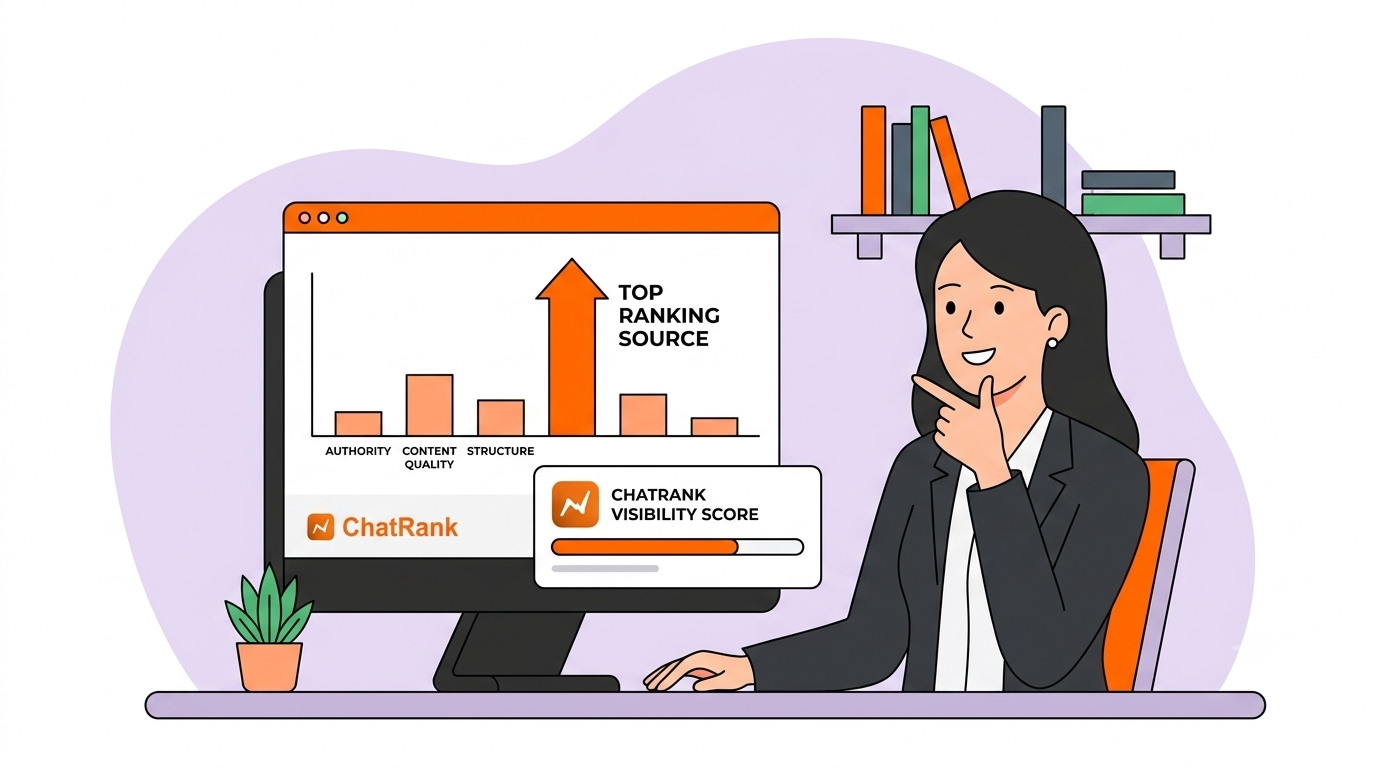
Why AI Models Choose Some Sources Over Others
You've searched ChatGPT, Perplexity, or Google Gemini and noticed it cited a competitor — not you. Or maybe your brand never shows up, even when the question is squarely in your lane.
You're not alone. And it's not random.
AI-powered search engines and chatbots follow clear internal rules to decide which sources to trust, quote, and recommend. Understanding those rules is the first step to doing something about it.
The Big Picture: How AI Models "Read" the Web
Before diving into each factor, it helps to understand the two main ways AI models incorporate information into their responses.
Training data is everything the model learned during its initial training phase. This includes billions of web pages, articles, books, and forums — all ingested up to a fixed knowledge cutoff date.
When the base ChatGPT model answers a question without citing a source, it is pattern-matching against this internal knowledge base. It is not performing a live search.
Retrieval-Augmented Generation (RAG) is a separate architectural pattern — not a built-in feature of all AI systems. As NVIDIA explains, RAG connects a language model to an external knowledge source at query time.
A retrieval system fetches relevant documents and passes them as context into the model's prompt. The model then generates a response grounded in that retrieved content. Platforms like Perplexity AI, Google Gemini with Search Grounding, and ChatGPT with Browse use RAG-style pipelines — the base ChatGPT model does not.
Optimizing for RAG-enabled interfaces requires a different strategy than optimizing for training data. In a RAG pipeline, your content must be crawlable and structured so the retrieval system can match the right passage to the right query.
In a training-data context, what matters most is how consistently your brand appeared across the web before the model's cutoff. Both paths require deliberate effort — and different tactics.
Factor #1: Entity Recognition — Does the Model Know Who You Are?
Language models represent knowledge through entities — well-defined concepts like organizations, people, products, and places. When training data contains consistent references to your brand across many independent sources, the model builds a stable internal picture of what you do and who you serve.
Consider how a model handles a query about HubSpot. It confidently describes the product suite, target audience, and competitive landscape. That's because HubSpot appears in thousands of blog posts, press articles, Wikipedia entries, and industry directories.
A brand with sparse online coverage gets a vague, hedged, or absent response. The model simply lacks enough coherent signal to say anything reliable.
Entity clarity also affects retrieval ranking in RAG-enabled interfaces. If your content doesn't establish who you are in the first few paragraphs, the retrieval layer may rank you below a competitor whose page opens with a direct, clear description.
Actionable Step: Build Your Entity Footprint
- Add a clear, factual "About" section to your homepage and key landing pages — written in direct, declarative sentences, not marketing language. State plainly what your organization does, who it serves, and where it operates.
- Get listed on authoritative third-party sources: industry directories, Crunchbase, LinkedIn company page, Google Business Profile, and relevant Wikipedia categories. Third-party mentions signal to a language model that your entity is real and independently recognized.
- Implement structured data markup — particularly
Organization,Person, andProductschemas. As documented by Google Developers, structured data helps search engines understand your entity and display it in rich results. Since RAG-enabled AI tools often retrieve content through search indexes, stronger entity signals there can improve your AI visibility too.
Factor #2: RAG vs. Training Data — Can the System Find and Use Your Content?
For AI interfaces that use live retrieval — Perplexity, Gemini with Search Grounding, ChatGPT with Browse — being retrievable is non-negotiable. Your content must be crawlable, indexable, and front-loaded with meaning.
RAG retrieval systems score candidate passages based on how well they match a given query. They do not read pages the way a human does. They score chunks of text for relevance.
Content that buries its main point behind several paragraphs of introduction is at a disadvantage — even if the overall piece is high quality.
For example: if someone asks Perplexity "What is stretch therapy good for?", the retrieval layer surfaces pages that answer directly in the opening lines. A page starting with "Stretch therapy improves flexibility, reduces muscle tension, and supports injury recovery" will outperform one starting with "Many people struggle with tight muscles..." — even if the second page is longer.
For content in a model's training data, a different strategy applies. You need consistent, accurate mentions of your brand across many credible, independent sources over time.
AI crawlers are also distinct from traditional search crawlers. OpenAI's GPTBot and Perplexity's PerplexityBot have their own crawl behaviors, separate from Googlebot. If your robots.txt blocks these agents, your content will not be retrieved by those platforms — regardless of how well-optimized it is.
Actionable Step: Structure Content for AI Retrieval
- Frame H2 and H3 headers as the actual questions your audience types, then answer them in the very first sentence of that section — before context, caveats, or background.
- Use bullet points and numbered lists for multi-part answers. Retrieval systems extract structured lists efficiently and models use them to generate organized responses.
- Check your
robots.txtand meta tag settings to confirm you are not unintentionally blocking AI crawlers, includingGPTBot(OpenAI),PerplexityBot, andGoogle-Extended(used by Gemini). - Aim to answer the core question within the first 100–150 words of each section.
Factor #3: Authority Signals — Why Some Sources Get Trusted Over Others
AI systems that use retrieval favor sources with strong authority signals. This goes beyond simple domain authority scores.
During training, language models absorb patterns about which sources are most frequently cited by other credible sources. A site consistently referenced by major publications develops a higher implicit trust weight. This weighting is not explicitly programmed — it emerges from patterns in the training data.
Topical authority also matters significantly for retrieval-based systems. A general lifestyle blog will consistently rank below a dedicated health publication on health-related queries. Retrieval systems favor domains that show consistent depth on a subject over time.
E-E-A-T (Experience, Expertise, Authoritativeness, Trustworthiness) is a framework from Google's Search Quality Rater Guidelines. It is used by human quality evaluators — not as a direct algorithmic ranking signal.
The practices E-E-A-T encourages — clear authorship, demonstrated expertise, accurate sourcing — produce content that ranks well in Google's index. Since tools like Gemini retrieve content through that index, following E-E-A-T principles is a sound indirect strategy for AI visibility.
Actionable Step: Build Topical Authority Deliberately
- Develop a content cluster strategy: build interconnected content that covers a topic from multiple angles. For example, a hub page on "sports massage therapy" supported by satellite posts on "massage for runners," "post-game recovery," and "assisted stretching techniques." This signals consistent domain depth to both search engines and retrieval systems.
- Earn backlinks and mentions from credible sources in your industry. A single citation in a respected publication carries more authority signal than dozens of thin self-published posts.
- Add clear author bios with credentials — professional background, certifications, and relevant experience — to every piece of content. This contributes to the overall quality profile of your content within Google's ranking systems.
How Should You Structure Content So AI Systems Can Quote It?
AI models don't just locate pages — they extract specific passages. Your content must contain clear, self-contained statements that retain their meaning when pulled out of context.
Vague or hedged content rarely gets cited. Consider the difference:
The second statement is specific, self-contained, and immediately useful. A language model could incorporate it directly and accurately. The first says nothing a model could quote to answer a real question.
Semantic HTML structure also supports accurate content extraction. Using proper <h1>, <h2>, <h3>, <article>, and <section> tags helps crawlers and retrieval systems understand the hierarchy of your content.
Actionable Step: Audit Your Content for Extractability
- Read each section and ask: "If this paragraph appeared alone in an AI response, would it be useful, accurate, and self-contained?" If not, rewrite it to be more specific.
- Add FAQ sections to key pages — these are highly optimized for AI extraction because they pair a clear question with a bounded, direct answer.
- Include data points, definitions, and step-by-step processes — these are the content types that retrieval systems extract and language models cite most frequently.
- Avoid filler phrases like "in today's world" or "it depends on many factors" that add length without adding extractable information.
Does Content Freshness Affect Whether AI Models Cite You?
Yes — especially for platforms using live retrieval. Recency is a meaningful signal for queries about current events, evolving practices, product updates, or recent research.
Since at least 2024, Perplexity has displayed publication dates alongside citations. Retrieval systems prefer recently updated content when a query implies a need for current information. A well-written page last updated in 2022 can lose retrieval rank to a shorter, more recently updated competitor page.
For base model responses without live retrieval, freshness is bounded by the training cutoff. The model can't access content published after that date. Content widely cited in sources from 2024 and 2025 carries stronger signal than older, rarely-referenced material.
Freshness doesn't require constant new content. Updating high-value existing pages is often more impactful than publishing new ones. A comprehensive guide updated in early 2026 signals more current relevance than one last touched in 2022.
Actionable Step: Create a Content Refresh Calendar
- Audit your top 10 most important pages and record when each was last meaningfully updated.
- Set a quarterly review schedule to update statistics, refresh examples, and revise any recommendations that have evolved.
- Display a visible "Last Updated" date on long-form pages — this signals recency to both users and crawlers.
- When you substantially update a page, promote it again through social and email channels to drive fresh engagement and backlink signals back to the content.
How Do You Know If Your GEO Efforts Are Actually Working?
The honest answer: without a monitoring tool, you don't.
You can implement every best practice above — entity signals, structured content, strong authority, fresh updates, correct crawler permissions — and still have no reliable way to know whether your brand is appearing in ChatGPT, Perplexity, or Gemini responses. AI outputs are dynamic. They shift based on query phrasing, model version, retrieval context, and a constantly changing source landscape.
This is the problem ChatRank was built to solve.
ChatRank monitors your brand's visibility across AI-powered search interfaces. It tracks when your brand is cited, which queries surface your content, which competitors are being recommended instead of you, and how your AI visibility trends over time. Rather than guessing whether your GEO efforts are working, you get concrete, trackable data:
- Brand mention tracking — Know when and how AI models cite your brand across different platforms and query types.
- Query-level visibility — See exactly which questions drive your AI appearances and which ones your competitors currently own.
- Competitive benchmarking — Measure your share of AI voice against the brands competing for the same queries.
- Trend monitoring — As you implement the steps above, ChatRank's trend data shows what is moving and what still needs work.
The five factors above are the levers. ChatRank is the dashboard that tells you which ones are moving — and by how much.
Final Thoughts
AI search is not a black box. The systems powering ChatGPT, Perplexity, and Gemini make structured decisions based on entity clarity, content structure, topical authority, retrievability, and freshness. Each of those factors is something you can influence — starting today.
The brands winning in AI search right now are not necessarily the biggest. They are the ones that made it easy for AI systems to identify who they are, assess the reliability of what they say, and extract a useful, quotable answer from their content.
Start with one factor. Apply the actionable step. Use ChatRank to track whether your visibility is improving.
Your audience is already asking AI for answers and recommendations. The only question is whether your brand is part of those answers.
You've searched ChatGPT, Perplexity, or Google Gemini and noticed it cited a competitor — not you. Or maybe your brand never shows up, even when the question is squarely in your lane. You're not alone. And it's not random.
AI-powered search engines and chatbots follow clear internal rules to decide which sources to trust, quote, and recommend. Understanding those rules is the first step to doing something about it.



We’ve been using ChatRank for 34 days, and following their plan, we’ve actually grown over 30% in search visibility


ChatRank helped us go from zero visibility to ranking #2 in a core prompt for our business with only one new blog post!


My business has always come from word of mouth. Now people are actually finding me on ChatGPT!