AI Content Won’t Save a Thin Website. Your Business Knowledge Will
Generic AI content will not help thin websites win AI search. Learn why your business knowledge, proof, FAQs, and customer context matter.

Everyone has access to AI now. That is the uncomfortable part.
Your competitors can open ChatGPT. Your agency can open ChatGPT. Your intern can open ChatGPT. Your cousin who “does marketing” can open ChatGPT. In five minutes, anyone can produce a blog post that looks decent enough at first glance.
So if everyone can create content, where is the advantage?
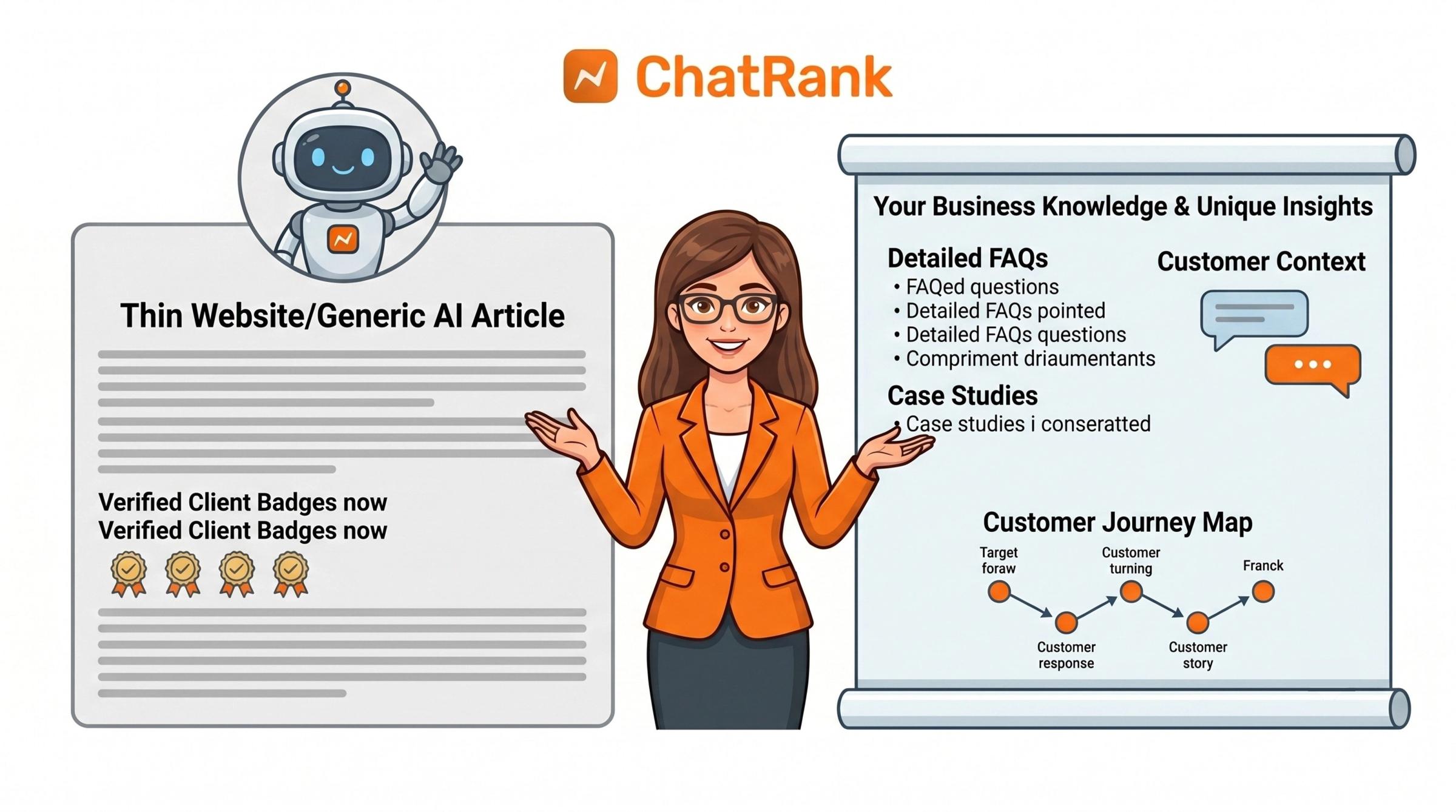
It is not in producing more words. The internet is not exactly starving for more bland paragraphs. The advantage is in producing content with something real behind it: your customer stories, product details, service nuance, proof points, objections, outcomes, examples, and expertise. The things that only your business knows.
That is also why thin websites struggle in AI search.
If your website is vague, your service pages are shallow, your FAQs are obvious, your claims have no proof, and your content could apply to almost any competitor in your category, AI tools do not have much to work with. You can generate ten more generic blogs, but that does not magically make your brand easier to trust or recommend.
AI can help you create content faster. But your business knowledge is what makes the content worth using.
The Problem Is Not AI Content. The Problem Is Empty Content.
AI content gets blamed for a lot, sometimes fairly.
There is plenty of lazy AI content out there. You have seen it. It opens with “in today’s rapidly evolving digital landscape,” says “unlock the power of” something, lists three neat benefits, and ends with a CTA that sounds like it escaped from a software brochure.
No one needs more of that. But AI is not the real problem. Empty content is.
A human can write empty content too. A content agency can write empty content. A founder can write empty content if they are trying to sound more polished than useful. The issue is not whether AI helped write the piece. The issue is whether the piece contains anything specific, true, and helpful.
For AI search, that matters even more.
AI tools are trying to answer questions, compare options, and recommend brands. If your content only says the same generic things as everyone else, it does not give those tools a strong reason to include you.
A dental practice saying “we care about patient comfort” is fine, but it is not enough. What does that look like? Do you offer sedation? Do you explain procedures before starting? Do you work with anxious children? Do your reviews mention patience, warmth, and clear communication?
An ecommerce brand saying “our products are high-quality” is also fine, but again, not enough. What materials do you use? What do customers love? What tradeoffs did you design around? Who is the product best for? What makes it better for a specific use case?
The content only becomes useful when it moves from generic claim to specific proof. That is the human layer.
Thin Websites Give AI Tools Thin Signals
Most websites are thinner than their owners realize. They have a homepage, a few service pages, a contact page, maybe a blog, maybe some reviews, and enough copy to look legitimate. But when you read closely, the content often does not say much.
The service pages are short. The FAQs answer questions no one is really asking. The brand positioning sounds like it was borrowed from a competitor. The proof is vague. The customer stories are missing. The comparison content does not exist. The details that would help someone decide are trapped in sales calls, front-desk conversations, support tickets, and the founder’s head.
That may have been passable when the main goal was to rank for a few keywords and get people to click through. AI search raises the bar.
When someone asks ChatGPT, Google AI Overviews, Gemini, Perplexity, or another AI-powered tool for a recommendation, the tool needs enough context to understand whether your business belongs in the answer. It may look at your website, reviews, third-party mentions, directories, social conversations, product information, service pages, and other online signals.
If those signals are thin, vague, or inconsistent, your brand becomes harder to understand. Not because your business is bad. Because the internet version of your business is under-explained. That is the gap many teams need to fix.
What Makes a Website Too Thin for AI Search?
A thin website is not always a small website. Some websites have hundreds of pages and still feel thin because every page says almost the same thing. Others only have a handful of pages but do a strong job of explaining the business clearly.
Thinness is not about word count. It is about usefulness. Your website may be too thin for AI search if:
- Your service pages list what you offer but do not explain who each service is for.
- Your product pages describe features but do not explain use cases, tradeoffs, or buyer concerns.
- Your FAQs answer basic questions but ignore what customers actually ask before buying or booking.
- Your homepage sounds professional but could apply to any business in your category.
- Your reviews are not reflected in your website content.
- Your claims are not supported by proof.
- Your comparison content is missing, so customers have to rely on competitors or third-party sites.
- Your location, audience, specialties, process, or differentiators are unclear.
- Your blog posts explain topics but never connect them back to your business’s actual experience.
This is where generic AI content can make things worse. If a website is already thin, adding more generic content does not solve the problem. It just creates a bigger thin website. More pages. Same lack of substance. That is not visibility. That is clutter.
AI Search Needs the Details Only You Know
Your business knows things that are not on your website.
A doctor knows which questions patients ask before a procedure. A dentist knows what parents worry about before bringing in an anxious child. A dog trainer knows which behavior problems owners misunderstand. An ecommerce founder knows why one material was chosen over another. A SaaS team knows which objections come up in demos. A local service business knows which emergency calls are most common in its area.
That information is marketing gold.
It is also exactly the kind of information generic AI cannot invent honestly. AI can guess. It can create a plausible answer. It can produce a clean paragraph that sounds reasonable. But plausible is not the same as true.
For content to help your brand show up in AI search, it needs to include the real details:
- Customer stories
- Common objections
- Real use cases
- Specific outcomes
- Product or service nuance
- Local knowledge
- Team experience
- Process details
- Review patterns
- Before-and-after context
- Comparison points
- Facts, figures, and examples from inside the business
This is the difference between a generic article and a useful one. A generic article says, “Choosing the right provider is important.”
A useful article says, “For patients with dental anxiety, the first visit often matters more than the treatment plan. The practice needs to explain what will happen, avoid rushing the appointment, and give the patient a sense of control before any procedure starts.” One is filler. The other helps someone make a decision.
AI tools are more likely to trust content that gives them enough substance to understand when, why, and for whom a brand is relevant.
Why a $20 ChatGPT Subscription Is Not a Marketing System
A ChatGPT subscription can help you write. It cannot, by itself, tell you what matters. That is the part many businesses miss.
You can ask ChatGPT to write a blog post about almost anything. It will do it. Sometimes it will do a decent job. But it does not automatically know which prompt your competitor is winning, which page on your site is too thin, which customer question is missing from your FAQ, which third-party source matters in your category, or which piece of proof would make your content stronger.
It also does not know your business unless you give it the right context. That is why the real challenge is not “can AI write content?” Of course it can.
The real challenge is knowing:
- What content should be created
- Why that content matters
- What gap it is solving
- Which AI search prompts it supports
- What competitors are doing better
- Which details the business needs to provide
- How the content should fit into the broader brand
- Whether the work is improving visibility over time
That is not just writing. That is an operating system.
This is where ChatRank is different from simply opening a blank AI chat and hoping for the best. ChatRank is designed to identify the gaps, recommend the work, ask the right questions, and help turn human input into content that supports AI search visibility.
A blank prompt says, “What do you want to write?” ChatRank says, “Here is what you should work on, here is why it matters, and here are the details we need from you to make it good.” That is a very different starting point.
The Questions Are the Product
One of the most important parts of AI-assisted content is not the draft. It is the questions that come before the draft.
Good questions pull out the information that makes content stronger. They stop the business from publishing another generic article and force the useful details to the surface.
For example, if ChatRank identifies a content gap around a service, product, or prompt, the system should not just generate a polished article from public information. It should ask for the details only the business can provide.
Questions might include:
- What do customers usually misunderstand about this service?
- What result have customers seen after using this product?
- What makes your approach different from the competitor currently showing up?
- What proof do you have for this claim?
- Which customer story best explains the value?
- What should someone know before choosing this option?
- What questions does your team answer again and again?
- What facts, numbers, or examples can make this more credible?
- What would a customer only learn after speaking to you directly?
These questions are not admin. They are the work.
They are how the business’s knowledge gets turned into content that actually says something. That is the difference between “AI wrote us a blog” and “AI helped us turn our expertise into something useful.”
Strong AI Content Starts With Specificity
If your content could belong to any competitor, it is probably not doing enough.
A medical practice does not need a generic article about why regular checkups matter. It needs content that reflects what patients ask, what the practice treats, how the providers work, which concerns come up before booking, and what the patient experience actually looks like.
An ecommerce brand does not need another article called “How to Choose the Right Product.” It needs content that explains who the product is best for, where it performs well, what tradeoffs matter, how customers use it, and how it compares to alternatives.
A local service business does not need a vague page about “reliable service.” It needs to explain response times, service areas, emergency availability, common problems, warranties, pricing expectations, and what customers should do next.
Specificity creates trust. It also helps AI tools connect your brand to more precise questions. A user is rarely asking, “Who provides high-quality solutions?”
They are asking, “Which dentist is good with anxious kids?” or “What HVAC company can handle emergency repairs on weekends?” or “Which dog trainer works with reactive dogs?” or “What software is easiest for a small team with no marketing department?”
The more specific the question, the more specific your content needs to be. Generic content may cover the broad category. Specific content helps you belong in the answer.
Thin FAQs Are a Missed Opportunity
FAQs are often treated like an afterthought. That is a mistake.
Good FAQs are one of the simplest ways to make a website more useful for AI search because they mirror how people ask questions. They also help businesses capture the concerns that come up before someone is ready to buy, book, call, or compare.
The problem is that many FAQ sections are too shallow. They answer questions like:
- “Do you offer consultations?”
- “How do I contact you?”
- “Where are you located?”
Those may be useful, but they rarely go far enough. Better FAQs answer the questions that reveal intent, concern, or decision-making.
For a medical practice, that could be:
- “How do I know if this treatment is right for me?”
- “What should I expect at my first appointment?”
- “Do you treat children with dental anxiety?”
- “What questions should I ask before choosing a provider?”
For an ecommerce brand, it could be:
- “Which product is best for first-time buyers?”
- “How does this compare to cheaper alternatives?”
- “What size should I choose?”
- “What ingredients or materials should I avoid?”
For a service business, it could be:
- “When is this problem an emergency?”
- “What affects the cost?”
- “How quickly can someone come out?”
- “What should I check before calling?”
These questions give AI tools more context. They also help real customers feel less uncertain. That is the kind of content that earns its place.
Comparison Content Helps AI Understand Fit
People ask AI tools for comparisons because they want help deciding. That makes comparison content valuable.
If your website does not explain how your service, product, or approach compares to alternatives, AI tools may rely on other sources to do that for you. Sometimes that will be a third-party article. Sometimes it will be a competitor’s page. Sometimes it will be whatever information is easiest to find. That is not ideal.
Comparison content does not need to be aggressive or salesy. In fact, the best comparison content is usually honest.
It should explain:
- Who each option is best for
- What the tradeoffs are
- When your solution makes sense
- When another option might be better
- What buyers should consider
- What questions to ask before choosing
This helps customers make better decisions. It also gives AI tools clearer language around when your brand should be recommended.
For ChatRank, this is especially important because the market is noisy. A user comparing GEO tools, AI search platforms, content workflow tools, or AI writing tools needs to understand the difference between a data-heavy platform, a complex content operations system, and a workflow built for non-power users.
That distinction matters. If you do not explain your fit, AI tools may not explain it for you.
Off-Site Signals Add Credibility
Your website is important, but it is not the whole story. AI tools may also look at what other places say about you. Reviews, directories, Reddit threads, social mentions, comparison pages, industry lists, local publications, podcasts, YouTube videos, and third-party blogs can all contribute to how your brand is understood online.
That is why off-site credibility matters.
If your website says you are a leading provider but nobody else mentions you, that is a weaker signal. If your reviews, directories, customer discussions, and third-party mentions all support the same story, the signal becomes stronger.
This does not mean you need to chase every platform.
A medical practice does not need to be everywhere. It needs to show up in the places patients use and AI tools can understand: Google reviews, relevant healthcare directories, local listings, insurance directories, and trustworthy service content.
An ecommerce brand may need product reviews, marketplace presence, comparison content, social proof, and mentions in the places shoppers research.
A local service business may need strong local listings, reviews, community mentions, and service-specific pages.
The goal is not more noise. It is a more complete footprint.
ChatRank’s broader approach to organic marketing matters here. AI search visibility is not only about your blog. It is about how your brand is represented across the internet.
The Real Advantage Is the Workflow
Businesses do not need to choose between “AI writes everything” and “humans do everything manually.” That is a false choice, and not a very useful one.
The better model is AI-assisted, human-informed content.
AI can help identify what needs to be created, where the gaps are, what competitors are doing, which prompts matter, and how to structure the content. The human adds the substance: the proof, stories, facts, examples, expertise, and judgment.
That is where the advantage is. Not in having AI. Everyone has AI. The advantage is having a workflow that knows what to do with it.
This is why ChatRank is more useful than a blank AI writing tool for lean teams. It does not just wait for you to know what to ask. It helps identify the right work, guides you through the missing details, and turns that input into content designed to improve how your brand appears in AI search.
For a founder, office manager, junior marketer, practice manager, or small team, that matters. They do not need another blank box. They need a system that says: this gap matters, this is the content we need, these are the questions only you can answer, and this is how we turn that into something useful.
Your Business Knowledge Is the Moat
The fear is understandable. If everyone can use AI to create content, will the competition just get louder? Yes. Probably.
A lot of businesses will publish more content because AI makes it easy. Much of it will be forgettable. Some of it will be actively painful. Most of it will sound fine and say very little. That does not mean content stops mattering. It means real substance matters more.
Your advantage is not that you can generate articles. Your advantage is that you know things your competitors do not. You know your customers. You know your service. You know your product. You know the objections, the outcomes, the weird edge cases, the local details, the common mistakes, the proof, and the stories that never make it onto the website unless someone asks for them.
That knowledge is the moat. AI can help turn it into content. ChatRank can help identify where that content is needed and guide the process so you are not guessing.
But the raw material has to come from the business.
That is what makes the content specific enough to help humans and AI tools understand why your brand belongs in the answer.
A Thin Website Is Fixable
If your website is thin, that is not a disaster. Most are. The issue is not that you are behind forever. The issue is that thin content leaves too much of your business unexplained.
The fix is to start adding the substance AI tools and customers need:
- Clearer service and product pages
- Better FAQs based on real customer questions
- Stronger proof behind claims
- More specific examples
- More comparison content
- More review-driven insight
- More off-site credibility
- Better alignment between what you say and what customers experience
You do not need to do all of it at once. In fact, please do not turn this into a 47-point internal project that dies in a spreadsheet. Start with the gaps that matter most.
That might be the service page competitors are beating you on. It might be the prompt where AI tools mention everyone except you. It might be the FAQ your front desk answers ten times a week. It might be the customer story that proves what your homepage only claims.
This is exactly the kind of work ChatRank is built to surface. Not more content for the sake of content. The right content, with the right human detail, aimed at the right visibility gap.
AI Search Rewards Brands That Explain Themselves Better
AI content is not going away. Neither is AI search.
The brands that win will not be the ones that publish the most generic articles. They will be the ones that explain themselves clearly, support their claims with proof, answer the questions customers are actually asking, and make their expertise visible across the places AI tools look.
That is the real work.
ChatRank helps make that work manageable by identifying content gaps, tracking where competitors are showing up, asking for the human details AI cannot know, and helping turn those details into content that can improve AI search visibility.
A thin website does not need more filler. It needs more of what only your business can provide. That is what makes AI-assisted content useful. Not the AI on its own, and not a blank prompt sitting in a $20 subscription.
The workflow. The proof. The questions. The human knowledge. That is where the advantage is.



We’ve been using ChatRank for 34 days, and following their plan, we’ve actually grown over 30% in search visibility


ChatRank helped us go from zero visibility to ranking #2 in a core prompt for our business with only one new blog post!



My business has always come from word of mouth. Now people are actually finding me on ChatGPT!