Beyond the Blue Link: Mastering Generative Engine Optimization (GEO) for the AI-First Era
This blog post explores mastering Generative Engine Optimization (GEO) to maintain brand visibility as AI-driven "zero-click" searches fundamentally redefine the traditional digital marketing landscape.

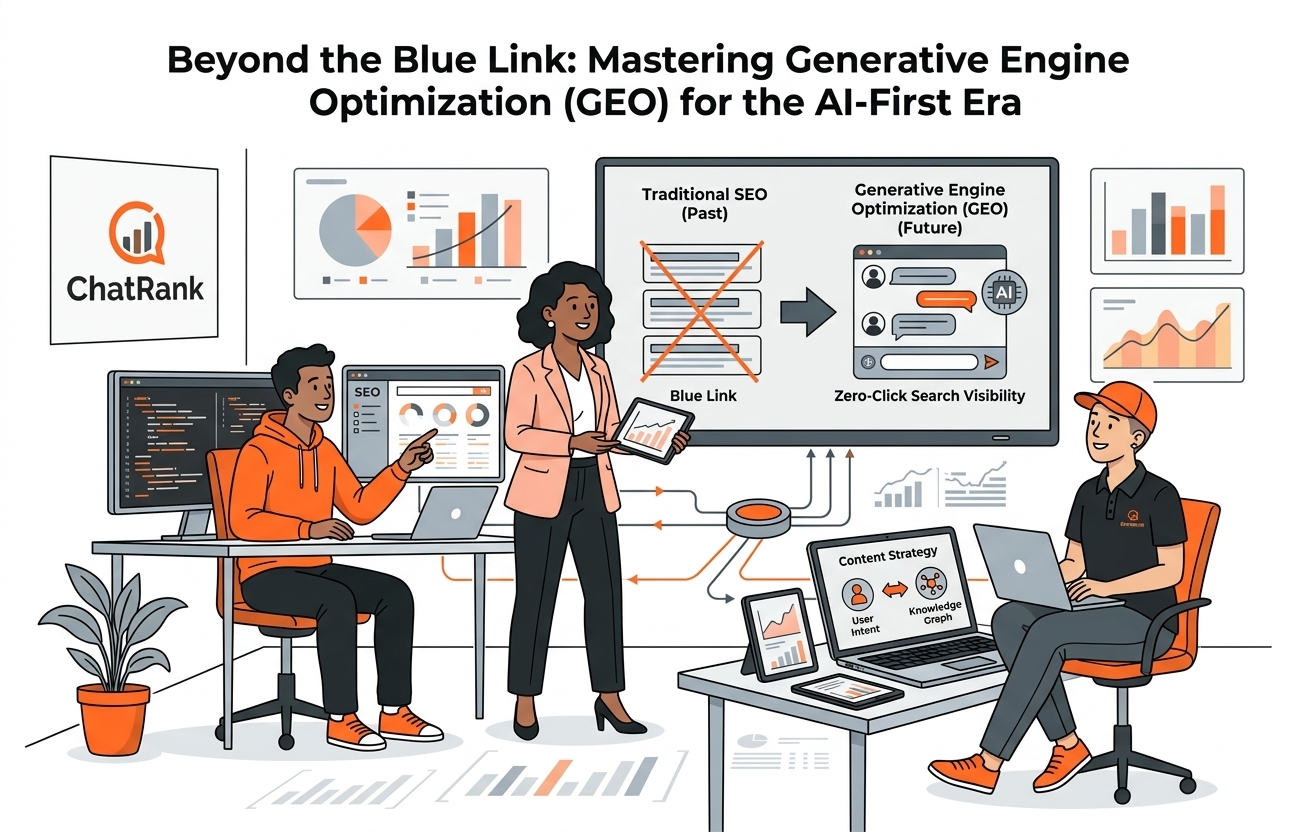
Beyond the Blue Link: Mastering Generative Engine Optimization (GEO) for the AI-First Era
In the legacy era of digital marketing, the "blue link" was king. Success was measured by how high your URL sat on a Google search results page. However, the emergence of Large Language Models (LLMs) and Generative AI has fundamentally shifted the search paradigm. Today, we are witnessing the rise of Generative Engine Optimization (GEO) and Answer Engine Optimization (AEO)—strategies focused not on ranking a page, but on becoming the definitive source cited by AI systems like ChatGPT, Google Gemini, and Perplexity.
According to research from AthenaHQ, by 2026, nearly 50% of Google searches now include AI-generated overviews. For brands, this means visibility is no longer just about traffic; it is about attribution and authority within a synthesized answer.
1. The Architecture of GEO: Why AI Models Choose Your Brand
Generative Engine Optimization is the process of structuring and verifying information so that LLMs can accurately extract, synthesize, and cite it. Unlike traditional SEO, which relies heavily on keyword density and backlink volume, GEO prioritizes factual density and entity clarity.
The Mechanism of Retrieval-Augmented Generation (RAG)
To understand GEO, one must understand how AI search engines work. Most modern "answer engines" use a process called Retrieval-Augmented Generation (RAG). When a user asks a question, the system searches its indexed data for relevant "chunks" of information, then uses an LLM to rewrite those chunks into a cohesive answer.
- Statistic: Industry analysis shows that AI Overviews reduce clicks to traditional websites by an estimated 30%+ on pages where they appear.
- The GEO Solution: To remain visible, brands must optimize for "Citation Frequency." Being the primary source cited in a RAG response ensures that even if a user doesn't click, your brand maintains the highest "Share of Voice" in the conversation.
2. Advanced AEO: Dominating the "Zero-Click" Journey
Answer Engine Optimization (AEO) is a subset of GEO that focuses specifically on providing direct, concise answers to user queries. As users shift toward conversational search, the goal is to become the "featured snippet" of the AI world.
The Rise of the Zero-Click Reality
Data indicates that zero-click searches have risen significantly, with rates reaching 40% to 60% for certain query types in 2025. This is not a loss of opportunity, but a shift in the medium.
To win in AEO, content must be structured into "Information Units":
- Direct Definitions: Clear, punchy sentences (under 50 words) that define a concept.
- Structured Lists: Data-heavy lists that AI crawlers can easily parse into bullet points.
- Semantic Cues: Using phrases like "For example," "In summary," and "The evidence suggests" to help models identify key takeaways.
3. The Multi-Model Strategy: Optimizing for ChatGPT vs. Google Gemini
Not all AI engines are created equal. Each model has unique weights for what it considers "authoritative." Research suggests that while Google Gemini leans heavily on its existing search index and E-E-A-T (Experience, Expertise, Authoritativeness, Trust), models like ChatGPT often prioritize high-quality, long-form conversational data and reputable news sources.
Benchmarking Performance Across Models
ChatRank’s core business model focuses on Multi-Prompt Tracking—the ability to see how your brand is perceived across different AI interfaces.
- Insight: Pages cited in AI Overviews are already in the top 10 search results roughly 50% of the time. However, the other 50% comes from niche, high-authority sources that may not rank for broad keywords but provide the specific "fact-first" data the AI requires.
- Actionable Tactic: Implement
llms.txtfiles—a new standard for providing machine-readable summaries of your site’s most important facts specifically for AI crawlers.
4. Technical Foundations: Schema and Entity Optimization
The "language" of GEO is not English; it is Schema Markup. To an AI, your brand is an "Entity" with a set of "Attributes."
Building Entity Authority
To increase your "Entity Trust Score," your data must be consistent across the web. Discrepancies in your address, service offerings, or founding date can cause an AI to skip your content in favor of a more "certain" source.
- Local AEO: For businesses with physical footprints, local pages with dedicated LocalBusiness and PostalAddress schema are critical. AI assistants increasingly personalize answers by region, drawing from pages that clearly communicate geographic relevance.
- Authoritative Signals: Including detailed author bios with credentials and links to professional profiles (like LinkedIn or ResearchGate) reinforces the "Trust" component of E-E-A-T, making the AI more likely to cite your content in high-stakes queries (e.g., medical or financial advice).
5. Does Content Freshness and Depth Actually Drive AI Citations?
Yes — and the data is clear. Two of the most controllable factors in GEO are how recent your content is and how comprehensively it covers a topic.
How Does Content Age Affect Citation Probability?
According to a 2026 GEO Benchmark Study by ConvertMate, which analyzed over 12,500 queries across 8,000 domains, content updated within 30 days receives 3.2x more citations across AI platforms than content that is six months or older. Semrush's 2026 data corroborates this, reporting that 65% of AI bot hits target content less than one year old.
This means a quarterly content refresh cycle is no longer optional — it is a GEO baseline requirement.
Does Longer Content Win More Citations?
Depth matters more than length alone, but the two often go hand in hand. The same ConvertMate analysis found:
- Pages with 20,000+ characters averaged 10.18 citations each
- Pages under 500 characters averaged just 2.39 citations — a 4.3x gap
- The optimal range for most brands is 2,500–4,000 words, balancing comprehensiveness with readability
However, word count without structure is worthless. Research from Princeton University and Georgia Tech (the foundational academic paper on GEO) found that adding statistics and cited sources boosted AI visibility by up to 40% — the single highest-performing tactic tested. Improving fluency and readability added another 15–30% lift.
What Structural Elements Do AI Models Prefer?
According to Foundation Marketing's 2026 GEO analysis, 68.7% of pages cited by ChatGPT follow a logical H1 → H2 → H3 heading hierarchy. Additionally, 61% of cited pages use structured data markup such as FAQPage, Article, or HowTo schema.
- Front-load your key claims: Growth Memo's 2026 research found that 44.2% of all LLM citations are pulled from the first 30% of an article. Put your most important insights in the introduction.
- Use FAQ sections: Pages that added structured FAQ blocks saw a 44% increase in AI search citations, per BrightEdge's 2026 AI Overviews analysis.
- Use comparison tables and lists: These formats provide data that AI models can synthesize directly into their responses.
Actionable takeaway: Schedule a quarterly content audit. For each high-priority page, update statistics, add a FAQ section, and verify that your heading hierarchy is logical. These changes alone can meaningfully increase your citation rate within 30–60 days.
6. What Is the First-Mover Opportunity in GEO Right Now?
Despite the rapid growth of AI search, most brands are not yet tracking or optimizing for it. That gap is your opportunity.
How Many Brands Actually Have a GEO Strategy Today?
According to Conductor's 2026 GEO Benchmarks Report, 98% of CMOs are now investing in Answer Engine Optimization — but that investment does not mean execution. Separate research from Digital Applied (2026) found that 47% of brands still have no dedicated GEO strategy, and fewer than 15% of companies have built a systematic approach to AI citation tracking.
The GEO State of the Market report from Superlines puts it plainly: only 22% of marketers are actively tracking AI visibility, leaving a 78% blind spot in competitive intelligence.
Why Does Acting Early Matter So Much?
AI citation patterns are not random — they compound. Platforms like ChatGPT and Perplexity develop "citation trust" in sources over time. Brands that earn consistent citations today build a moat that is harder to dislodge as competition grows.
The data from ConvertMate's 2026 benchmark study shows that early GEO adopters in e-commerce are seeing 2–3x the AI citation rates of competitors who have not yet adapted their content strategies.
Meanwhile, the GEO market itself is growing fast. According to Valuates Reports (2025), the GEO services market is projected to grow from $886 million in 2024 to $7.3 billion by 2031 — a 34% CAGR. The brands investing now are positioning for a channel that will only become more competitive.
What Is the AI Traffic Conversion Advantage?
Here is a critical business case for GEO that goes beyond visibility: traffic from AI platforms converts significantly better than traditional organic search.
- Semrush's 2026 AI search data reports that AI-referred visitors convert at 4.4x the rate of standard organic visitors
- AI retail traffic shows a 27% lower bounce rate and 38% longer session duration than non-AI traffic
- HubSpot's 2026 State of Marketing Report found that AI referral traffic converts 3x better than traditional search, with leads from LLMs up 1,850% year-over-year
This is not just a visibility play. AI citations drive fewer raw clicks but dramatically higher-quality visits. For brands focused on conversion efficiency, this is a powerful argument for investing in GEO now.
7. Measuring Success in the Age of AI
Traditional metrics like "keyword ranking" are becoming secondary to "AI Brand Mentions." If a user asks "What is the best AI tool for PR?" and ChatGPT mentions JustReachOut, that is a conversion of intent, even if no click occurs immediately.
New KPIs for GEO/AEO
- Citation Rate: How often is your URL cited as a source in generative responses?
- Sentiment Alignment: Does the AI describe your brand using the specific characteristics of your Brand Voice (e.g., Professional, Visionary, or Helpful)?
- Attribution Quality: Is the AI attributing the correct facts to your brand, or is there a "hallucination" risk?
- Statistic: 86% of enterprise SEO teams have already integrated AI into their workflows, and 82% plan to increase investment in AI-driven visibility tools.
Frequently Asked Questions About GEO and AEO
What is Generative Engine Optimization (GEO)?
Generative Engine Optimization (GEO) is the practice of structuring and verifying your content so that AI-powered search engines — like ChatGPT, Google Gemini, and Perplexity — select and cite it when generating answers for users. Unlike traditional SEO, which targets blue-link rankings, GEO targets citation frequency inside AI-generated responses.
How is GEO different from traditional SEO?
Traditional SEO optimizes for Google's ranking algorithm using keywords, backlinks, and on-page signals. GEO optimizes for how large language models extract, synthesize, and attribute information. Only 6.82% of ChatGPT results overlap with Google's top 10, meaning the two disciplines require different strategies — though strong foundational content benefits both.
How does AEO differ from GEO?
Answer Engine Optimization (AEO) is a subset of GEO focused specifically on short, direct, conversational answers. If GEO is about becoming a cited authority across AI systems broadly, AEO is about winning the zero-click moment — being the source whose language the AI uses verbatim to answer a user's question.
Which AI platforms should I optimize for first?
As of March 2026, ChatGPT holds approximately 60.4% of the generative AI chatbot market, making it the highest-priority platform for most brands. Google Gemini (15.2%) and Microsoft Copilot (12.9%) round out the top three. For B2B and research-heavy audiences, Perplexity (5.8%) punches far above its size in referral value. A multi-platform strategy is recommended because each model uses different citation logic.
How do I know if my content is being cited by AI?
Start by manually searching your target queries in ChatGPT, Perplexity, and Google AI Mode each month. Track whether your brand or URLs appear in responses. For systematic monitoring, tools like those offered by ChatRank track citation frequency, sentiment, and share of voice across multiple AI interfaces — giving you a real-time picture of your generative visibility.
How long does it take to see results from GEO?
According to implementation timeline data from GEO benchmark studies, most brands see initial citations in long-tail queries within 4–6 weeks of optimization. Meaningful visibility in core queries typically follows within 60–90 days. Sustained citation leadership — consistently outperforming competitors — is a 6–12 month journey.
Is GEO worth investing in for smaller brands?
Yes. One of GEO's most significant advantages is that domain authority matters less than content quality and structure. Research shows that 83% of AI Overview citations come from pages outside the organic top 10. A well-structured, specific, expert-written page from a smaller site can earn citations that large competitors miss entirely.
Conclusion: The ChatRank Advantage
The transition from SEO to GEO is not a trend; it is a fundamental restructuring of how information is accessed. Brands that continue to focus solely on traditional organic traffic will find themselves invisible in the conversational interfaces where users now spend their time.
By focusing on factual accuracy, structured data, and multi-model monitoring, you can ensure that when the AI provides the answer, it is your brand’s voice that the user hears.
Are you ready to see where your brand stands in the AI landscape? Explore ChatRank's multi-prompt tracking and take control of your generative visibility today.


We’ve been using ChatRank for 34 days, and following their plan, we’ve actually grown over 30% in search visibility


ChatRank helped us go from zero visibility to ranking #2 in a core prompt for our business with only one new blog post!


My business has always come from word of mouth. Now people are actually finding me on ChatGPT!