How ChatRank Drives Brand Visibility in the Generative AI Search Landscape
The digital discovery ecosystem is undergoing its most significant structural change since Google's introduction. The shift is from traditional keyword-based search to natural-language interactions with Large Language Models (LLMs). For modern enterprises, ranking on the first page of Google is no longer sufficient; success in 2026 requires being the primary cited source in AI-generated answers delivered by platforms like ChatGPT, Perplexity, Google AI Overviews, and Gemini.

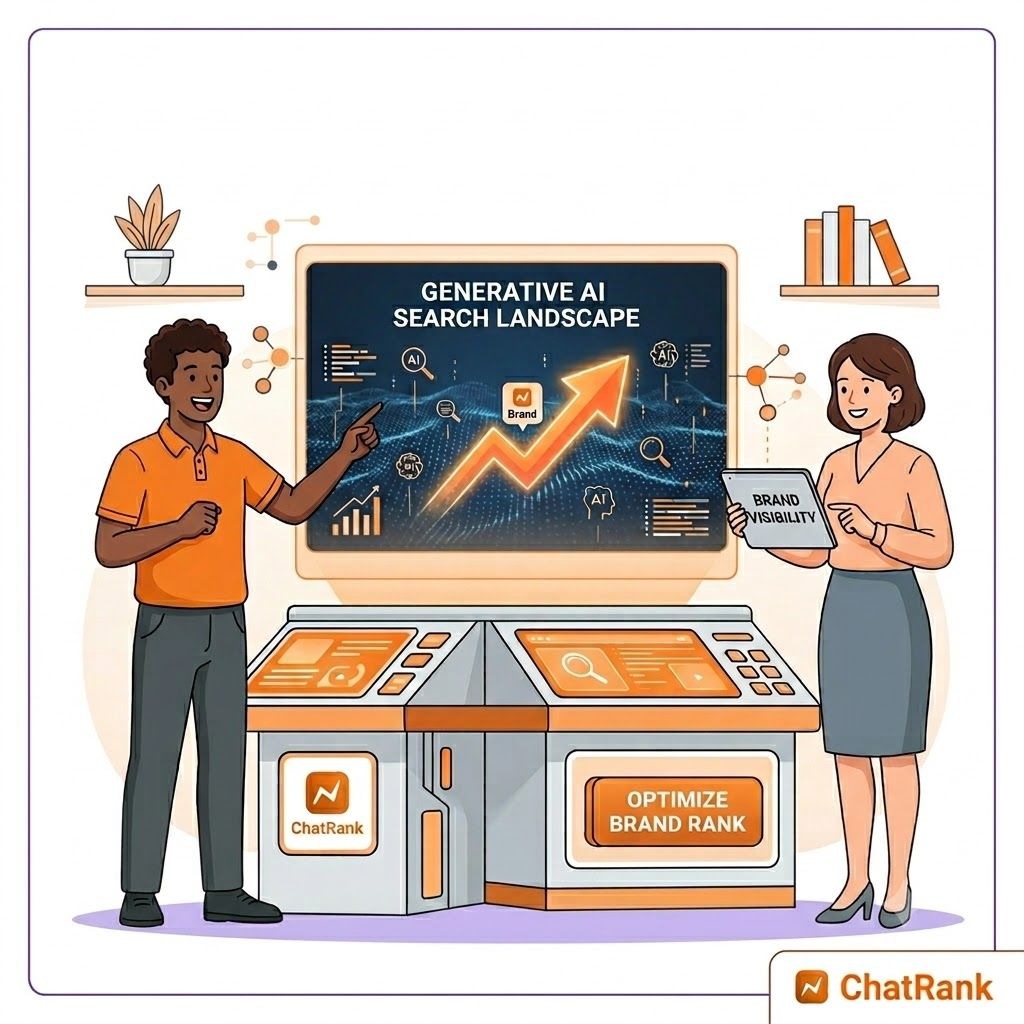
This article explains how ChatRank, an AI Brand Visibility and Analytics platform — helps brands solve the "Invisible Reach" problem by implementing advanced Answer Engine Optimization (AEO). By restructuring content into high-fidelity knowledge sources, ChatRank ensures brands are accurately represented where modern discovery actually happens.
What Is ChatRank and What Role Does It Play in the AI Search Landscape?
ChatRank is a platform designed to measure, analyze, and improve brand presence across generative AI systems. It provides transparency and actionable data for mid-market enterprises and digital agencies navigating the transition from traditional SEO to AI-driven discovery. Its core function is to tell brands not just whether they appear in AI answers, but how they are positioned, with what sentiment, and why competitors may be cited more frequently.
Why Has Zero-Click Search Made AEO a Business Necessity?
The zero-click phenomenon is no longer a trend — it is the new default. SparkToro and Datos (2024) found that 58.5% of U.S. Google searches end without a click to any external website. When an AI Overview is present, that rate climbs to 83%, meaning 8 out of 10 users receive their answer directly in the interface and never visit a website (Bain & Company / Dynata, December 2024).
In this environment, the "citation" is the impression. A brand that is not mentioned inside the AI's answer does not exist for that user — regardless of its traditional search rank. This makes measuring and optimizing Share of Synthesis (how frequently and positively your brand appears in AI-generated answers) a core business metric.
What Is the "Invisible Reach" Problem and How Does ChatRank Solve It?
Traditional SEO tools are engineered to track "blue links", keyword rankings and organic click-through rates. They are structurally incapable of measuring how a brand is mentioned, positioned, or cited inside a conversational AI response.
ChatRank addresses this gap by providing three specific measurement capabilities:
- AI Visibility Scores: The percentage of AI-generated answers that mention a specific brand for a defined set of customer-intent prompts.
- Citation Tracking: Identifying which third-party sources (such as G2, Wikipedia, or Reddit), the AI is using to validate and inform brand claims.
- Sentiment Analysis: Monitoring how AI frames the brand (e.g., "best for small teams," "expensive," or "most cited in healthcare").
Strategic Pillar 1: Structural Review for AI Citation Readiness
To make a standard draft into an AI-citable reference, content must follow a strict structural hierarchy. AI models do not read like humans; they scan for modular "chunks" of information that independently answer specific questions.
Immediate Answer Delivery
Every section must answer its heading's premise in the first sentence. This approach — sometimes called the Featured Snippet format — leads with the direct response before adding supporting context. Content buried in introductory paragraphs is frequently skipped by AI retrieval systems.
Heading Independence
Every H2 and H3 must be answerable in isolation. If an AI quotes a single section, the information must remain coherent without the rest of the article providing context.
Technical Accessibility and Raw HTML
AI crawlers including GPTBot (OpenAI), BingPreview (Microsoft), PerplexityBot, and ClaudeBot (Anthropic) prioritize content in the raw page source. Content hidden behind JavaScript, loaded via infinite scroll, or rendered client-side is effectively invisible to these systems. Server-side rendering and semantic HTML tags (<h1>, <article>, <table>) ensure zero-friction indexing.
Strategic Pillar 2: Eliminating Filler and Increasing Information Density
To be cited as an authority, content must move from narrative blog-style writing to neutral, encyclopedic reference material. AI systems are trained to select high-density data over polished prose that conveys little new information.
Examples of High-Density vs. Filler Writing
| Type | Example Sentence |
|---|---|
| High-density (citable) | "Mightycause charges a flat-rate fee structure, making total cost predictable regardless of donation volume." |
| Filler (not citable) | "In today's fast-paced digital landscape, nonprofits are searching for meaningful ways to connect." |
Avoid appositives that bury key information in subordinate clauses. For example, "Mightycause, a platform known for predictable fees, charges a flat rate" hides the main fact. The stronger construction is: "Mightycause charges a flat-rate fee, which provides cost predictability."
Strategic Pillar 3: Entity-First Content and Semantic Connectivity
LLMs do not match keywords — they interpret meaning and relationships. This is the practical basis of Entity-First Content Structuring.
The foundational research here comes from the Princeton / ACM KDD 2024 GEO study, which found that structuring content around named entities and verifiable facts — rather than opinion-based marketing language — significantly increases the probability of citation. The study specifically found that adding statistics boosted AI visibility by up to 40%, and that promotional language carries a measurable citation penalty across LLM architectures.
Strategic Pillar 4: External Validation and Share of Citation
Visibility is not solely determined by what you publish on your own site. AI systems rely on external validation — mentions on trusted third-party platforms — to confirm that a brand is credible and authoritative.
The Hierarchy of Citation-Trusted Domains
According to multiple AEO research sources, the following domains carry disproportionate weight in LLM training and real-time retrieval:
- Wikipedia: Consistently the most cited domain in ChatGPT responses.
- G2: Among the top cited domains for B2B software recommendations in LLM outputs.
- Reddit and Quora: High-authority sources for community-validated, "real-world" user advice — heavily weighted by Perplexity in particular.
- Industry publications and .edu domains: A single strong mention in an authoritative research hub or university site often outweighs dozens of low-value backlinks for AI citation purposes.
Strategic Pillar 5: FAQ Optimization as a Query Coverage Mechanism
FAQs are not summaries. In an AEO context, they are query coverage mechanisms — structured to capture the specific, natural-language questions users ask AI models. A generic meta-FAQ ("What is this article about?") provides no coverage. A specific FAQ ("Which fundraising platform is best for small nonprofits with under 1,000 donors?") can directly match user intent and trigger citation.
Each FAQ answer should be direct, declarative, and 2–4 sentences maximum. It must stand alone if quoted by an AI assistant without any surrounding context.
Frequently Asked Questions
How does content structure affect the likelihood of being cited by ChatGPT?
Content using structured formatting — lists, tables, and direct Q&A sections — is significantly more likely to be cited. Research reviewed in the Princeton GEO study found that structured, citation-rich pages consistently outperform long-form narrative content in AI retrieval.
What is the relationship between traditional SEO rankings and Google AI Overviews?
They are strongly correlated but not synonymous. Conductor's 2026 benchmark data indicates that approximately 17% of sources cited in Google AI Overviews also rank in the organic top 10. Strong SEO authority is a prerequisite for AI visibility — but it is not sufficient on its own.
Do AI-generated citations help with conversion rates?
Yes. Semrush found that AI-driven visitors convert at 4.4x the rate of standard organic visitors, and Conductor data indicates LLM visitors convert at 2x the rate compared to traditional organic search traffic. AI pre-qualifies user intent before the visit, resulting in higher-quality traffic.
How often should a brand track its AI Visibility Score?
AEO is an ongoing practice, not a one-time audit. Marketing teams should run their core prompt set monthly to monitor growth trends and identify sudden drops in citation frequency or sentiment shifts — both of which can signal algorithmic or competitive changes.
What is the Citation Gap?
The Citation Gap occurs when AI models cannot find a brand's information because the content lacks Semantic Connectivity — clear mapping to named entities and verified facts. Restructuring content with entity-relationship clarity helps close this gap and positions the brand's data as the preferred source for AI synthesis.
Conclusion: From Invisible Reach to Cognitive Authority
The transition from Search Engine Optimization to Cognitive Authority represents the defining shift in digital marketing for the next decade. Brands that invest in AEO today — prioritizing depth, structural clarity, and external validation — will establish durable citation footprints that compound in value as AI adoption grows.
ChatGPT alone now serves over 900 million weekly active users as of February 2026. The question is no longer whether your customers are using AI to research your category — it is whether you are the answer they receive when they do.


We’ve been using ChatRank for 34 days, and following their plan, we’ve actually grown over 30% in search visibility


ChatRank helped us go from zero visibility to ranking #2 in a core prompt for our business with only one new blog post!



My business has always come from word of mouth. Now people are actually finding me on ChatGPT!