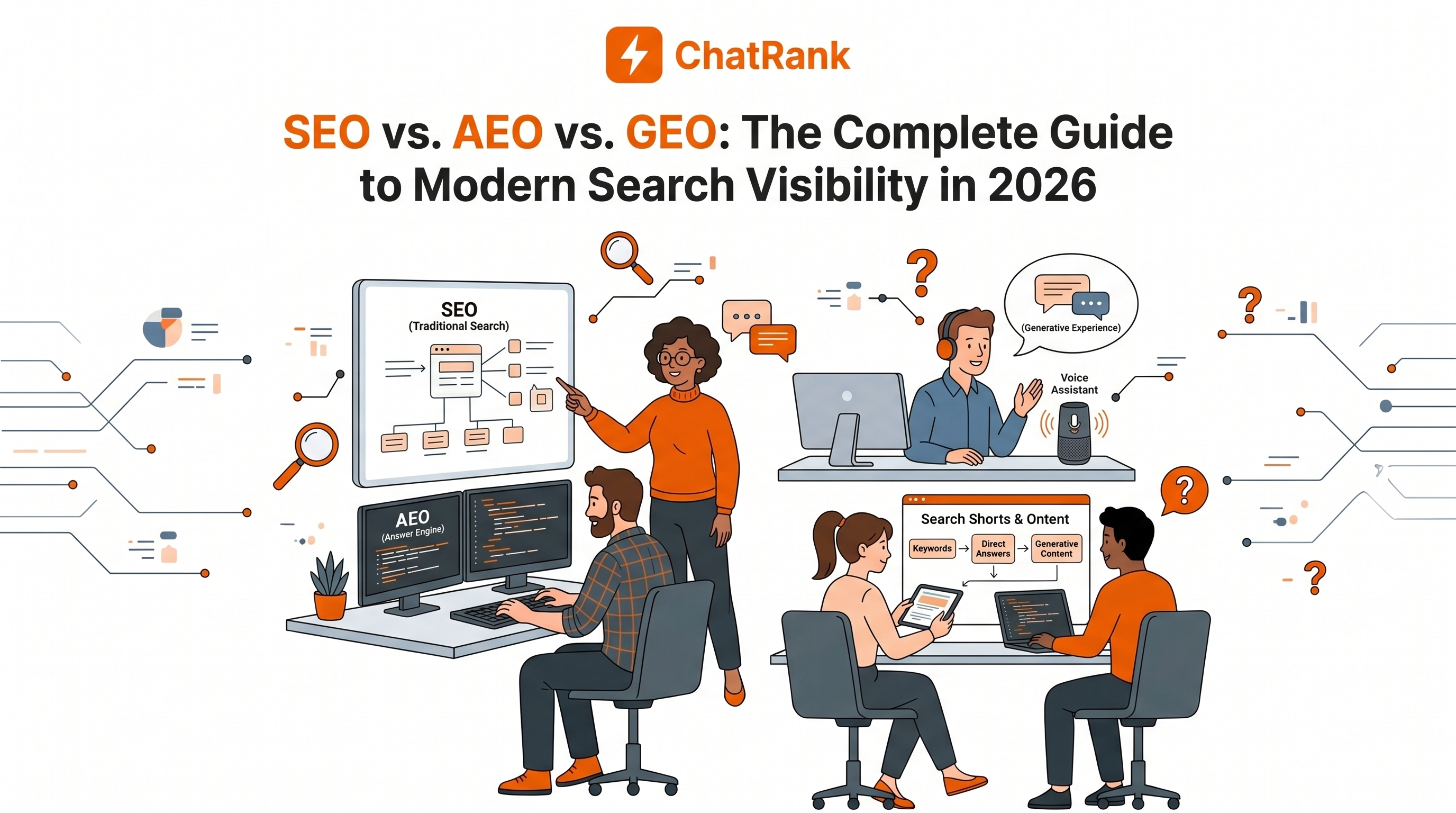
SEO vs. AEO vs. GEO: The Complete Guide to Modern Search Visibility in 2026
For over two decades, "search optimization" meant one thing: ranking higher on Google. You targeted keywords, earned backlinks, and improved technical site performance. That was the entire game. Today, that game has three distinct dimensions. A user might type a query into Google, ask their voice assistant a direct question, or chat with ChatGPT for a deep research session — and each of those moments requires a different optimization strategy to win visibility.
SEO vs. AEO vs. GEO: The Complete Guide to Modern Search Visibility in 2026
Search has fundamentally changed — and most marketers haven't caught up yet.
This guide breaks down SEO, AEO, and GEO — what each one is, how they differ, how they overlap, and most importantly, why GEO is additive, not a replacement for what came before. It also explains why ChatRank is the tool forward-thinking brands and agencies are using to track and grow their visibility across all three disciplines.
What Are SEO, AEO, and GEO? Clear Definitions
SEO — Search Engine Optimization
SEO is the practice of improving a website's visibility in traditional search engine results pages (SERPs) — primarily Google and Bing — by optimizing for ranking signals including keywords, backlinks, page speed, technical health, and content quality.
SEO encompasses three core areas:
- Technical SEO: Site speed, crawlability, mobile optimization, schema markup, and Core Web Vitals
- On-Page SEO: Keyword placement, heading structure, content depth, internal linking, and metadata
- Off-Page SEO: Backlinks, brand mentions, and authority signals from external sources
According to Statista, Google processes over 5.9 million searches per minute, making SEO a foundational business activity — not a nice-to-have. SEO results typically require 3–6 months of consistent effort before meaningful ranking improvements appear.
AEO — Answer Engine Optimization
AEO is the practice of structuring content so that AI-powered search systems — including Google's AI Overviews, featured snippets, and voice assistants like Siri and Alexa — can extract and surface your content as a direct, immediate answer to user queries.
AEO targets Position Zero — the featured answer box that appears above all ranked results. It also optimizes for voice search responses, where an assistant reads a single answer aloud rather than presenting a list of links.
According to research by Yext (2025), an AI Overview appearing in search results correlates with a 34.5% lower average CTR for the top-ranking organic page below it — because users got their answer without clicking. AEO results typically become visible within 1–3 months of structured implementation.
GEO — Generative Engine Optimization
GEO is the practice of structuring and enriching website content so that large language models (LLMs) — including ChatGPT (OpenAI), Claude (Anthropic), Gemini (Google), and Perplexity — cite your content as a trusted source when generating AI-synthesized responses.
GEO was formally defined and studied by researchers from Princeton University, Georgia Tech, the Allen Institute for AI, and IIT Delhi. Their landmark paper, "GEO: Generative Engine Optimization," was presented at the ACM SIGKDD 2024 conference, establishing the first empirical framework for measuring and improving AI citation visibility.
Their findings were striking: adding citations, statistics, and authoritative sourcing to content boosts visibility in generative engine responses by up to 40%. Initial GEO visibility can appear within 4–6 weeks; sustained citation authority builds over 3–6 months.
The Side-by-Side Comparison: SEO vs. AEO vs. GEO
Use this table as your quick reference guide across every dimension that matters for practitioners:
| Dimension | SEO | AEO | GEO |
|---|---|---|---|
| Primary Goal | Rank pages in search engine results pages (SERPs) | Be the direct, extracted answer (Position Zero) | Be cited inside AI-generated responses |
| Target Platforms | Google, Bing, Yahoo | Google AI Overviews, Siri, Alexa, Cortana, Voice Search, Featured Snippets | ChatGPT, Gemini, Perplexity, Claude, Bing Copilot |
| User Behavior | Browse results and click through to websites | Ask a specific question, get a direct answer | Ask AI to research, compare, or recommend |
| Primary Metrics | Keyword rankings, organic traffic, CTR, conversions | Featured snippet wins, AI Overview inclusion rate, zero-click impressions | AI citation frequency, Share of Model (SoM), brand mention rate in AI responses |
| Key Content Signals | Keywords, backlinks, domain authority, Core Web Vitals | FAQ schema, concise Q&A, structured headings, direct answer paragraphs (40–60 words) | Statistics, source citations, expert quotes, entity authority, fact density |
| Content Formats | Long-form keyword-rich pages, blog posts, product pages | FAQ pages, How-To guides, definition paragraphs, comparison tables | Research articles with sourced data, original studies, definitional content, expert roundups |
| Technical Requirements | robots.txt, sitemap, canonical tags, page speed, mobile-first | Schema markup (FAQPage, HowTo, Speakable) | Allow AI bots (GPTBot, ClaudeBot, PerplexityBot), consider llms.txt |
| Measurement Tools | Google Search Console, Ahrefs, Semrush, GA4 | Ahrefs snippet tracking, Semrush, manual SERP checks | ChatRank, Semrush AI Visibility Toolkit, manual AI prompt testing, brand monitoring tools |
| Authority Signals | Domain authority, backlinks, E-E-A-T | Answer clarity, structured markup, content directness | E-E-A-T, named authorship, original data, third-party brand mentions |
| Time to Results | 3–6 months | 1–3 months | 4–6 weeks (initial); 3–6 months (sustained) |
| Maturity Level | 25+ years established | 5–7 years, evolving | Newest (2023+), rapidly growing |
Key Takeaway: Each discipline targets a different moment in the user discovery journey. SEO captures the browser. AEO captures the quick-answer seeker. GEO captures the AI researcher. All three happen billions of times per day.
GEO Is Additive — Not a Replacement
This is perhaps the most important point in this entire guide, and it needs to be stated clearly: GEO does not replace SEO or AEO. It builds on them.
Here is the data that proves it:
According to Semrush's 2025 AI Search Report, 99% of URLs cited in Google's AI Mode also rank in the top 20 organic search results. You cannot be cited by AI if your content cannot be found and trusted in the first place. Strong SEO is the technical foundation that both AEO and GEO require to function.
Additionally, the Princeton GEO study (Aggarwal et al., KDD 2024) found that the same content improvements that boost AI citations — clear structure, authoritative sourcing, factual density — also support traditional SEO and AEO performance.
Think of the relationship as a stack:
- Foundation Layer (SEO): Technical health, domain authority, backlinks, and on-page keyword optimization. This ensures your content is discoverable by both search engines and AI crawlers.
- Answer Layer (AEO): Structure every piece of content with direct answer paragraphs, FAQPage schema, and conversational headings. Ensures your content can be extracted for featured snippets and voice answers.
- Citation Layer (GEO): Enrich every article with named statistics, external citations to authoritative sources, expert quotes with attribution, and self-contained paragraphs. This is what makes your content quotable by LLMs.
Each layer strengthens the others. Content structured for answer extraction (AEO) is exactly the format that ChatGPT, Perplexity, and Claude prefer to cite. The entity authority and third-party mentions built for GEO also generate brand signals and backlinks that improve organic rankings. This is a compounding flywheel, not three separate efforts.
Where SEO, AEO, and GEO Overlap
Despite their differences, all three disciplines share a common foundation. The following practices benefit all three simultaneously:
- E-E-A-T signals (Experience, Expertise, Authoritativeness, Trustworthiness) — Google's Quality Rater Guidelines reinforce this for SEO; AI systems weight it heavily for GEO citations
- Content freshness — Regular updates signal authority across all surfaces
- Clear heading hierarchy — H1/H2/H3 structure helps search engines rank, answer engines extract, and AI systems parse
- Strong technical site health — Page speed, mobile optimization, and crawlability support discoverability across all platforms
- Schema markup — While critical for AEO and GEO, schema also benefits SEO by enabling rich results
Where the disciplines diverge most sharply:
- Backlinks matter greatly for SEO and AEO, but for GEO, unlinked brand mentions and entity authority across platforms like Reddit and YouTube are equally important
- Google rankings are foundational for SEO and AEO; GEO is less dependent — research shows 90% of ChatGPT-cited pages rank position 21+ in Google
- Zero-click optimization is shared by AEO and GEO, while traditional SEO is fundamentally click-oriented
The Academic Foundation: What the Princeton GEO Study Found
Understanding the original research helps separate evidence-based GEO tactics from marketing speculation. The 2024 Princeton study tested nine different content optimization methods against a benchmark of 10,000 diverse user queries (GEO-bench) across multiple domains.
The results revealed dramatic performance differences:
| GEO Method | Impact Level | Visibility Improvement |
|---|---|---|
| Cite Sources | Universal | 30–40% across all domains |
| Statistics Addition | Universal | 30–40% across all domains |
| Quotation Addition | Universal | 30–40% across all domains |
| Fluency Optimization | Moderate | 15–18% |
| Authoritative Tone | Domain-specific | 8–12% |
| Technical Terms | Limited | 2–5% |
| Easy-to-Understand | Low | 3–7% |
| Unique Vocabulary | Minimal | 0–2% |
| Keyword Stuffing | Harmful | −10% visibility decrease |
The most surprising finding: GEO can significantly level the playing field for smaller websites. Sites ranked fifth in traditional Google search saw up to 115.1% more visibility in AI responses after implementing the "Cite Sources" strategy — while some top-ranked sites saw their AI visibility decline.
This has major strategic implications: content quality and structure matter far more than domain authority when it comes to AI citations. A smaller, well-optimized business can outperform a larger competitor in AI search through smart GEO implementation.
How the Search Landscape Has Shifted: Key Statistics
The urgency of adopting all three disciplines is backed by hard data:
- AI-referred traffic surged 357% year-over-year between 2024 and 2025 (Semrush, 2025)
- 60% of Google searches in the US now end without a single click — users get their answer directly on the results page (Bain & Company, 2025)
- 47% of Google searches now contain AI Overviews, according to ChatRank's research
- 41% of consumers use an AI tool like ChatGPT to research purchases
- 93% of Gen Z Americans use ChatGPT or other AI tools, representing the next generation of buyers
- AI-referred visitors convert at 4.4x the rate of traditional organic visitors (Semrush, 2025)
- Gartner has projected that traditional search volume will drop 25% by 2026 as users migrate to AI assistants
The business case is unambiguous: the brands that appear in AI answers are earning visibility, trust, and conversions that their competitors are missing — even when both rank well on Google.
Common Mistakes Brands Make With Each Discipline
SEO Mistakes in the AI Era
- Optimizing for Google while ignoring the AI citation gap — Brandlight's AI Citation Analysis found that overlap between top Google organic results and AI-cited sources has dropped below 20% as AI systems develop their own citation preferences
- Treating technical SEO as a checklist exercise rather than a foundation for AI discoverability
AEO Mistakes
- Treating AEO as "just FAQ schema" — The real lever is answer architecture: opening every heading-level section with a direct, self-contained 40–60 word answer before expanding. Google's AI Overview extraction algorithm scans for the best standalone passage, not just schema markup
- Measuring AEO success by page traffic, which will naturally decline for informational zero-click queries
GEO Mistakes
- Blocking AI crawlers without knowing it — Cloudflare changed its default configuration in 2025 to automatically block AI bots, meaning millions of websites now block GPTBot (OpenAI), ClaudeBot (Anthropic), and PerplexityBot without the site owner's knowledge. Check your
robots.txtfile immediately - Writing for algorithms instead of entities — AI systems reward clarity, named entities, and subject-predicate-object sentence structures that build topical authority
- Measuring GEO success by keyword rankings — the correct metrics are Share of Model (SoM) and AI citation frequency, not SERP positions
A Practical 90-Day Implementation Roadmap
Here is a concrete, sequenced approach to building all three disciplines simultaneously:
Weeks 1–2: SEO Audit and Technical Foundation
- Run a technical SEO crawl (Screaming Frog or Semrush). Fix crawl errors, update meta tags, confirm XML sitemap and
robots.txtare correct - Critically: explicitly allow AI crawlers — add GPTBot, ClaudeBot, and PerplexityBot to your
robots.txt - Implement or audit schema markup: Organization, Article, FAQPage, and HowTo schemas
Weeks 3–4: AEO Content Pass
- Identify your top 10 pages. Rewrite the opening paragraph of each H2 section as a direct 50-word answer to the question implied by the heading
- Add FAQPage schema to any page with question-based content
- Ensure every key concept has a self-contained definition paragraph that makes complete sense when read in isolation
Weeks 5–8: GEO Enrichment
- Add at least 3 named, linked statistics per 1,000 words of content. Replace "studies show" language with specific named source citations
- Include 2–3 expert quotes per article from recognizable industry authorities, properly attributed with name, title, and context
- Create an
llms.txtfile at your root domain to guide AI crawlers to your most valuable content
Weeks 9–12: Authority Building and Measurement
- Build off-page authority through original research publication, guest posting on authoritative sites, and cultivating authentic mentions on Reddit, Quora, and trusted industry forums
- Set up tracking: Google Search Console and GA4 for SEO; featured snippet monitoring for AEO; and manual AI citation audits in ChatGPT and Perplexity for GEO
- Establish baselines for each discipline's core metrics before the next optimization cycle
Bridging All Three Disciplines: Why ChatRank Is the Tool You Need
Tracking SEO metrics is straightforward — Google Search Console, Ahrefs, and Semrush have solved that problem. Tracking AEO snippet wins is possible through existing tools. But tracking GEO performance — understanding how your brand is being mentioned, cited, and recommended inside AI responses — requires purpose-built technology.
This is precisely what ChatRank was built for.
ChatRank is the all-in-one AI visibility toolkit that helps brands and agencies stand out and win in ChatGPT and Google AI Answers. Here's what makes it uniquely positioned to bridge all three disciplines:
Monitoring Across AI Platforms
ChatRank provides clear, actionable tracking of your brand's visibility and ranking across AI models and topics. You don't have to manually check ChatGPT, Gemini, and Perplexity every week — ChatRank does it automatically, surfacing where you appear, where your competitors appear, and how your visibility is trending over time.
Actionable Content Recommendations
Tracking alone doesn't move the needle. ChatRank goes beyond monitoring by generating content recommendations optimized specifically for improving AI visibility. Rather than generic advice, you receive guidance tailored to your brand's actual gaps in AI search presence.
Usage Analytics and Growth Measurement
ChatRank provides analytics to measure your growth and optimize your direct traffic from AI tools. As AI-referred visitors convert at 4.4x the rate of organic visitors (Semrush, 2025), understanding which AI platforms are sending traffic — and what they're saying about your brand — directly impacts revenue.
Agency-Ready Client Management
For agencies managing multiple brands, ChatRank offers seamless multi-client management, built-in sales enablement reports that help close deals, and flexible pricing that scales with your portfolio.
In a landscape where only 16% of brands are systematically tracking AI search performance (McKinsey, 2025), ChatRank provides the competitive intelligence that most of your competitors are flying blind without.
Frequently Asked Questions
Is SEO dead because of AI?
No. Traditional SEO generated 1,000% more traffic than organic social media in 2024, according to BrightEdge. Semrush's 2025 data confirms that 99% of AI-cited URLs also rank in the top 20 organic results. SEO is the prerequisite for both AEO and GEO success — not a competing strategy.
What is the difference between AEO and GEO?
AEO focuses on extraction — getting your content pulled as a direct answer by Google's AI Overviews, featured snippets, or voice assistants. GEO focuses on citation — getting your brand referenced inside responses generated by standalone AI platforms like ChatGPT, Claude, and Perplexity. AEO lives within the Google ecosystem. GEO extends across all LLM platforms.
Can I do GEO without doing SEO first?
Not effectively. AI systems use search indexes to discover content. Without SEO foundations (being indexed, having quality content, earning authority signals), AI systems have less reason to find and cite your content. Build SEO first; layer GEO on top.
How do I measure GEO success?
The primary metric is Share of Model (SoM) — how frequently your brand appears in AI-generated responses across your target topics. Secondary metrics include citation sentiment, citation context quality, and referral traffic from AI platforms in GA4. Tools like ChatRank are purpose-built to track these AI-specific metrics that traditional SEO dashboards miss.
How long does GEO take to show results?
Initial GEO visibility — where your content begins appearing in AI citations — can emerge within 4–6 weeks of implementing GEO content improvements. Sustained citation authority that consistently shows up across multiple queries and platforms typically develops over 3–6 months, with results compounding as AI systems reinforce trusted sources across related queries.
The Bottom Line: All Three, Working Together
The debate over SEO vs. AEO vs. GEO misses the point. These are not competing strategies — they are layers of a single, compounding visibility system.
- SEO builds the foundation: domain authority, technical health, and organic discoverability
- AEO captures the direct answer: featured snippets, AI Overviews, and voice search responses
- GEO earns the AI citation: positioning your brand as the trusted source LLMs reference across ChatGPT, Gemini, Perplexity, and beyond
The brands winning visibility in 2026 are not asking "which one?" They are asking "how do we integrate all three?" — and they are using purpose-built tools like ChatRank to track, measure, and grow their presence across every surface where modern discovery happens.
The window to establish early AI visibility authority is still open. The brands that act now will compound that authority over time, becoming the default citations that AI engines reach for whenever someone in their niche asks a question.


We’ve been using ChatRank for 34 days, and following their plan, we’ve actually grown over 30% in search visibility


ChatRank helped us go from zero visibility to ranking #2 in a core prompt for our business with only one new blog post!


My business has always come from word of mouth. Now people are actually finding me on ChatGPT!