SEO vs. GEO: What's the Difference and Which One Should You Prioritize?
This blog post explores the evolution of search from traditional Search Engine Optimization (SEO) to the emerging field of Generative Engine Optimization (GEO). As AI-powered "answer engines" like ChatGPT, Perplexity, and Google’s AI Overviews rise, brands must adapt to stay visible.

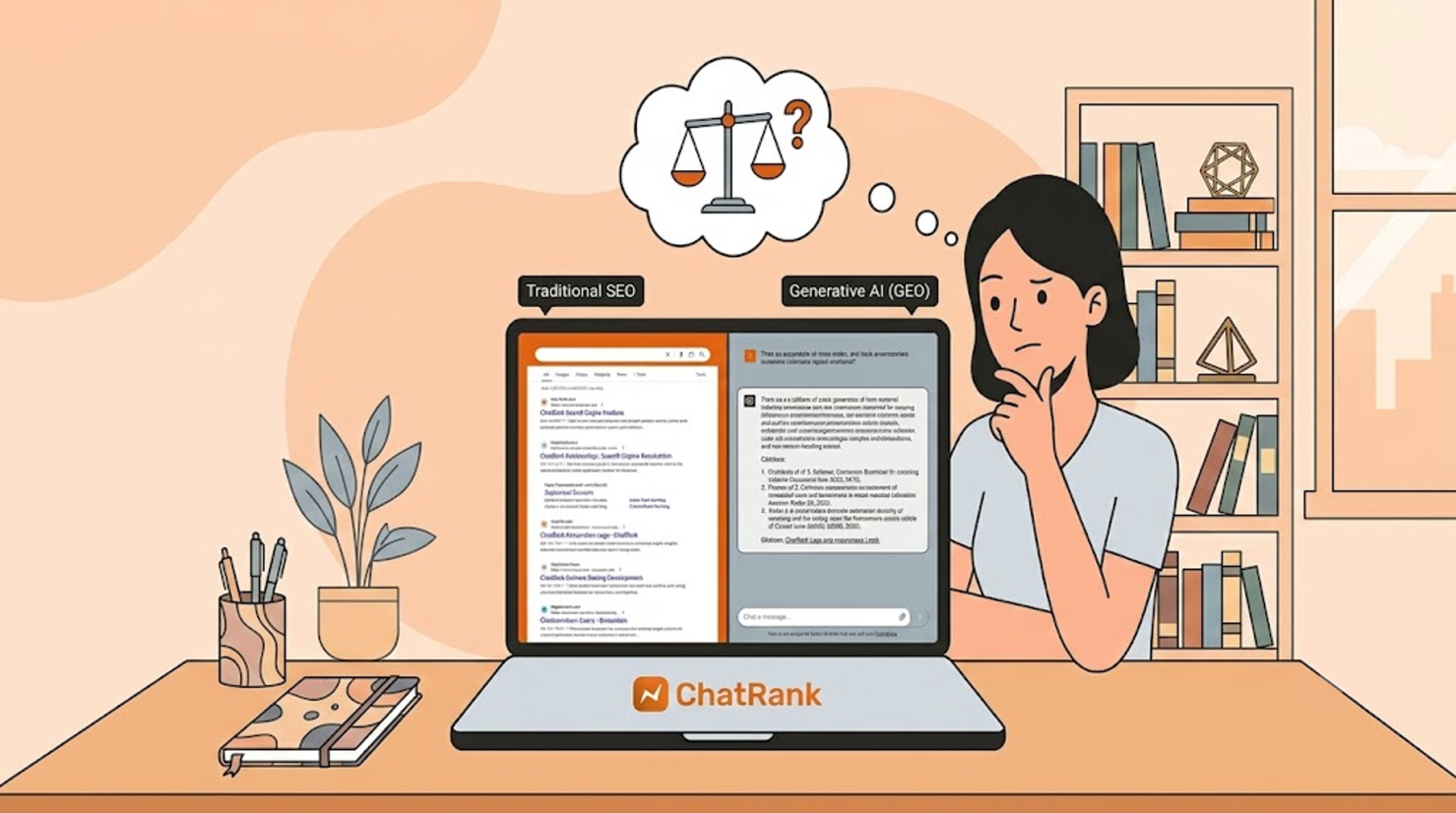
SEO vs. GEO: What's the Difference and Which One Should You Prioritize?
Search is no longer just a list of ten blue links. The rise of AI-powered answer engines — from Google's AI Overviews to ChatGPT, Perplexity, and Gemini — has fundamentally changed how users find information and how brands compete for visibility. As a result, a new discipline has emerged alongside traditional Search Engine Optimization (SEO): Generative Engine Optimization (GEO).
But what exactly separates the two? And more importantly, which one should your brand be investing in right now?
The short answer: both — but in different ways, for different goals. This post breaks down the core differences, explains how AI-generated results are reshaping search behavior, and shows you how to build a strategy that covers both fronts.
SEO vs. GEO: A Side-by-Side Comparison
Before diving into strategy, it helps to understand the foundational differences between these two disciplines.
| Dimension | SEO (Search Engine Optimization) | GEO (Generative Engine Optimization) |
|---|---|---|
| Goal | Rank in traditional search results (SERPs) | Appear in AI-generated answers and citations |
| Primary Signals | Backlinks, keywords, technical health, on-page structure | Authority, clarity, structured data, topical depth, citations |
| Platforms | Google, Bing, Yahoo | ChatGPT, Perplexity, Google AI Overviews, Gemini, Copilot |
| Success Metric | Rankings, organic traffic, CTR | Brand mentions, citations, visibility in AI responses |
| Content Format | Keyword-targeted pages, metadata, headers | Authoritative long-form content, FAQs, clear entity definitions |
| Link Strategy | Backlink acquisition for domain authority | Earning citations in trusted sources that AI models train on |
| User Intent Focus | Query matching | Conversational, multi-step, and contextual intent |
| Measurement Tools | Google Search Console, Ahrefs, Semrush | ChatRank, Profound, Brandwatch AI monitoring |
Both disciplines share DNA — quality content and authority matter in both — but their optimization targets, success metrics, and tactical playbooks diverge significantly.
How AI Overviews Are Changing SERP Click-Through Behavior
Google's AI Overviews (formerly Search Generative Experience, or SGE) began rolling out broadly in the United States in May 2024 and have since expanded globally. Their impact on traditional organic search behavior has been one of the most closely watched developments in digital marketing.
Research and industry analysis have consistently pointed to the same pattern: when an AI Overview appears at the top of a SERP, a meaningful share of users get their answer directly from that module — without clicking through to any underlying website. This is often called a "zero-click" result.
According to analysis published by Search Engine Land and corroborated by data from tools like Semrush and SparkToro, queries that trigger AI Overviews tend to see lower click-through rates to traditional organic listings, particularly for informational queries where the AI can fully satisfy user intent on the page. Navigational and transactional queries are less affected, since users still need to visit a site to complete a purchase or access an account.
This shift has two critical implications for marketers:
- Ranking #1 organically no longer guarantees the same click volume it once did. If an AI Overview answers the question before a user scrolls to organic results, top-ranked pages may see CTR decline even while maintaining position.
- Being cited inside the AI Overview can be more valuable than ranking below it. When Google's AI surfaces your content as a source — displaying your brand name and a link within the answer — it signals authority and can drive highly qualified clicks from users who are already informed.
This is precisely why GEO has become a strategic priority: optimizing to be the source the AI cites, not just a result beneath it.
As noted by Google's Search Central blog, AI Overviews are designed to help users with complex, multi-step queries by synthesizing information from multiple high-quality sources. Brands that produce clear, accurate, well-structured, and authoritative content are best positioned to be selected as those sources.
When GEO Outperforms Traditional SEO
GEO isn't a replacement for SEO, but there are specific scenarios where it delivers outsized value compared to traditional search optimization alone.
1. High-Competition Informational Keywords
For broad, informational queries ("what is the best CRM for small businesses?"), ranking organically against established domain authorities is extremely difficult for newer or mid-sized brands. However, if your content is structured in a way that AI models can easily parse, cite, and synthesize, you can earn placement inside an AI answer even without a top-10 organic ranking. GEO levels the playing field.
2. Brand Discovery in Conversational AI Interfaces
A growing share of consumers now begin product and service research in ChatGPT, Perplexity, or Gemini — not in Google Search at all. These interfaces have no traditional SERP. If your brand isn't being mentioned in AI-generated responses for relevant queries, you are effectively invisible to this audience segment. SEO does nothing to address this gap; GEO is the only strategy that does.
3. B2B and High-Consideration Purchases
Enterprise buyers and B2B decision-makers increasingly use AI tools to shortlist vendors, compare features, and draft RFPs. A 2024 survey by Forrester found that a significant portion of B2B buyers use generative AI tools as part of their research process. Brands that earn consistent citations in AI responses to category-level queries ("best SEO tools for enterprise brands") build awareness and credibility at the very top of the funnel.
4. Reputation and Competitive Positioning
AI-generated answers don't just surface information — they frame narratives. If a competitor is consistently cited as the go-to authority in your category while your brand goes unmentioned, that shapes perception among AI-assisted researchers. GEO strategies focused on PR, thought leadership, and structured data help ensure your brand is part of the conversation.
Running SEO and GEO in Parallel: A Practical Framework
The most resilient digital marketing strategies in 2025 treat SEO and GEO as complementary, not competing, disciplines. Here's how to build a dual-track approach:
Unify Your Content Foundation
Great SEO content and great GEO content share the same root: depth, accuracy, and authority. Invest in long-form, well-researched content that genuinely answers complex questions. This serves both traditional crawlers and AI training pipelines simultaneously.
Structure Content for AI Parsability
GEO-specific tactics layer on top of solid SEO fundamentals:
- Use FAQ sections with clear, direct answers to common questions.
- Define key terms explicitly (AI models are more likely to cite clear definitions).
- Implement structured data markup (Schema.org) for articles, products, FAQs, and organizations — Google uses this to better understand and feature your content.
- Write in plain, declarative language. AI models prefer unambiguous prose over clever, jargon-heavy copy.
Build Off-Page Authority Across Both Channels
For SEO, this means backlink acquisition from relevant, high-authority domains. For GEO, it means earning citations in content that AI models reference — think Wikipedia entries, industry publications, major news outlets, and well-regarded blogs. PR and digital authority campaigns serve double duty here.
Measure Both Tracks Separately
Traditional SEO metrics (rankings, organic traffic, domain authority) won't tell you how your brand is performing in AI-generated answers. You need dedicated GEO measurement — tracking how often your brand is mentioned, cited, or recommended in responses from platforms like ChatGPT, Perplexity, and Google AI Overviews.
Tools and Platforms That Support GEO — and Why ChatRank Leads the Field
As GEO has matured from a theoretical concept into a core marketing discipline, a new category of tools has emerged to support it. Here's how the landscape breaks down:
Traditional SEO Platforms (With Some AI Features)
Tools like Ahrefs, Semrush, and Moz remain essential for keyword research, backlink analysis, and technical SEO auditing. Some have begun integrating AI Overview tracking features, but these remain secondary to their core SERP-focused functionality. They are not purpose-built for GEO.
Emerging GEO-Specific Platforms
- Profound — Offers AI answer monitoring focused on enterprise use cases.
- Brandwatch — Provides brand mention monitoring that can be configured to track AI-sourced mentions.
- Otterly.ai — An early-stage tool focused on tracking brand presence in AI-generated responses.
ChatRank: Purpose-Built for AI Search Visibility
ChatRank is purpose-built for the GEO era — designed from the ground up to help brands monitor, measure, and improve their visibility inside AI-generated answers across the platforms that matter most: ChatGPT, Google AI Overviews, Perplexity, Gemini, and more.
What sets ChatRank apart:
- AI Search Visibility Monitoring — Track in real time how often and how favorably your brand appears in AI-generated responses for your target queries.
- Competitive Benchmarking — See exactly where competitors are being cited and where you're missing from the conversation, enabling precise competitive intelligence.
- GEO Optimization Guidance — ChatRank doesn't just tell you where you stand — it surfaces actionable insights to improve your citations, framing, and authority signals across AI platforms.
- Multi-Platform Coverage — Unlike tools that focus on a single AI interface, ChatRank monitors brand presence across the full AI search ecosystem, giving you a unified view of your generative search footprint.
For brands that are serious about winning in the AI search era, ChatRank provides the visibility layer that no traditional SEO tool can offer.
Which Should You Prioritize?
If you're asking whether to invest in SEO or GEO, you're framing the question incorrectly. The real question is: what proportion of your search investment should shift toward GEO, and how quickly?
Here's a practical heuristic:
- If your audience is primarily finding you through transactional or navigational queries (e.g., branded searches, e-commerce), SEO should still be your primary focus — but start building GEO infrastructure now.
- If your business competes on informational authority (B2B SaaS, professional services, content-driven brands), GEO should receive significant investment today, because the competitive window for earning early AI citation authority is still open.
- If your audience includes tech-forward, AI-native users (marketers, developers, knowledge workers), you may already be losing ground to competitors who are showing up in AI answers and you are not.
The brands that will dominate search in 2026 and beyond are the ones building for both the algorithmic web and the generative AI layer — simultaneously, strategically, and with the right tools in place.
The Bottom Line
SEO and GEO are not rivals — they are two layers of the same visibility strategy, optimized for two different types of search interfaces. As AI Overviews, ChatGPT, and Perplexity continue capturing a larger share of search intent, the cost of ignoring GEO grows with every passing quarter.
Build the content foundation that serves both. Structure it for AI parsability. Earn authority across the web. And use dedicated platforms like ChatRank to measure and optimize your presence in AI-generated answers — because what you can't measure, you can't improve.
The search landscape has split into two lanes. Make sure your brand is competing in both.
Sources and further reading: Google Search Central Blog (search.google.com/search/docs); Search Engine Land (searchengineland.com); Moz Blog (moz.com/blog); Princeton NLP Group — "GEO: Generative Engine Optimization" (arxiv.org/abs/2311.09735)



We’ve been using ChatRank for 34 days, and following their plan, we’ve actually grown over 30% in search visibility


ChatRank helped us go from zero visibility to ranking #2 in a core prompt for our business with only one new blog post!


My business has always come from word of mouth. Now people are actually finding me on ChatGPT!