The AI Search Visibility Checklist for Lean Teamsg Post
Use this AI search visibility checklist to see whether your brand is ready to show up when customers ask AI for recommendations.

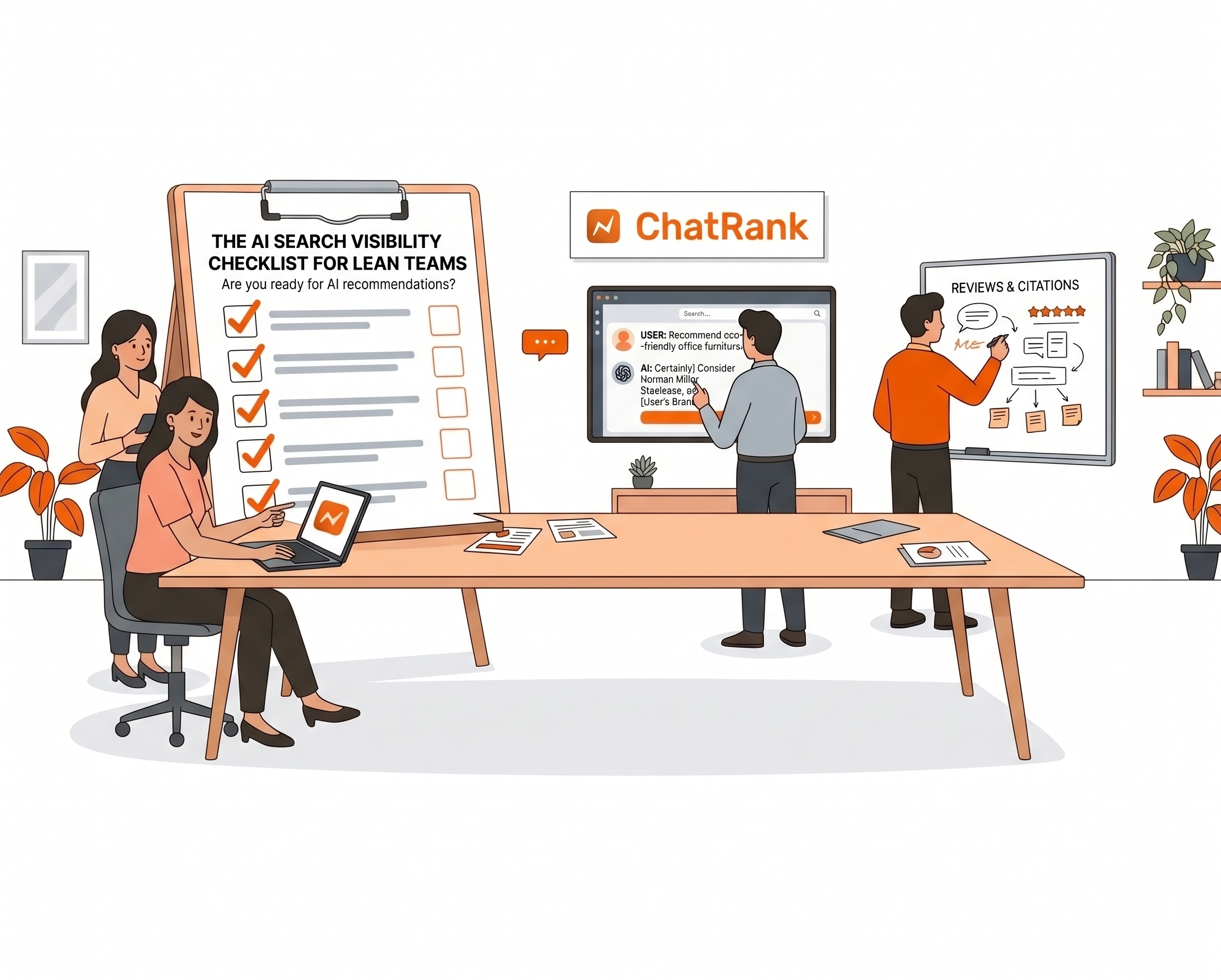
Most businesses are not ignoring AI search.
They know something is changing. They know customers are asking ChatGPT, Google AI Overviews, Gemini, Perplexity, and other AI tools for recommendations. They know showing up in those answers probably matters.
The problem is not awareness. The problem is knowing what to do next. That is where things get messy.
Do you need more blogs? Better service pages? More reviews? A Reddit strategy? A clearer homepage? A fancy GEO dashboard? A content engineer? A full-time marketer? A minor miracle?
For lean teams, the answer cannot be “do everything.” A founder, office manager, junior marketer, practice manager, or small ecommerce team does not have the time to turn AI search visibility into a second job.
So the better question is simpler: is your brand easy for AI tools to understand, trust, and recommend?
This checklist will help you find out.
1. Can AI Tools Clearly Understand What You Do?
Start here, because if this part is fuzzy, everything else gets harder.
AI tools do not “know” your business the way your team does. They build an understanding from what exists online: your website, reviews, third-party mentions, directories, articles, comparison pages, social conversations, and other public sources.
If those sources are vague, outdated, inconsistent, or thin, your brand becomes harder to place inside an answer.
A clear brand should answer a few basic questions without making the reader work for it:
- What do you sell or provide?
- Who is it for?
- Where do you operate?
- What problems do you solve?
- What makes you different from nearby or similar competitors?
- Why should someone trust you?
This sounds obvious, but a lot of websites fail here. They say things like “personalized solutions,” “high-quality service,” “trusted experts,” and “innovative approach” without saying anything specific enough to be useful.
That is fine if your goal is to sound like every other business in your category. Less fine if your goal is to be recommended.
For AI search, clarity is not decoration. It is infrastructure.
2. Are Your Core Service or Product Pages Strong Enough?
Your homepage cannot do all the work.
If you are a dental practice, each important service needs enough detail to stand on its own. Invisalign, pediatric dentistry, emergency dental care, dental implants, teeth whitening, and sedation dentistry are not the same page with different headings.
If you are a local service business, “HVAC repair,” “AC installation,” “emergency plumbing,” and “water heater replacement” should not be buried in a single paragraph under “Services.”
If you are an ecommerce brand, your product and category pages need to explain who the product is for, what problem it solves, what makes it different, and what tradeoffs matter.
AI tools are trying to answer specific questions. Thin pages make that harder. A strong service or product page should usually include:
- A plain-language explanation of the service or product
- Who it is best suited for
- Common questions customers ask before buying or booking
- What makes your approach, product, or team different
- Location or availability details, where relevant
- Proof points, reviews, certifications, or experience
- A clear next step
This is where a lot of businesses accidentally make themselves invisible. They technically have the page, but the page does not say enough.
A page called “Dermatology Services” is not the same as a useful explanation of acne treatment for teens, mole checks, eczema care, cosmetic dermatology, or what a new patient can expect.
AI tools need context. So do humans.
3. Do You Answer the Questions Customers Actually Ask?
Most brands write for the way they describe themselves. Customers search for the way they experience the problem. That gap matters.
A practice might say “comprehensive orthodontic care.” A parent might ask, “What is the best orthodontist for a nervous teenager?”
A software company might say “AI-powered workflow automation.” A buyer might ask, “What tool can help my team create content without hiring a content strategist?”
An ecommerce brand might say “premium performance fabric.” A customer might ask, “What is the best workout shirt that does not smell after one wear?”
The second version is what AI search cares about.
Your content should answer the real questions that come up in sales calls, front-desk conversations, support tickets, DMs, reviews, and demos. Not the questions you wish customers asked. The ones they actually ask.
Good question-led content might cover:
- “How do I know if this is right for me?”
- “What does this cost?”
- “How long does it take?”
- “What should I expect?”
- “What makes one provider or product better than another?”
- “What are the risks or tradeoffs?”
- “How does this compare to another option?”
- “What happens after I book, buy, or sign up?”
This is also where human input becomes the advantage. AI can help structure the answer, but your team knows what customers are confused about, what they care about, and what usually makes them say yes. That is the good stuff. Use it.
4. Is There Enough Proof Behind Your Claims?
AI search visibility is not just about saying the right things. It is about having enough proof that those things are worth believing.
Most brands make claims. Fewer back them up properly.
“We are trusted.” By whom?
“We deliver great results.” What results?
“We offer a better experience.” Better how?
“We are the best choice.” For which customer, in which situation, and compared to what?
Proof gives your brand weight. It helps customers make decisions, and it gives AI tools more substance to work with when they are deciding whether to include you in an answer.
Useful proof can include:
- Customer reviews
- Case studies
- Before-and-after examples, where appropriate
- Testimonials
- Years of experience
- Certifications
- Awards
- Specific outcomes
- Photos or examples of work
- Provider or team credentials
- Product testing or performance details
- Clear explanations of your process
The point is not to stuff every page with bragging. The point is to make your credibility easier to see.
A claim without proof is just marketing. And the internet has enough of that already.
5. Are Reviews Supporting the Story You Want AI to Understand?
Reviews matter because they are one of the few places where customers describe your business in their own words.
That makes them useful for humans and AI tools.
If your website says you are family-friendly, but your reviews never mention kids, parents, comfort, patience, or bedside manner, that positioning may not be strongly supported online.
If you want to be known as the best local option for emergency plumbing, but reviews mostly talk about general repairs, your online reputation may not be reinforcing the thing you want to rank or show up for.
This does not mean manipulating reviews. It means paying attention to what customers naturally say and whether your review profile reflects the services, qualities, and use cases you want to be known for.
Look at your reviews and ask:
- What words do customers use to describe us?
- Which services or products come up most often?
- Are the reviews recent?
- Are they specific or generic?
- Do they mention the problems we most want to be found for?
- Do they support the way we describe ourselves on our website?
- Are there important services that barely appear in reviews at all?
For local businesses, medical practices, dental offices, legal firms, home services, and high-consideration purchases, this can be a big deal.
Your reviews are not just social proof. They are part of your public brand data.
6. Are You Showing Up Outside Your Own Website?
Your website matters, but AI tools do not only look at your website.
They may pull signals from review sites, directories, industry lists, third-party blogs, social platforms, Reddit threads, comparison sites, media mentions, and other places where your brand appears. That means your off-site presence matters too.
For a medical practice, that could include Google reviews, Healthgrades, Zocdoc, insurance directories, local listings, and patient review platforms.
For a local service business, it might include Google Business Profile, Yelp, Angi, Nextdoor, Reddit, local directories, and trade-specific platforms.
For an ecommerce brand, it could include reviews, marketplace listings, gift guides, comparison articles, Reddit threads, YouTube mentions, and social conversations.
For a SaaS or service brand, it might include G2, Capterra, industry blogs, LinkedIn, Reddit, partner pages, and competitor comparison articles.
The question is not whether you can be everywhere. You cannot, and that would be a terrible use of your time. The question is whether the places that matter in your category are telling a clear, consistent story about your brand.
If your website says one thing, directories say another, your reviews are outdated, and Reddit has no idea you exist, that is a visibility gap.
7. Do You Know Which Prompts You Should Appear For?
Most teams still think in keywords. That is not wrong, but it is incomplete.
AI search is often prompt-led. People ask full questions, compare options, describe situations, and look for recommendations. The prompts that matter may be much more specific than the keywords you currently track.
A keyword might be “pediatric dentist.”
A prompt might be, “What is the best pediatric dentist near me for a child who is scared of the dentist?”
A keyword might be “best project management software.”
A prompt might be, “What project management tool is easiest for a small remote team that hates complicated software?”
A keyword might be “protein powder.”
A prompt might be, “What protein powder is best for someone with a sensitive stomach who wants clean ingredients?”
These prompts reveal intent. They show how customers think, what they care about, and which brands AI tools may recommend in a real buying moment.
Your team should know:
- Which prompts matter most for your category
- Which prompts you currently appear for
- Which prompts competitors appear for
- Which prompts reveal missing content
- Which prompts show a mismatch between your positioning and what AI understands
This is one of the places where guessing gets expensive. You can spend months writing content that feels useful, only to realize it does not match the questions customers are actually asking.
ChatRank helps make this visible by showing where your brand stands in AI search, where competitors are beating you, and which opportunities are worth acting on.
No crystal ball required. Just better tracking.
8. Are Competitors Being Recommended Where You Are Not?
This is the moment most teams finally pay attention.
It is one thing to know AI search matters in theory. It is another thing to ask ChatGPT or Google AI Overviews for a recommendation in your category and see three competitors appear while your brand is nowhere.
Not fun. Very useful.
Competitor visibility tells you where the gap might be. Maybe they have better service pages. Maybe they have more specific reviews. Maybe they are mentioned in comparison content. Maybe they answer patient or customer questions more clearly. Maybe their positioning is easier to understand.
The goal is not to copy them. The goal is to understand why they are easier to recommend.
Look at the competitors showing up and ask:
- What do they explain better than we do?
- What pages or topics do they have that we do not?
- Which third-party sites mention them?
- What do their reviews consistently say?
- Are they clearer about who they serve?
- Are they answering more specific customer questions?
- Are they stronger in local, social, or review-based signals?
This is where AI search visibility becomes practical. If a competitor is showing up and you are not, that is not just a ranking problem. It is a clue.
ChatRank is built to help teams find those clues and turn them into tasks.
9. Is Your Content Specific Enough to Be Worth Recommending?
Generic content is everywhere. That is exactly why it is not enough.
A blog post that says “regular dental visits are important” is not going to do much for a dental practice. A service page that says “we provide reliable HVAC solutions” is not going to make an HVAC company stand out. An ecommerce article that says “choose the right product for your needs” is just filler dressed up as advice.
Specific content does more work.
It explains the tradeoffs. It answers the awkward questions. It helps people decide. It shows where your experience is different. It adds the facts, stories, examples, and details only your business knows.
For AI search, that matters because tools are trying to generate useful answers. Thin content gives them very little to use.
Before publishing a piece of content, ask:
- Could this article apply to almost any business in our category?
- Does it include anything only we would know?
- Does it answer a real customer question?
- Does it include proof, examples, or specifics?
- Would a customer be more confident after reading it?
- Would an AI tool have a clearer reason to understand or recommend us?
If the answer is no, the content probably needs more substance.
This is where ChatRank’s human-in-the-loop approach matters. The system can help identify the topic, structure the piece, and optimize the draft. But the business needs to add the customer details, proof points, product nuance, and real context that make it worth publishing.
That is how you avoid adding more AI sludge to the internet.
10. Do You Have a Weekly Workflow, or Just a Vague Intention?
Most businesses do not fail at marketing because they are lazy. They fail because marketing becomes too vague.
“Improve AI visibility” is not a task. “Create more content” is not a task. “Be more active online” is not a task. Those are intentions, and intentions are where good ideas go to die quietly in a Monday meeting.
A useful workflow is much more concrete.
This week, update the service page that is too thin. This week, answer the prompt your competitor keeps winning. This week, add three patient FAQs to the Invisalign page. This week, respond to the Reddit thread asking about AI search tools. This week, collect a customer quote for the article already drafted.
That is the level of clarity lean teams need. A good AI search workflow should tell you:
- What matters this week
- Why it matters
- What input is needed from the human
- What can be drafted or prepared by AI
- What should be published, updated, or monitored
- Whether visibility changes over time
That is the practical layer ChatRank is built around. It does not just show you another dashboard and wish you luck. It gives you a clearer game plan, asks for the details only you know, and helps turn those details into work that can improve your visibility.
Because let’s be honest: most founders, dentists, office managers, ecommerce teams, and local service businesses are not waking up excited to become GEO experts. They just want to know what to do next.
What to Do With This Checklist
If your brand is weak in one or two areas, that is normal. Most teams are. AI search is still new enough that even strong businesses have gaps.
The problem is not having gaps. The problem is not knowing where they are.
Start with the parts that are easiest to audit:
- Is your website clear?
- Are your service or product pages useful?
- Do you answer real customer questions?
- Do your reviews support your positioning?
- Are you mentioned in the places that matter?
- Do you know which prompts you should appear for?
- Do you know where competitors are winning?
- Do you have a weekly workflow to improve it?
If you cannot answer those questions confidently, you are not behind. You are just operating with limited visibility.
That is fixable.
AI Search Visibility Gets Easier When You Know What to Fix
AI search can sound complicated because the technology behind it is complicated.
But the work does not always need to be.
For most lean teams, the first step is not building a massive content operation or hiring a technical GEO specialist. It is understanding whether your brand is clear, credible, specific, and visible enough to be recommended when customers ask AI for help.
That is what this checklist is really about.
ChatRank helps brands and agencies see where they stand in AI search, where competitors are winning, and which content, review, website, or off-site opportunities deserve attention next. It turns a broad visibility problem into a weekly set of actions your team can actually manage.
No 40-page strategy deck. No guessing. No pretending your office manager has suddenly become a content engineer.
Just a clearer way to know where you stand and what to do next.



We’ve been using ChatRank for 34 days, and following their plan, we’ve actually grown over 30% in search visibility


ChatRank helped us go from zero visibility to ranking #2 in a core prompt for our business with only one new blog post!



My business has always come from word of mouth. Now people are actually finding me on ChatGPT!