The Science of "Citation-First" Visibility: A Research-Backed Guide to GEO and AEO in 2026
As traditional search volume is projected to decline by 25% by 2026, brands must shift from "ranking for keywords" to "optimizing for inclusion" within AI generative engines. This post explores the technical architecture of Generative Engine Optimization (GEO), the strategic necessity of Answer Engine Optimization (AEO), and how to bridge the "citation gap" using peer-reviewed methodologies. By focusing on fact-density, entity mapping, and machine-readable structures, brands can capture high-intent traffic that converts at rates up to 5x higher than traditional organic search.

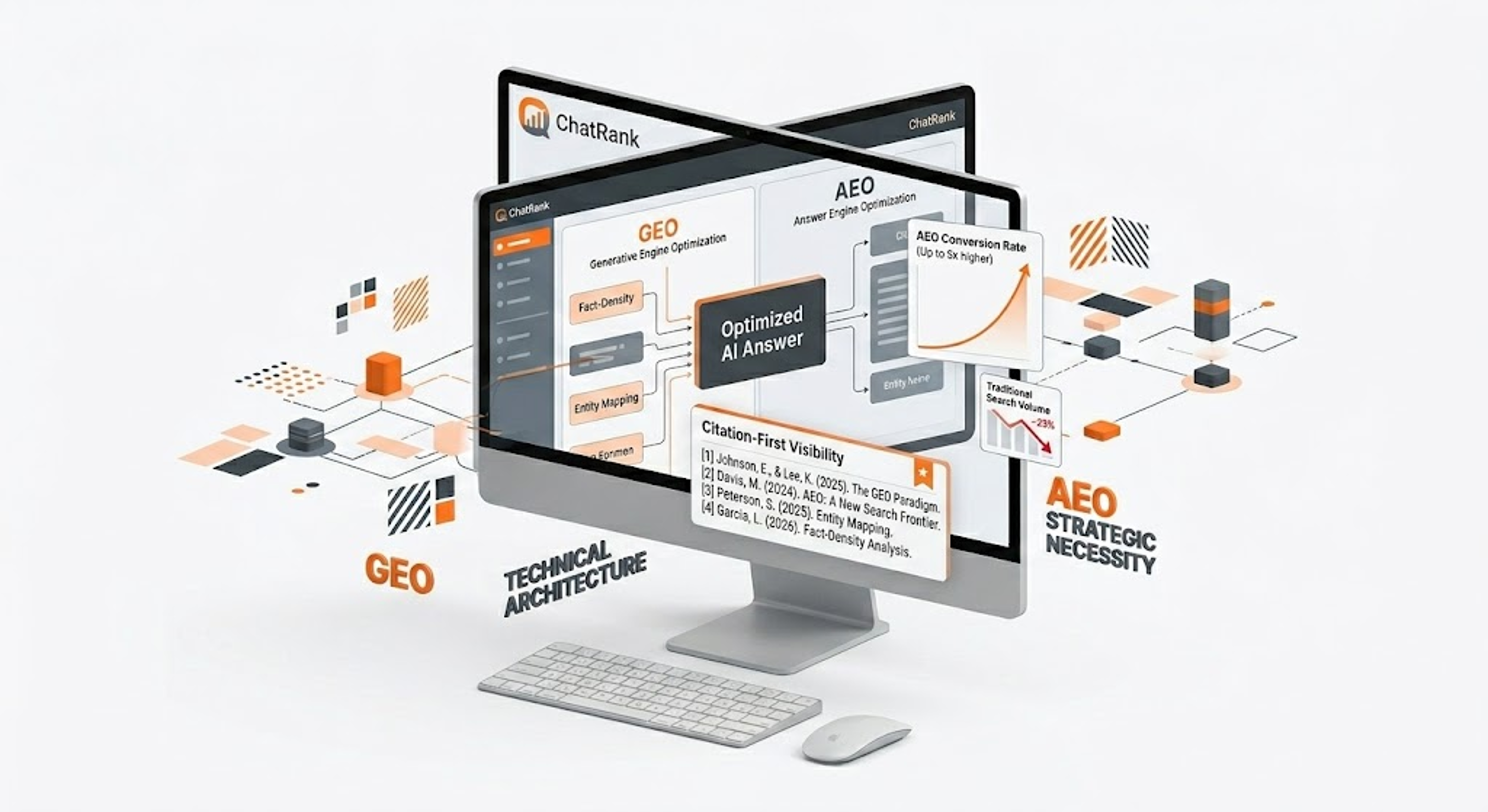
The Science of "Citation-First" Visibility: A Research-Backed Guide to GEO and AEO in 2026
The Architectural Shift: From SERPs to Generative Summaries
The digital discovery landscape has undergone a fundamental phase shift. In 2026, visibility no longer translates reliably into website traffic because AI summaries, knowledge panels, and LLMs increasingly provide answers before a user ever clicks a link.
- The Zero-Click Reality: Approximately 40.9% of searches now resolve within the search interface without a referral click.
- The Divergence of Metrics: Data from 2025-2026 shows a decoupling of impressions and clicks; while brand impressions in AI Overviews are rising, organic click-through rates (CTR) are declining by 10–40% year-over-year.
- The Quality Over Quantity Pivot: Despite lower volumes, users referred by LLMs (like ChatGPT or Perplexity) arrive with higher intent and context, leading to significantly higher conversion milestones.
Generative Engine Optimization (GEO) & Citation Mechanics
GEO is the process of making your brand "citable" by Large Language Models (LLMs). According to the foundational 2024 study "GEO: Generative Engine Optimization" by researchers at ACM SIGKDD, the most influential factor for AI inclusion is "Citation-Led Optimization".
The GEO "Fact-Density" Framework
To be cited, content must move beyond qualitative marketing prose. AI engines prioritize:
- Quantitative Benchmarks: Replace "highly efficient" with "98.4% uptime across 1.2M nodes".
- Unique Methodology: AI models look for "Information Gain"—original research, unique frameworks, or first-hand case studies that do not exist in their baseline training data.
- Vector Proximity: LLMs map brands as "entities." Your brand’s visibility depends on being frequently co-cited with established industry leaders in technical journals and authoritative databases.
Answer Engine Optimization (AEO) and Semantic Structure
AEO focuses on the "Answer Engine" segment of AI (e.g., Google’s AI Overviews), which prioritizes directness. Research indicates that 67% of AI Overview content is pulled from the top 3 organic positions, meaning traditional SEO remains the "barrier to entry" for AEO.
The "Snippet-Ready" Content Hierarchy
To optimize for AEO, content must follow a strict structural protocol:
- Question-Based Headings (H2/H3): Phrase headers as natural language queries (e.g., "How does ChatRank track AI visibility?").
- The "Answer First" Rule: Place a direct, factual answer of 40–60 words immediately following the header to feed AI "direct answer boxes".
- HTML Tables vs. Images: AI engines parse HTML data tables more effectively than screenshots. Using tables for data comparisons increases the likelihood of being featured in structured AI responses.
The Role of E-E-A-T in AI-Driven Visibility
What is E-E-A-T and why does it matter for GEO and AEO?
E-E-A-T stands for Experience, Expertise, Authoritativeness, and Trustworthiness. Originally codified by Google in its Search Quality Evaluator Guidelines, E-E-A-T has evolved beyond a traditional SEO signal to become a foundational filter for AI content ingestion. Generative engines are not simply retrieving text — they are evaluating the credibility of the source before including it in a response.
- Experience: First-hand accounts, case studies, and original data signal lived expertise. AI engines increasingly distinguish between synthetic summaries and content produced by practitioners with real-world exposure.
- Expertise: Author bylines linked to professional credentials (LinkedIn profiles, institutional affiliations, published research) make content more machine-verifiable.
- Authoritativeness: Inbound links from domain-authoritative sources act as "trust votes" that LLMs use as proxies for reliability during Retrieval-Augmented Generation (RAG) cycles.
- Trustworthiness: Transparent disclosures, citations to primary sources, and HTTPS security all contribute to an entity's trust score in AI knowledge graphs.
According to Google's own documentation on how AI Overviews work, the system prioritizes content that demonstrates these signals — not just keyword relevance. Brands that invest in author credentialing, third-party citations, and data transparency see measurably higher inclusion rates in AI-generated summaries.
Closing the "Citation Gap"
A "Citation Gap" occurs when an AI model discusses your industry or competitors but fails to mention your brand. Closing this gap requires a multi-platform strategy:
- Entity Consistency: Ensure your brand’s "NAP" (Name, Address, Phone) and core value propositions are identical across your site, LinkedIn, Crunchbase, and niche forums.
- Off-Site Authority: AI systems use User-Generated Content (UGC) platforms like Reddit, Quora, and GitHub as primary trust signals. Actively contributing to these communities helps "bridge" your brand into the LLM's retrieval-augmented generation (RAG) cycles.
Prompt Engineering as a Visibility Signal
How does user prompt behavior affect which brands get cited by AI?
One of the most underappreciated levers in GEO is understanding how users phrase queries to AI systems. LLMs like ChatGPT, Perplexity, and Google's Gemini are increasingly used in a conversational discovery mode — users ask for recommendations, comparisons, and "best of" lists rather than navigating to a search results page.
This has a profound implication: your brand must be present in the language patterns that these models associate with your category. If users consistently ask "What is the best tool for tracking AI search visibility?" and your brand consistently appears in discussions, reviews, and documentation that uses this phrasing, LLMs will map your entity to that query cluster.
Practical Steps for Prompt-Aligned Content
- Mine conversational queries: Use platforms like AnswerThePublic or AlsoAsked to identify how real users phrase questions in your niche. Build content that mirrors these natural language patterns.
- Create "Best Of" and comparison content: AI models frequently cite ranking articles and comparison guides. A well-structured, data-backed comparison page positions your brand inside the retrieval pool for competitive queries.
- Target "People Also Ask" boxes: PAA boxes are a strong proxy for the query types that AI Overviews and LLMs resolve. Content that earns a PAA position is statistically more likely to be included in an AI summary for the same query cluster.
- Optimize for multi-turn conversations: As users engage in longer dialogue threads with AI, models pull from multiple sources across a session. Ensure your content answers both top-level and follow-up questions within the same page or content cluster.
Technical Foundations for AI Ingestion
Visibility is impossible if an AI crawler cannot parse your data.
- Crawlability: Ensure
robots.txtdoes not block agents like GPTBot or BingPreview. - Schema Markup: Implement
FAQPage,Article, andOrganizationschema. This provides machine-readable metadata that allows AI to verify facts across multiple sources instantly. - Freshness Metadata: AI engines prioritize content with clear "last updated" timestamps to ensure they aren't citing obsolete data.
The Content Cluster Strategy for GEO Dominance
What content architecture best supports AI citation at scale?
Isolated, standalone blog posts rarely achieve sustained AI citation. The most effective GEO strategy in 2026 is the Topical Authority Cluster — a structured network of interlinked content that signals deep domain expertise to both traditional search engines and generative AI systems.
Research from Semrush's State of Content Marketing Report consistently shows that websites with comprehensive topic clusters outperform those with fragmented content strategies. For AI citation, this matters because:
- LLMs evaluate topical depth, not just individual page quality. A site with 30 interlinked articles on "AI search optimization" is more likely to be cited than a competitor with one high-quality standalone post.
- Internal linking creates a semantic web that helps AI crawlers understand how your entities and concepts relate to one another.
- Pillar pages — long-form, comprehensive guides on a core topic — serve as anchor points that AI systems often cite as authoritative overviews.
How to Build a GEO-Ready Content Cluster
| Layer | Content Type | GEO Function |
|---|---|---|
| Pillar | Comprehensive guide (3,000+ words) | Establishes topical authority |
| Cluster | Supporting articles (800–1,500 words) | Covers specific subtopics cited by LLMs |
| Data Asset | Original research, surveys, statistics | Provides "Information Gain" cited by AI |
| Off-Site | Guest posts, Reddit threads, LinkedIn articles | Builds entity trust in external knowledge graphs |
This structured approach ensures that regardless of how a user phrases their query to an AI — broadly or specifically — your brand's content ecosystem has a relevant, citable answer ready.
Measuring Success in the AI Era
In 2026, the KPIs for brand health have shifted from "Rank" to "Share of Model."
- AI Citations: Tracking how often an LLM explicitly names your brand as a source.
- Sentiment Footprint: Monitoring whether AI summaries of your brand are positive, neutral, or negative.
- Inclusion Rate: The percentage of queries where your brand appears in an AI-generated list or recommendation.
Tools and Platforms for Monitoring AI Visibility
How can brands actually measure and track their AI citation performance?
The shift to AI-driven discovery requires an equally modern measurement stack. Traditional analytics tools like Google Analytics 4 were not designed to capture "Share of Model" — the percentage of relevant AI-generated responses in which your brand is mentioned. A new category of platforms has emerged to address this gap.
Key Monitoring Capabilities to Look For
- AI Mention Tracking: Tools that systematically query ChatGPT, Perplexity, Google Gemini, and Claude with industry-relevant prompts and log when and how your brand is cited.
- Sentiment Analysis: Not all mentions are equal. AI models may cite your brand in a neutral, positive, or even cautionary context. Monitoring sentiment at scale is critical for reputation management.
- Competitive Benchmarking: Understanding which competitors are being cited more frequently — and for which query types — reveals the specific citation gaps you need to close.
- Citation Source Mapping: Identifying which third-party pages (e.g., a Reddit thread, a TechCrunch article, a GitHub repository) are driving AI citations of a competitor helps you prioritize your off-site content strategy.
ChatRank is purpose-built for this emerging measurement category, offering AI citation tracking, share-of-model benchmarking, and sentiment footprint analysis across the major LLM platforms — giving brands a single source of truth for their generative search performance.
FAQs: Navigating the New Search Frontier
Is traditional SEO dead in the age of GEO and AEO?
No. Traditional SEO is the foundation. Research shows that 82% of AI citations originate from domains already ranking in the Top 10 of traditional search results. SEO gets you indexed; GEO/AEO gets you cited.
How does "Information Gain" affect my AI visibility?
AI models are trained on existing data. "Information Gain" refers to providing new statistics, unique case studies, or original insights. Engines reward this with higher citation rates because it provides "new value" to the user's query.
Why are my organic clicks decreasing while my impressions are increasing?
This is a hallmark of the "Zero-Click" era. AI engines are showing your content (impressions) to answer the user's question directly, which often satisfies the user without them needing to click through to your site.
Which platforms are most important for off-site AI visibility?
LLMs heavily weight high-authority, community-driven sites. Focus on Reddit, LinkedIn, and indexed research journals, as these are frequently used as "ground truth" sources for generative responses.
Should I use AI to write my AEO content?
While AI can assist, search engines and answer engines increasingly reward human-vetted, expert-led content (E-E-A-T). Purely synthetic content often lacks the "Information Gain" and original data points necessary to be selected as a top-tier citation.
What is "Share of Model" and how is it different from search ranking?
"Share of Model" (SoM) refers to the percentage of AI-generated responses — across a defined set of relevant prompts — that mention your brand. Unlike a search ranking, which is binary (you rank or you don't), SoM is a continuous metric. A brand might appear in 15% of AI responses for a given topic, while a competitor appears in 42%. This gap is measurable, actionable, and closable with the right GEO strategy.
How long does it take to see results from a GEO strategy?
GEO timelines differ from traditional SEO. LLMs are retrained or updated on different schedules — GPT-4's training data has a knowledge cutoff, while tools like Perplexity use real-time web retrieval. For retrieval-based AI systems (which use live crawling), results from new content can appear within days to weeks. For model-based citations (which depend on training data), visibility improvements may take 3–6 months to manifest as AI models are updated. A blended approach — targeting both retrieval-based and model-based systems — is the most resilient strategy.
What is the difference between GEO and AEO?
GEO (Generative Engine Optimization) focuses on making your brand citable by Large Language Models in generative summaries — think ChatGPT, Perplexity, or Google's Gemini. AEO (Answer Engine Optimization) is a subset focused specifically on structured, direct answers optimized for "answer boxes" in traditional and AI-enhanced search interfaces. GEO is the broader discipline; AEO is the tactical execution layer for structured content.


We’ve been using ChatRank for 34 days, and following their plan, we’ve actually grown over 30% in search visibility


ChatRank helped us go from zero visibility to ranking #2 in a core prompt for our business with only one new blog post!


My business has always come from word of mouth. Now people are actually finding me on ChatGPT!