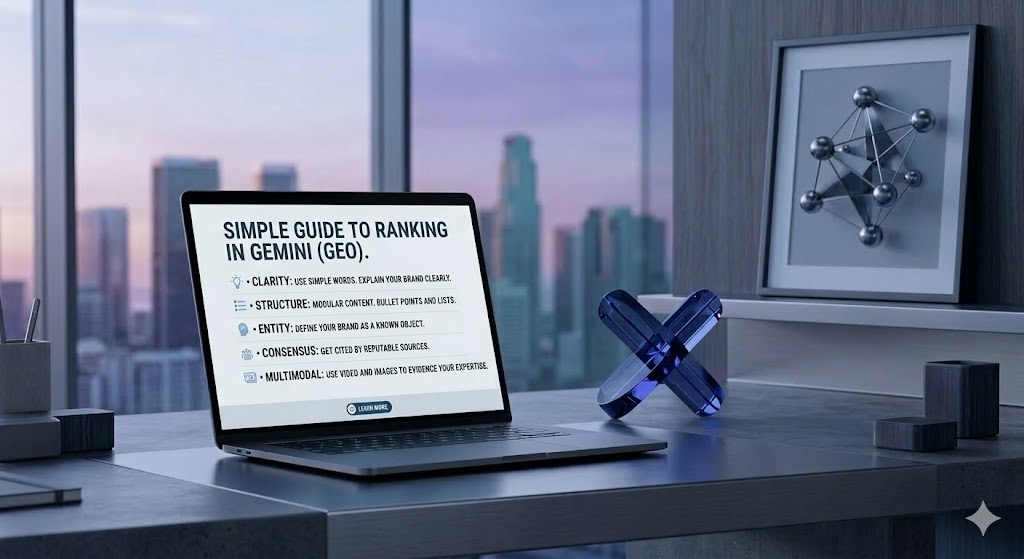
Tools to improve ranking in Gemini: Explained
• Tools to improve ranking in Gemini refers to the specialized software and strategies used for Generative Engine Optimization (GEO) to ensure content is cited by Google’s AI. • It matters now because Gemini will power approximately 40% of all Google searches by 2026, making AI visibility a requirement for organic survival. • It works by optimizing for multimodal processing, enhancing entity clarity, and maintaining factual consistency across high-authority platforms.

Tools to improve ranking in Gemini: Explained
What Does It Mean to "Rank" in Gemini?
When someone asks Google's Gemini a question, Gemini picks certain websites to use as sources in its answer. If your website is one of those sources, your brand "ranks" in Gemini. This is different from showing up in regular Google search results.
Instead of a list of blue links, Gemini gives people a full answer — and it picks only a few trusted sources to back that answer up. If your brand is not one of those sources, users may never find you at all.
The short answer: Ranking in Gemini means your content is picked, quoted, or cited when people ask Gemini questions about your topic.
This guide explains the tools you can use to make that happen
Why Does Gemini Ranking Matter in 2026?
Gemini powers Google's AI Overviews — the AI-generated summaries that appear at the top of many Google searches. Google reports that AI Overviews now reach 2 billion monthly users across 200+ countries. According to Semrush's 2025 analysis of 10 million keywords, AI Overviews appeared on roughly 15–25% of U.S. Google searches throughout 2025 — with strong variation by industry and query type.
Here is why this matters:
- Users often get answers directly from Gemini without clicking any link
- Brands cited in Gemini's answers gain trust, visibility, and authority
- According to Exposure Ninja's 2026 AI Search Statistics report, AI search traffic converts at 14.2% compared to Google's 2.8% — making AI-referred visitors significantly more valuable per visit
- Only 22% of marketers are currently tracking AI visibility, creating a major opportunity for early movers (Source: Exposure Ninja)
If you are a marketer, business owner, or SEO professional, showing up in Gemini is one of the most valuable things you can do right now.
What Is Answer Engine Optimization (AEO)?
Answer Engine Optimization (AEO) is the practice of making your content easy for AI tools like Gemini, ChatGPT, and Perplexity to read, trust, and cite.
Think of it this way: regular SEO helps you climb the Google rankings. AEO helps you get picked by AI as the best answer.
Here is a simple comparison:
| Traditional SEO | Answer Engine Optimization (AEO) |
|---|---|
| Goal: Rank on page one of Google | Goal: Be cited inside the AI's generated answer |
| Optimizes for search engine crawlers | Optimizes for AI extraction and synthesis |
| Success = clicks to your website | Success = brand mentioned or recommended by AI |
| Focuses on keywords and backlinks | Focuses on clear answers, structure, and trust signals |
Both SEO and AEO work together. According to Google Search Central, the same foundational best practices that help you rank in Google Search — helpful content, technical accessibility, and E-E-A-T signals — also support inclusion in AI features like Gemini. But if you want to rank in Gemini specifically, AEO sharpens that strategy.
Top Tools to Improve Your Ranking in Gemini
Let's look at the best tools available today to help your brand show up in Gemini answers.
1. ChatRank — Best for Strategic AI Visibility Growth
[ChatRank](https://chatrank.ai) is a platform built specifically to help brands grow their visibility in AI-generated answers across Gemini, ChatGPT, Perplexity, and more.
Unlike tools that only track your mentions, ChatRank combines monitoring with expert-led execution. That means it does not just tell you where you are missing — it helps you fix it.
What ChatRank does:
- Tracks how often your brand is cited across Gemini, ChatGPT, Claude, and Perplexity
- Compares your performance to your competitors
- Identifies "Semantic Gaps" — topics where Gemini talks about your industry but leaves your brand out
- Recommends AI-optimized content to fill those gaps
- Restructures your existing content so Gemini can read and cite it more easily
- Delivers up to 25 AI-optimized content pieces per month
— Ryan Wimpey, Founder, Tip Top K9
— Pukar Hamal, CEO and Founder, SecurityPal
Why ChatRank stands out: Most tools report the problem. ChatRank solves it. Its expert-led approach is perfect for brands and agencies that want real results, not just dashboards.
Pricing: Tiers range from $2,499/mo (Essentials) to $9,999+/mo (Elite)
2. Otterly.ai — Best for Quick Multi-Engine Tracking
Otterly.ai is an easy-to-set-up tracking tool that monitors your brand across Google AI Overview, ChatGPT, Perplexity, Gemini, and Bing Copilot.
Best for: Small teams that want fast alerts and simple onboarding
Key features:
- Real-time alerts when your brand appears or drops from AI answers
- Covers all major AI engines in one place
- Easy setup with no technical knowledge needed
Limitation: Lower tiers limit the number of tracked prompts, and it does not help you fix content gaps.
Pricing: Starts at $29/mo
3. Profound — Best for Content Planning
Profound helps you see where your brand shows up in AI answers, what Gemini says about you, and which sources it uses. Its "Conversation Explorer" feature draws on a dataset of 200M+ real AI conversations to show which topics are trending.
Best for: Strategy and content teams that want to plan what to write based on real AI demand.
Key features:
- Shows which questions lead to AI mentions
- Tracks brand visibility across ChatGPT, Google, and Perplexity
- Competitive citation audit — see which sources AI picks over you
Pricing: Starts at $99/mo
4. Similarweb — Best for Enterprise Teams
Similarweb gives a full picture of how AI tools talk about your brand. It shows exact prompts that trigger your name, which sources feed those mentions, and how much AI-driven traffic lands on your site
Best for: Large teams that need detailed data on AI traffic, prompts, and competitor presence.
Key features:
- Tracks mentions across ChatGPT, Perplexity, Gemini, Copilot, and Grok
- Shows prompt-level data and source attribution
- Includes competitor benchmarking for AI share-of-voice
Limitation: Can be too complex and expensive for small teams.
5. HubSpot AEO Grader — Best Free Starting Point
HubSpot AEO Grader is a free tool that gives a quick snapshot of how your brand shows up in Gemini, ChatGPT, and Perplexity. It checks visibility, share of voice, and the tone of how your brand is talked about
Best for: Marketers new to AEO who want a fast, free audit
Key features:
- No setup or installation needed
- Shows visibility, sentiment, and share-of-voice scores
- Simple, actionable tips to improve
Limitation: Not built for ongoing tracking or deep analysis6. Semrush — Best for SEO + AEO Together
Semrush is best known as an SEO tool, but now includes AI Overview tracking. According to Search Engine Land's coverage of Semrush's 2025 study, Semrush analyzed over 10 million keywords to track AI Overview trends throughout 2025. If your team already uses Semrush, the AEO features are a natural add-on.
Best for: SEO professionals who want Google AI Overview data inside their existing workflow
Key features:
- Tracks which keywords trigger Google AI Overviews
- Monitors your share of voice versus competitors
- Historical AIO trend data
Limitation: Does not track Perplexity, ChatGPT, or Gemini chat directly — primarily covers Google AI Overviews.
Content Strategies to Rank in Gemini (AEO Approach)
Tools help you track and measure. But your content is what Gemini actually reads and cites. Here are the most important content strategies, based on Google Search Central's guidance on AI features:
Answer Questions Directly
Gemini looks for the clearest, most direct answer. Lead every section with a short, complete answer in plain language — then add supporting detail after. AI systems extract and synthesize, so content that is easy to parse at a glance is more likely to be cited.
Use Question-Based Headings
Structure your content around real questions people ask — headings like "What is Gemini SEO?" or "How do I rank in Google AI Overviews?" This mirrors the conversational way people prompt AI tools and helps Gemini map your content to relevant queries.
Add FAQ Schema Markup
FAQ schema markup (written in JSON-LD format) tells Gemini exactly where your question-and-answer pairs are. According to a study cited by serps.io, source citation improves by ~30% when schema markup is included. This is one of the fastest, most practical wins available.
Use Structured Data (Schema Markup)
Beyond FAQs, Google recommends that your structured data matches the visible text on the page. Useful schema types include:
- Article/BlogPosting — for blog content
- Organization — for brand identity signals
- Product — for product pages
- HowTo — for step-by-step guides
- Review — for ratings and testimonials
Schema markup turns your content into machine-readable signals that Gemini can easily understand and trust.
Show Expertise and Trust (E-E-A-T)
Gemini strongly favors content that shows Experience, Expertise, Authoritativeness, and Trustworthiness (E-E-A-T). Google Search Central confirms that helpful, reliable, people-first content is the primary signal for inclusion in AI features. In practice, this means:
- Include real author bios with credentials
- Cite your sources with links to reputable data
- Share first-hand experience and real results
- Update content regularly and show "last updated" dates
Keep Content Fresh
AI platforms tend to favor recently updated content. Data from AirOps cited by serps.io shows that 95% of ChatGPT citations come from content updated within the last 10 months, and pages with "last updated" timestamps receive notably more citations. Review and update your most important pages at least every quarter.
Use Multiple Formats
Different formats help Gemini extract different types of information:
- Comparison tables for side-by-side facts
- Numbered lists for step-by-step processes
- Short paragraphs for definitions and direct answers
- Bold key phrases for important takeaways
Technical Steps to Help Gemini Find Your Content
Even great content will not rank if Gemini cannot read it. Google's guidance on AI features confirms that technical accessibility is a prerequisite for inclusion. Here are the key steps:
- Make sure Gemini's bots can crawl your site. Check your
robots.txtfile and confirm you are not blocking AI crawlers like GPTBot or Google-Extended. - Add an `llms.txt` file to declare how AI tools can use your content.
- Use server-side rendering (SSR) so AI bots see your full content, not a blank page from JavaScript.
- Fix site speed — aim for mobile load times under 2.5 seconds.
- Use clean, semantic HTML with clear heading levels (H1, H2, H3).
How to Measure Your Gemini Ranking Progress
To know if your efforts are working, track these key metrics:
| Metric | What It Measures | Why It Matters |
|---|---|---|
| Citation Rate | How often your brand is cited per 100 AI queries on your topic | Directly shows whether Gemini is picking your content as a source |
| Share of Answer (SoA) | % of relevant prompts where your brand appears in the AI response | Benchmarks your visibility against competitors |
| Sentiment Score | How positively Gemini describes your brand when it does mention you | Negative or neutral mentions may hurt more than they help |
| AI Referral Traffic | Sessions arriving at your site from Gemini or other AI tools | Ties AI visibility to real business outcomes |
| Content Freshness | Age of your most-cited pages since last update | Correlates with citation frequency — stale pages lose priority over time |
ChatRank tracks all of these across Gemini and other AI platforms, giving you a clear picture of where you stand and what to do next.
Quick-Start Checklist: Improve Your Gemini Ranking Today
Use this checklist to get started right away:
- [ ] Audit your brand in Gemini — ask it questions about your industry and see if you appear
- [ ] Set up a tracking tool (start free with HubSpot AEO Grader, then scale with ChatRank)
- [ ] Add FAQ schema to your top 5 most important page
- [ ] Rewrite your top blog posts to lead with a direct, plain-language answer in the first paragraph
- [ ] Add author bios with credentials to every key page
- [ ] Ensure your
robots.txtallows AI crawlers - [ ] Refresh any content older than 6 months — update stats, add new data, and revise the "last updated" date
- [ ] Add comparison tables and structured lists wherever possible
- [ ] Track your Share of Answer weekly and compare to competitors
Frequently Asked Questions
What is Gemini ranking and why does it matter?
Gemini ranking means your brand or content is cited or recommended by Google's Gemini AI when users ask questions. It matters because Google AI Overviews — powered by Gemini — now reach 2 billion monthly users globally, and brands cited in those answers get more trust, visibility, and higher-quality traffic than those that are not.
What is the fastest way to start showing up in Gemini?
The fastest way is to add FAQ schema markup to your key pages and rewrite your content so it opens with a clear, direct answer. Google confirms that standard SEO best practices — including structured data and helpful content — are the primary path to inclusion in AI features. For a full strategy with ongoing results, use a dedicated tool like ChatRank to identify gaps and create AI-optimized content at scale.
Do I need special markup for Gemini?
No. Google Search Central states there are no additional technical requirements beyond standard Google Search eligibility. Google recommends following existing best practices — including Article, FAQPage, Organization, and HowTo schema in JSON-LD format — which help Gemini understand and trust your content.
How is Gemini ranking different from traditional SEO?
Traditional SEO focuses on earning a spot in the top 10 blue links on a search results page. Gemini ranking focuses on being cited inside the AI's generated answer. The two overlap — Semrush data shows that about 52% of AI Overview citations also appear in the top 10 organic results — but traditional ranking alone no longer guarantees AI visibility
How long does it take to rank in Gemini?
Most brands begin seeing initial Gemini citations within 6 to 8 weeks of implementing AEO best practices. Significant, consistent citation growth typically happens within 3 to 6 months, depending on your industry competition and how authoritative your existing content already is.
What tools track Gemini visibility?
The top tools for tracking Gemini visibility include ChatRank (best for strategic growth and expert-led execution), Otterly.ai (best for quick multi-engine tracking), Profound (best for content planning and conversation volume data), Similarweb (best for enterprise teams), and HubSpot AEO Grader (best free starting point).
Does my content need to be updated regularly to stay in Gemini?
Yes. AI platforms strongly favor fresh, recently updated content. According to AirOps research cited by serps.io, 95% of ChatGPT citations come from content updated within the past 10 months. A good habit is to review and refresh your most important pages every quarter and always include a visible "last updated" date.
Can a small business rank in Gemini?
Absolutely. Google's own guidance emphasizes that helpful, relevant, people-first content is what earns inclusion — not company size. A small business with a well-structured, authoritative answer to a specific question can outrank a large company with vague or outdated content. Tools like ChatRank are designed to help businesses of all sizes compete for AI visibility.
Final Thoughts
Ranking in Gemini is the new frontier of digital visibility. As more users turn to AI for answers, the brands that appear in those answers will win trust, leads, and customers — even without a single click.
The good news is that the tools and strategies exist right now to help you compete. Google Search Central confirms that the same fundamentals that power good SEO — clear, trustworthy, well-structured content — are what get you cited in Gemini. Start there. Then use a platform like [ChatRank](https://chatrank.ai) to go deeper — identifying gaps, executing optimized content, and measuring your growth across Gemini and every major AI engine.
The brands investing in Gemini ranking today will own the citations of tomorrow. Now is the time to start.
Ready to improve your Gemini visibility? [Get started with ChatRank today .



We’ve been using ChatRank for 34 days, and following their plan, we’ve actually grown over 30% in search visibility


ChatRank helped us go from zero visibility to ranking #2 in a core prompt for our business with only one new blog post!


My business has always come from word of mouth. Now people are actually finding me on ChatGPT!