What AI Search Tools Need to Trust Your Brand
Learn what AI search tools need to trust your brand, from clear positioning and reviews to helpful content, off-site mentions, and proof.

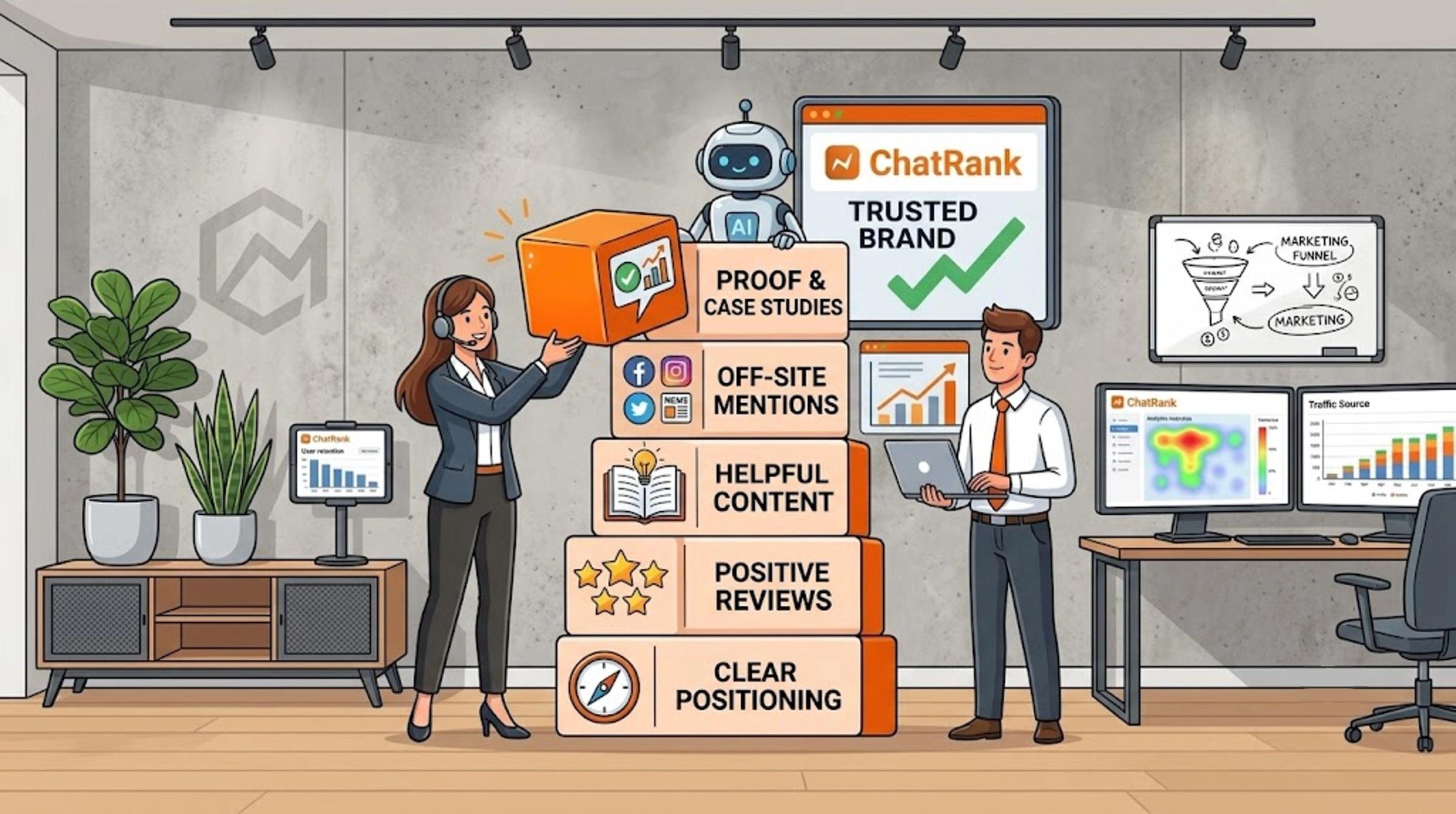
AI search does not work like a polite little directory.
It does not simply list every brand in your category, give everyone a fair turn, and hope the user makes the right decision. When someone asks ChatGPT, Google AI Overviews, Gemini, Perplexity, or another AI-powered search tool for a recommendation, the tool has to make choices.
Which brands should it mention? Which sources should it trust? Which companies seem relevant, credible, and specific enough to include?
Which ones are too vague, too thin, too inconsistent, or too invisible to confidently recommend? That is the part many businesses miss.
AI search visibility is not only about whether your website exists. It is about whether your brand gives AI tools enough clear, consistent, trustworthy information to understand who you are, what you do, who you serve, and why you belong in the answer.
That does not mean you need to become a technical GEO expert. It does mean your brand needs to be easier to understand and easier to trust online. Here is what that actually looks like.
AI Tools Need a Clear Picture of What Your Brand Does
Start with the obvious problem that somehow still trips up half the internet: your brand needs to be clear.
Not clever. Not vague. Not “innovative solutions for modern teams.” Clear.
AI tools are trying to connect a user’s question with the most relevant answer. If your website, listings, reviews, and content do not make it obvious what you do, who you help, and where you fit, you are making that job harder.
A dental practice should make it clear whether it offers pediatric dentistry, emergency dental care, Invisalign, implants, cosmetic dentistry, or general family care. A local HVAC company should clearly explain whether it handles repairs, installation, maintenance, emergency callouts, commercial work, residential work, or all of the above. An ecommerce brand should explain what its products are, who they are for, and why someone would choose them instead of another option.
This is not just for customers. It is for the systems interpreting your brand.
A clear brand gives AI tools the basic building blocks they need:
- What the business offers
- Who it serves
- Where it operates
- What use cases it fits
- What category it belongs in
- What makes it different
If that information is scattered, buried, or described in generic language, the brand becomes harder to recommend.
The first step to building trust in AI search is not fancy. It is saying what you do like a normal person.
AI Tools Need Consistency Across Your Online Presence
A customer can sometimes tolerate a little brand inconsistency. AI tools are less forgiving.
If your homepage describes your business one way, your Google Business Profile describes it another way, your service pages use different language, your directory listings are outdated, and your reviews mostly talk about services your website barely mentions, that creates noise.
A human might be able to figure it out. An AI tool may not give you the benefit of the doubt.
Consistency helps reinforce what your brand should be known for. This matters because AI tools do not only look at one page in isolation. They may draw from several sources to understand whether your brand is relevant to a prompt.
For example, if you want to show up as a strong option for “best pediatric dentist for anxious children,” that idea should be supported in more than one place. Your website should explain how you support anxious children. Your service pages should make pediatric care clear. Your reviews should ideally mention patience, comfort, kindness, children, parents, or similar signals. Your directories should list the right services. Your FAQs should answer parent questions.
When those pieces line up, your brand becomes easier to understand. When they do not, you are asking AI tools to connect dots you have not bothered to connect yourself. That is risky.
AI Tools Need Specific Pages, Not Thin Mentions
A surprising number of businesses technically mention a service without properly explaining it.
They have a “Services” page with a list. They have a short paragraph under each heading. They have a few nice sentences about quality, care, and experience. And then they wonder why competitors with fuller, clearer pages show up more often.
A mention is not the same as coverage.
If a customer is asking a specific question, AI tools need specific information to work with. A thin page does not give enough context.
A strong service or product page should help explain:
- What the service or product is
- Who it is for
- When someone might need it
- What questions customers usually ask
- What makes your approach or product different
- What proof supports your claims
- What the next step looks like
This is especially important for brands with several services, products, locations, or customer types. If each page says almost the same thing with a different heading, that is not a content strategy. That is copy-paste in a trench coat.
AI tools need enough substance to understand where your brand fits. So do customers.
AI Tools Need Proof, Not Just Claims
Every brand says it is trusted. Every brand says it cares. Every brand says it offers high-quality service. Fine. Lovely. So does everyone else.
AI tools need more than claims. They need evidence that supports the version of your brand you want them to understand.
Proof can come from many places: reviews, case studies, customer stories, credentials, before-and-after examples, third-party mentions, product data, team experience, awards, certifications, process details, or specific outcomes.
The right proof depends on the business.
For a medical practice, proof might include provider credentials, patient reviews, specialties, years of experience, clear service explanations, and accurate FAQs. For a local service business, it might include emergency response details, service area coverage, review patterns, photos of work, and trade certifications. For an ecommerce brand, it might include product reviews, ingredient or material details, sizing guidance, testing information, use cases, and comparison content.
Proof helps AI tools understand why a brand deserves to be considered. It also helps avoid the biggest problem with generic content: it sounds right but says nothing.
If your content says your team is experienced, show what kind of experience. If you say your product works well for sensitive skin, explain why. If you say your practice is good with nervous children, describe what you actually do to make the visit easier.
The more specific the proof, the stronger the signal.
AI Tools Need Reviews That Support the Right Story
Reviews are not just nice little trust badges for humans. They are part of the public story of your brand.
When customers describe your business in their own words, they often reveal what your brand is actually known for. That can support your positioning, or it can expose a gap between what you say and what customers notice.
If you want to be known as a high-trust dental practice for families, reviews that mention children, comfort, patience, clear explanations, and friendly staff help support that story. If you want to be known as a fast emergency plumber, reviews that mention speed, responsiveness, after-hours service, and clear pricing matter. If you want your ecommerce product to be recommended for a specific use case, reviews should ideally describe that use case in real terms.
This does not mean coaching customers to write fake-perfect reviews. Please do not do that. The internet has suffered enough.
It means paying attention to whether your reviews reflect the services, strengths, and customer experiences you want to be known for.
A useful review profile should be:
- Recent
- Specific
- Consistent
- Relevant to your core services or products
- Aligned with your positioning
- Strong enough to support trust before someone clicks
If reviews are thin, outdated, vague, or focused on the wrong services, that can affect how confidently your brand is understood. Your reviews are not separate from AI visibility. They are part of the signal.
AI Tools Need Third-Party Mentions
Your own website will always be biased. That is not an insult. It is just how websites work. Of course your website thinks you are great. It is your website.
Third-party mentions help add outside context.
These might include directories, industry lists, local publications, review platforms, comparison sites, partner pages, Reddit threads, social conversations, forums, podcasts, YouTube videos, newsletters, or articles that mention your brand.
Off-site visibility matters because AI tools may use sources beyond your website to understand which brands are relevant and credible in a category. If your competitors are showing up on review platforms, comparison pages, local lists, and community conversations while your brand only exists on your own website, that is a visibility gap.
The goal is not to be everywhere. That is usually a waste of time and a fast way to make your team resent marketing.
The goal is to show up in the places that matter for your category.
For medical practices, that may include provider directories, review platforms, local listings, and insurance-related sources. For local service businesses, it may include Google Business Profile, Yelp, Angi, Nextdoor, local directories, and community mentions. For ecommerce brands, it may include product reviews, gift guides, marketplace pages, Reddit threads, influencer content, and comparison articles. For SaaS brands, it may include G2, Capterra, industry blogs, Reddit, LinkedIn, and competitor comparison content.
If AI tools are building answers from the open internet, your brand needs a footprint beyond your homepage.
AI Tools Need Helpful Content, Not Generic Content
Helpful content does not mean long content. It means content that answers a real question with enough specificity to be useful.
A 500-word page can be useful if it answers the question clearly. A 2,000-word article can be useless if it says the same five generic things every competitor says.
The best content for AI search usually does at least one of these things:
- Explains a service or product clearly
- Answers a specific customer question
- Compares options honestly
- Helps someone decide whether something is right for them
- Gives practical guidance
- Adds proof, examples, or real context
- Clarifies a common misunderstanding
- Shows why the brand is relevant to a specific use case
This is where a lot of AI-generated marketing goes wrong. It creates content that looks like content. It has headings. It has paragraphs. It has a tidy little conclusion. It may even sound polished.
But there is no real substance. No customer story. No tradeoff. No proof. No specific point of view. No detail that could only come from that business. AI search tools do not need more filler. Neither do customers.
If you want your brand to be trusted, your content needs to bring something useful to the internet. ChatRank’s approach is built around that idea: AI can help identify the opportunity, structure the work, and draft the piece, but the human needs to add the facts, stories, examples, and experience that make it worth publishing.
That is the difference between content and noise.
AI Tools Need FAQs That Match Real Buying Questions
FAQs can be extremely useful for AI search, but only when they answer the questions people actually ask.
A lot of FAQ sections are written like legal padding. They answer safe, obvious questions no one is really struggling with. Or they repeat the same basic information already on the page.
A better FAQ section closes the gap between what your business knows and what your customers are unsure about.
For a medical practice, that might include questions about appointment expectations, insurance, recovery time, who a treatment is right for, what to bring, or when to seek care. For a local service business, it might include questions about pricing, availability, emergency response, service areas, warranties, and what happens during a visit. For an ecommerce brand, it might include sizing, materials, returns, compatibility, ingredients, durability, and who the product is best for.
Good FAQs help AI tools connect your brand to specific prompts. They also help customers feel less confused before they take action.
The best source for FAQs is rarely a keyword tool. It is usually the people who talk to customers every day: front-desk staff, sales teams, support teams, providers, technicians, account managers, and founders.
They know what customers keep asking. That knowledge should not live only in someone’s head or inbox. It should be part of your content.
AI Tools Need Comparison Content
People do not only ask AI tools for definitions. They ask for help choosing. That means comparison content matters.
A customer might ask whether Invisalign or braces are better for their teenager. A homeowner might compare heat pumps and traditional HVAC systems. A founder might compare ChatRank and AirOps. A buyer might ask which product is better for sensitive skin, small teams, first-time users, tight budgets, or a specific use case.
If your brand never helps answer comparison questions, AI tools may rely on competitors or third-party sources to do that work for you. That is not ideal.
Comparison content does not need to be aggressive. In fact, it is usually better when it is honest. The goal is not to pretend your brand is the best choice for everyone. The goal is to explain fit.
Good comparison content helps answer:
- Who is each option best for?
- What are the tradeoffs?
- When does one option make more sense?
- What should buyers consider before choosing?
- Where does your brand fit?
- When might another option be better?
That kind of content builds trust because it respects the reader’s decision-making process.
It also gives AI tools clearer language around when your brand should be recommended.
AI Tools Need Your Brand to Stay Current
AI search visibility is not a one-time website update.
Things change. Competitors publish new content. Review patterns shift. New prompts become relevant. Customer questions evolve. Google and AI tools change how they surface answers. Your services, products, team, locations, pricing, and positioning may change too.
If your online presence does not keep up, your brand can slowly become less accurate, less relevant, or less competitive. This is why “set it and forget it” organic marketing is not enough anymore. You do not need to publish constantly for the sake of it. That is how teams end up with a bloated blog full of articles nobody asked for.
But you do need a regular way to monitor what is changing and decide what deserves attention next.
That might mean updating a thin service page, adding a new FAQ, responding to a relevant off-site conversation, collecting a better customer quote, improving a review profile, creating comparison content, refreshing a page, or clarifying messaging that has drifted.
Small, consistent improvements can matter. Especially when they are the right improvements.
AI Tools Need Clear Signals From More Than One Place
The brands that become easier to trust in AI search usually do not rely on one signal. They do not only have a website. They do not only have reviews. They do not only have blogs. They do not only have social mentions.
They build a clearer picture across multiple places.
That does not mean every brand needs a massive content operation. It means the important pieces should reinforce each other.
Your website should explain what you do. Your reviews should support the experience you claim to offer. Your service pages should answer real customer questions. Your third-party mentions should confirm you exist beyond your own website. Your FAQs should match actual buying concerns. Your comparison content should help users understand fit. Your off-site presence should reflect the conversations happening in your category.
Together, those signals help AI tools understand your brand with more confidence. That is what trust looks like online. Not one perfect page. A consistent pattern.
ChatRank Helps You See Which Signals Are Missing
Most lean teams cannot manually track all of this. They cannot spend every week checking prompts, competitors, reviews, service pages, Reddit threads, third-party mentions, content gaps, and AI answer changes. They have businesses to run. Customers to serve. Teams to manage. Emails to answer. Someone probably also has to fix the printer.
This is where ChatRank fits.
ChatRank helps brands and agencies understand where they stand in AI search, where competitors are showing up, and which opportunities deserve attention next. It is not only about website content. It looks at the broader organic picture: content gaps, competitor mentions, review opportunities, social and off-site conversations, brand alignment, and the prompts that matter.
The goal is not to hand a lean team a complicated dashboard and hope they magically become GEO experts.
The goal is to turn visibility gaps into clear tasks.
Maybe your service page needs more substance. Maybe your reviews are not supporting the story you want AI tools to understand. Maybe competitors are being mentioned in comparison content and you are not. Maybe there is a Reddit thread where your category is being discussed. Maybe your FAQs do not match how customers actually ask questions.
ChatRank helps surface those gaps and then asks for the human details AI cannot invent: customer stories, facts, examples, product nuance, quotes, and real business context.
That is how the work becomes manageable.
Trust Is Built Through Clarity, Proof, and Consistency
AI search can sound technical, and parts of it are. But the practical work of becoming more trustworthy in AI search is not mysterious.
Make your brand clear. Keep your information consistent. Build useful service and product pages. Answer real questions. Collect and use proof. Pay attention to reviews. Show up in the places your category cares about. Create content that helps people decide. Track where competitors are being recommended and where you are missing.
None of that is magic. It is just hard to do consistently when your team is already stretched.
That is why ChatRank exists. It helps you see how your brand appears in AI search, understand which signals may be missing, and turn those gaps into focused work your team can actually complete. Because AI tools do not trust brands because they say “trusted” on the homepage. They trust brands that are clear, consistent, useful, and backed by proof. Start there.



We’ve been using ChatRank for 34 days, and following their plan, we’ve actually grown over 30% in search visibility


ChatRank helped us go from zero visibility to ranking #2 in a core prompt for our business with only one new blog post!



My business has always come from word of mouth. Now people are actually finding me on ChatGPT!