What Is a ChatGPT Presence Tool and How Does It Work? The AI Discovery Gap: Why ChatGPT Is Now a Brand Visibility Problem
If ChatGPT is recommending specific brands in your category — but not yours — you have experienced the AI discovery gap firsthand. In 2026, discovery has shifted from a list of links to a series of authoritative AI answers. A #1 Google ranking no longer guarantees visibility in a ChatGPT or Gemini response, because those systems use fundamentally different criteria to select sources.

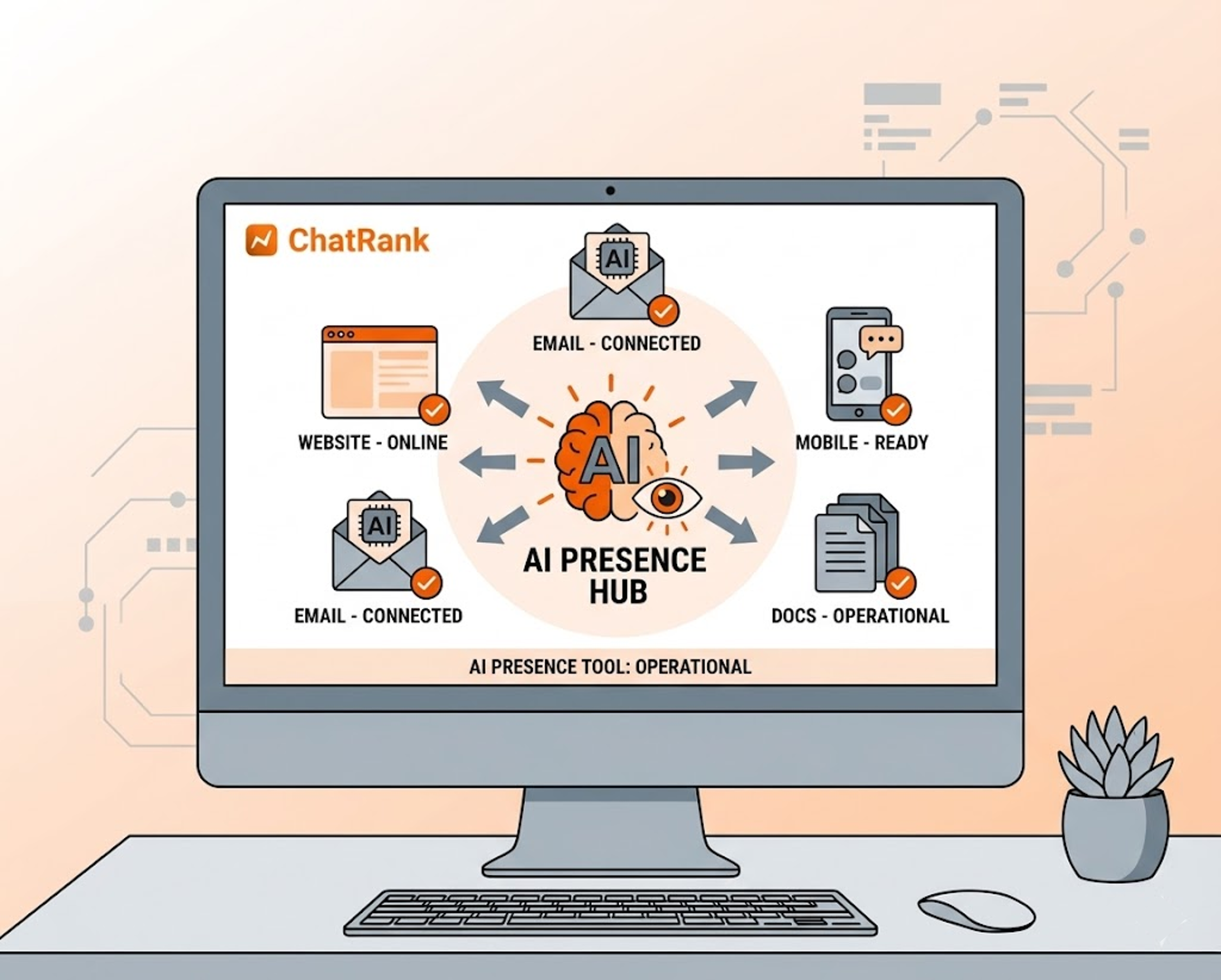
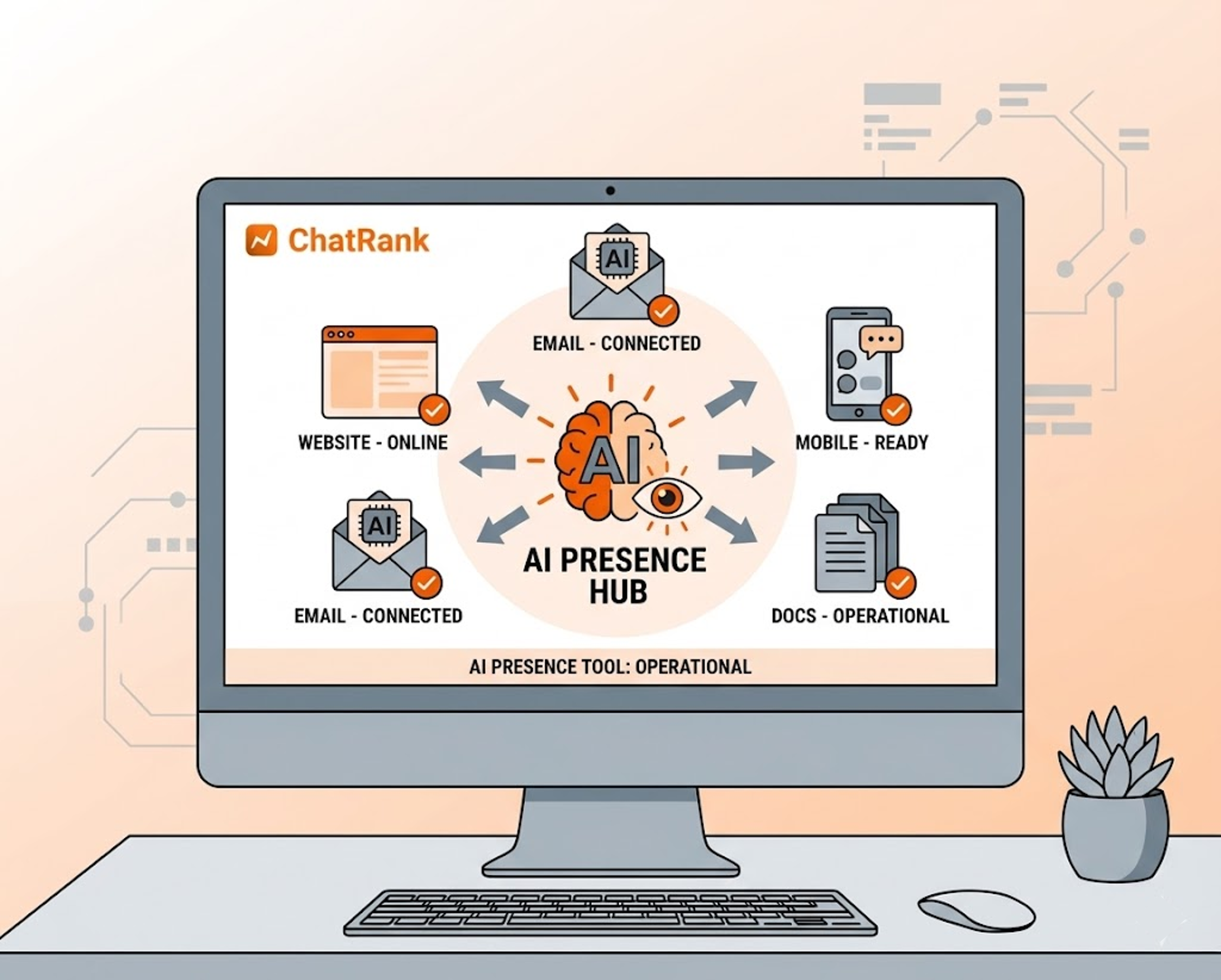
Adobe's 2025 survey of 1,000 U.S. consumers found that 24% now go to ChatGPT first when looking for information, with 77% of ChatGPT users having used it as a search engine. This shift has created a new discipline, Answer Engine Optimization (AEO), and a new category of software: ChatGPT presence tools.
What Is a ChatGPT Presence Tool?
A ChatGPT presence tool is software that monitors and optimizes how frequently and accurately your brand is cited in AI-generated responses. Unlike legacy SEO platforms that focus on keyword rankings, these tools measure Share of Answer (also called AI Visibility Score), across the major AI platforms.
Think of it as a diagnostic report card for your brand across the key AI systems: ChatGPT, Perplexity, Google AI Overviews, Claude, and Gemini. These tools simulate real customer intent to determine whether your brand is being recommended, ignored, or misrepresented by AI models across your most important query categories.
Why AI Visibility Is the Core KPI of 2026
The data points that frame this urgency are verified and well-sourced:
- ChatGPT scale: ChatGPT reached 900 million weekly active users as of February 2026, according to OpenAI — processing over 2.5 billion prompts per day.
- AI Overview growth: Google AI Overviews now appear in approximately 25% of U.S. searches, based on Conductor's 2026 benchmark of 21.9 million queries.
- Zero-click dominance: When an AI Overview is present, 83% of queries end without any click to an external website (Bain & Company / Dynata, December 2024). The citation is the brand exposure.
- Conversion advantage: AI-driven visitors convert at 4.4x the rate of standard organic visitors (Semrush, 2025), because AI pre-qualifies user intent before the visit occurs.
How These Tools Work: A 5-Step Process
Platforms like ChatRank follow a systematic process to audit and improve a brand's AI standing.
Step 1: Automated Query Simulation
The tool generates 25–50 "seed prompts" based on the specific conversational patterns of your ideal customer. Instead of a generic search like "CRM software," it simulates questions like "Which CRM is best for a small nonprofit that needs predictable fees and built-in donor management?"
Step 2: Cross-Platform Testing
The prompts are run simultaneously across multiple AI models. This is essential because AI models have different training data and citation preferences. Research shows that only 11% of domains cited in ChatGPT also appear as top results in Google Search for the same query — and citation overlap between different AI platforms is similarly low.
Step 3: Calculating the Visibility Score
The tool calculates your Visibility Score — the percentage of AI-generated answers that mention your brand. If your brand appears in 10 out of 50 tested prompts, your score is 20%. This baseline score establishes a measurable starting point for optimization.
Step 4: Competitive Gap Analysis
The platform identifies which competitors are appearing in prompt responses where your brand is absent. This reveals exactly what content signals, external validation sources, or structural elements the competitor is providing that your brand is not.
Step 5: Actionable AEO Optimization
The tool guides the creation of AI-citable content, content structured specifically so that AI models select your brand as a trusted source. This involves both technical structure improvements and substantive writing quality upgrades.
How to Build a Content Strategy That AI Can Use
AI systems do not "read" your website in the way a human does, they scan for discrete, independently answerable chunks of information. To appear as a source, content must shift from "bloggy" narrative writing to structured "reference" writing.
Structure Your Data for Extraction
- Lead with the answer: Place the direct response to a section's heading in the first sentence. Content that buries the answer three paragraphs in will not be selected for AI citation.
- One idea per block: Each H2 or H3 section should answer one specific question. Multi-topic sections create extraction ambiguity.
- Use clean HTML: AI crawlers prioritize content in semantic HTML (
<h1>,<ul>,<table>,<article>). Content loaded via JavaScript or rendered client-side is frequently missed.
Eliminate Content Fillers
To be "citation-ready," content must be stripped of narrative detours. Phrases like "In today's fast-paced digital landscape" or "As we navigate an ever-changing world" add zero informational value and reduce citation density. Every sentence must earn its place by adding a verifiable fact, a specific claim, or a concrete next step.
External Validation: The New Citation Currency
On-site optimization is necessary but not sufficient. AI models look for external validation — public signals from trusted third parties that confirm your brand is relevant and credible. This mirrors how traditional SEO valued backlinks, but the specific platforms that matter for AI citation are different.
- Wikipedia: Consistently the most cited domain in ChatGPT responses. A factual, non-promotional Wikipedia entry is one of the highest-leverage AEO investments a brand can make.
- G2: Among the top-cited domains in ChatGPT for B2B software categories. AI models consult review platforms when users ask for "best" or "top-rated" recommendations in a category.
- Reddit and Quora: Community-validated, non-promotional discussions on these platforms are heavily weighted by Perplexity AI and frequently cited in ChatGPT responses for practical advice queries.
- Original proprietary data: Publishing original research (surveys, case studies with verifiable results, or industry benchmarks), is the fastest path to becoming a primary source that other sites, and AI systems, quote.
Who Needs an AI Presence Tool?
While AI visibility monitoring benefits virtually any professional or organization with a digital presence, certain use cases are particularly high-priority:
- SEO professionals: Transitioning from traditional keyword-rank tracking to GEO (Generative Engine Optimization) requires different measurement tools and content frameworks.
- Marketing teams: Demonstrating ROI from AI channels requires dedicated attribution tools, since AI-driven traffic is frequently misattributed as "direct" in standard analytics.
- B2B SaaS companies: Software categories are among the most heavily cited in AI recommendation queries. If competitors are being recommended by ChatGPT and you are not, the competitive impact is immediate and significant.
- Content strategists: AI presence tools identify high-impact questions your audience is asking AI systems that your content currently does not answer — a direct signal for content creation priorities.
Frequently Asked Questions
What is the difference between a ChatGPT presence tool and a traditional SEO tool?
Traditional SEO tools measure keyword rankings and backlink profiles in Google and Bing. ChatGPT presence tools measure citation frequency, sentiment, and positioning within AI-generated responses across ChatGPT, Perplexity, Gemini, and other LLM platforms. The underlying data sources, measurement methods, and optimization tactics are fundamentally different.
Is a high Google ranking sufficient for AI visibility?
No. Only 11% of domains cited in ChatGPT are shared with Google Search results for the same query. Strong SEO provides domain authority that LLMs use as a trust signal, but content must also be structurally optimized for AI extraction to be consistently cited.
How do brands get cited on Wikipedia for AI purposes?
Brands cannot directly create or edit their own Wikipedia pages without risking removal for conflict of interest. The path to Wikipedia presence is through building genuine notability, media coverage, industry recognition, published research, and third-party sources that independently document the brand's significance. Once that external record exists, a factual Wikipedia entry can be created or expanded.
The Bottom Line: From Search to Answers
In 2026, being findable is not enough. You must be citable. Traditional SEO earns you a position in a list of links. AEO earns you a citation as the actual answer.
By using a ChatGPT presence tool like ChatRank, your brand stops guessing how AI perceives it and gains the data needed to move from background result to cited source. The brands that win this era are those that start optimizing for the answer engine today, not after their competitors have already established the citation footprint.



We’ve been using ChatRank for 34 days, and following their plan, we’ve actually grown over 30% in search visibility


ChatRank helped us go from zero visibility to ranking #2 in a core prompt for our business with only one new blog post!



My business has always come from word of mouth. Now people are actually finding me on ChatGPT!