What Is Generative Engine Optimization (GEO) and Why Every Brand Needs It in 2026
This post breaks down what GEO is, why it matters, and how forward-thinking brands are already using tools like ChatRank to get ahead.

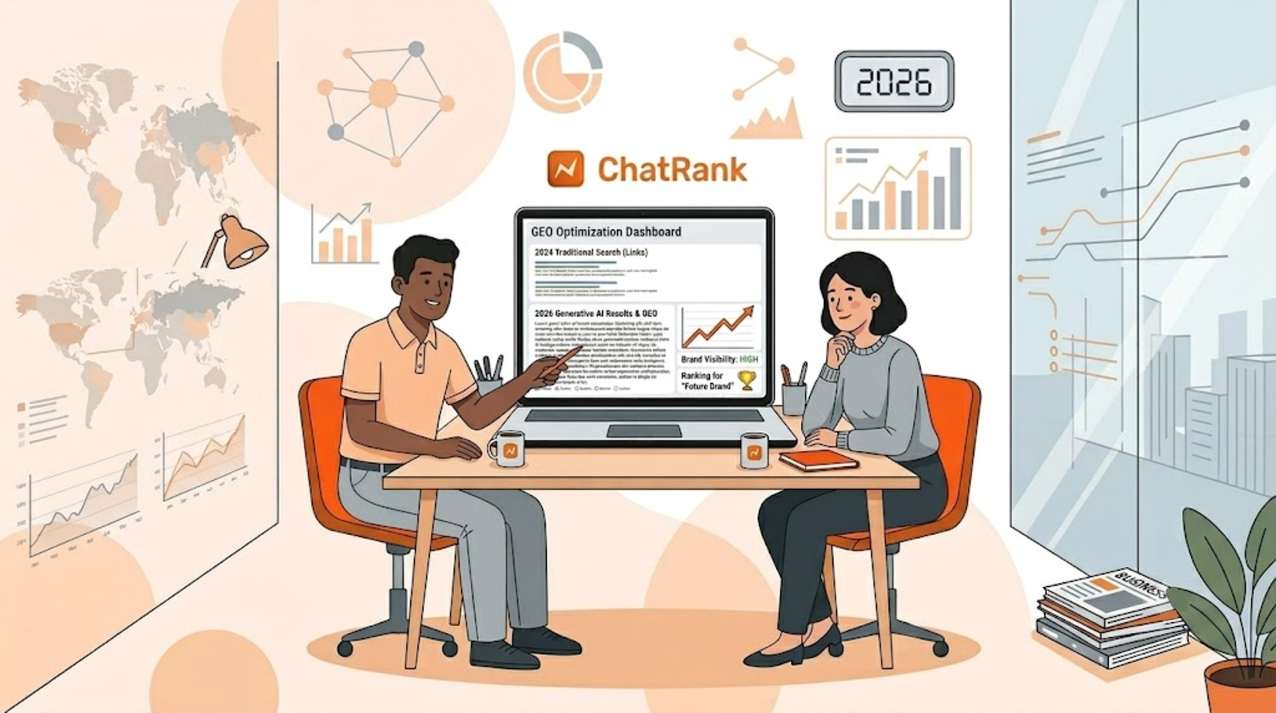
What Is Generative Engine Optimization (GEO) and Why Every Brand Needs It in 2026
Search is no longer just about ranking on page one.
In 2026, the most valuable real estate on the internet isn't a blue link, it's a citation inside an AI-generated answer. A new discipline called Generative Engine Optimization (GEO) has emerged to help brands earn that visibility, and understanding it is now table stakes for any marketing team serious about growth.
What Is Generative Engine Optimization (GEO)?
Generative Engine Optimization is the practice of structuring, writing, and distributing content so that AI-powered search engines — like ChatGPT, Google AI Overviews, and Perplexity — surface your brand, products, or expertise in their generated responses.
The term was formalized in a landmark 2023 paper from researchers at Princeton University, Georgia Tech, The Allen Institute for AI, and IIT Delhi titled "GEO: Generative Engine Optimization."defined GEO as optimizing content "to maximize its likelihood of being cited by generative engines" — a fundamentally different goal from traditional SEO.
Where SEO is about signals (backlinks, keyword density, crawlability, page speed, and domain authority), GEO is about answer-worthiness
AI models don't return a list of ten blue links for a user to evaluate. They synthesize information from across the web and deliver a single, confident answer. To be part of that answer, your content must be perceived by the model as:
- Authoritative — from a trusted, credentialed source
- Accurate — factually correct and verifiable
- Well-structured — easy for a model to parse and excerpt
- Directly relevant — matched precisely to the intent of the query
The key differences at a glance:
| Dimension | Traditional SEO | Generative Engine Optimization (GEO) |
|---|---|---|
| Goal | Rank on page one of SERPs | Be cited in AI-generated answers |
| Optimization Target | Search engine crawlers & algorithms | Large language models (LLMs) & retrieval systems |
| Key Signals | Backlinks, keywords, page speed, domain authority | Authority, content clarity, structure, external citations |
| Output | A ranked URL in a list of results | A referenced brand, fact, or recommendation in an AI answer |
| Measurement | Rankings, organic clicks, impressions | AI mention rate, citation frequency, share of voice |
GEO does not replace SEO — it extends it. But it requires a distinct mindset, distinct tactics, and distinct measurement.
The Rise of AI-Powered Search: A Fundamental Shift in How People Find Information
The numbers tell a clear story. Google confirmed that AI Overviews — the AI-generated summaries that appear at the top of search results — reached over 1.5 billion users per month across more than 100 countries as of early 2025, up from its initial rollout in May 2024. That means the majority of Google searches now begin with an AI-generated response before a single blue link is clicked.
Meanwhile, ChatGPT crossed 400 million weekly active users 2025, according to OpenAI, and a growing share of those users are turning to it specifically as a search replacement, not just a chat tool. ChatGPT's integration with Bing-powered web search, and the launch of features like ChatGPT Search, have made it a direct competitor to Google for informational queries.Perplexity AI, which positions itself explicitly as an "answer engine," reported over 15 million active users by late 2024 and has attracted significant enterprise adoption, particularly among researchers and professionals who want sourced, synthesized answers rather than a list of linkThe pattern across all three platforms is the same: users are asking questions and expecting complete answers, not a set of results to sift through. That behavioral shift is what makes GEO so urgent. If your brand isn't cited in those answers, you effectively don't exist for that query — no matter how well you rank in traditional search.
How AI Models Select and Surface Brand Content
Understanding how generative engines decide what to include in their answers is central to GEO. While the exact mechanisms vary by platform, several consistent principles apply across the major AI search systems.
1. Retrieval-Augmented Generation (RAG)
Most AI search tools today use a technique called Retrieval-Augmented Generation, where the model queries a live index of web content before generating a response. The retrieved sources act as evidence the model weaves into its answer. If your content is in that retrieved set, you have a chance of being cited. If it's not — because your site isn't indexed, isn't crawlable, or isn't deemed relevant — you're invisible.
2. Authority and Trust Signals
AI models are trained to favor content from sources perceived as credible. This includes established publications, sources with strong backlink profiles, content with named authors and credentials, and sites that are frequently referenced by other trusted sources. Expertise, Authoritativeness, and Trustworthiness (E-E-A-T) (the framework Google uses in its human quality rater guidelines), is effectively a proxy for how AI models also evaluate source quality.
3. Structured, Scannable Content
The Princeton GEO research found that specific content interventions meaningfully increased citation rates. Content that included statistics, cited authoritative sources, used clear headings, and adopted a fluent, quotable writing style was significantly more likely to be surfaced in AI-generated responses. In some tested strategies, citation rates improved by up to 40% over unoptimized content.
4. Brand Mentions Across the Web
AI models don't just look at your website in isolation. They aggregate signals from across the open web — review sites, media coverage, social discussions, forums, podcasts, and third-party publications. A brand that is consistently mentioned and cited across diverse, authoritative sources is far more likely to appear in AI-generated answers than one whose presence is limited to its own domain.
Why GEO Is Now a Business-Critical Discipline
The business case for GEO in 2026 is straightforward: if you're not optimizing for AI-generated answers, you are ceding high-intent, zero-click query territory to your competitors.
Consider the implications for a brand in any competitive category. When a prospective customer asks:
- "What's the best project management software for remote teams?"
- "What CRM should a growing startup use?"
- "Which brand is best for [your category]?"
…the AI's answer will reference a small handful of brands. Those brands get the awareness, the authority signal, and often, the click. The brands that aren't mentioned get nothing.
This is especially high-stakes because AI-generated answers now appear before organic results in a significant and growing share of Google queries. Independent studies, including research from Semrush, estimate that AI Overviews are present in approximately 15–25% of Google searches as of late 2025 — and that share skews heavily toward high-intent, informational queries where purchase decisions are made. Users increasingly trust and act on those answers without scrolling further, meaning that even at 15–25% query coverage, the business impact is disproportionately large. AI visibility and traditional click traffic are now deeply intertwined — optimizing for one without the other leaves significant brand exposure on the table.
Beyond customer acquisition, GEO matters for brand reputation. AI models don't just surface brands — they describe them.
What an AI says about your brand, your product, your values, or your category positioning is now a form of public perception. Brands that don't actively manage their AI presence risk being described:
- Inaccurately — with outdated or incorrect information
- Incompletely — missing key differentiators or strengths
- Not at all — invisible in the answers their prospects rely on
GEO is also increasingly relevant for B2B and enterprise brands. When procurement teams, executives, or consultants use AI tools to evaluate vendors, they rely on synthesized answers, not a list of links to sift through. The brands that show up consistently in those answers are the ones that get on the shortlist.
How ChatRank Helps Brands Monitor and Win in AI Search
Knowing GEO matters is one thing. Executing it — and measuring whether it's working — is another. This is where ChatRank comes in.
ChatRank is purpose-built for the GEO era.
The platform allows brands to monitor exactly how they appear (or don't appear), across AI-powered search engines, including ChatGPT, Google AI Overviews, and Perplexity. Rather than guessing whether your content is being cited in AI-generated answers, ChatRank gives you the data.
With ChatRank, brands can:
- Track AI mention frequency — understand how often your brand appears in AI-generated answers across target queries and topic areas
- Benchmark against competitors — see which competing brands are being surfaced in AI answers where you're not, and identify the content and authority gaps driving those outcomes
- Monitor AI share of voice — measure your brand's presence within AI-generated results over time and tie changes to specific content or PR initiatives
- Identify optimization opportunities — surface the specific queries where you're invisible to AI engines and prioritize content investments accordingly
- Measure GEO campaign performance — connect your content and digital PR efforts to measurable improvements in AI citation rates
In a discipline where the signals are new, the platforms are evolving rapidly, and the stakes are high, having a dedicated monitoring and optimization layer is not optional — it's foundational.
Think of ChatRank as what rank trackers were to SEO in the early 2010s: the essential infrastructure for knowing where you stand, understanding why, and making informed decisions about what to do next.
The Bottom Line: GEO Is the New SEO — and the Time to Act Is Now
Generative Engine Optimization is not a future trend. It is a present reality. More than 1.5 billion people are exposed to Google's AI Overview feature every month, and while independent studies estimate AI Overviews appear on roughly 15–25% of searches today, that figure is concentrated in exactly the high-intent, decision-stage queries that matter most to brands. Hundreds of millions more are asking ChatGPT and Perplexity questions your brand should be answering. The brands that understand how AI models select and surface content — and invest in optimizing for that — will build durable, compounding visibility in the channels where attention is already flowing.
The brands that wait will find themselves explaining to stakeholders why they're invisible in the search experiences their customers use most.
Ready to find out how your brand shows up in AI search — and what to do about it?
Start monitoring your AI search visibility with ChatRank at chatrank.ai



We’ve been using ChatRank for 34 days, and following their plan, we’ve actually grown over 30% in search visibility


ChatRank helped us go from zero visibility to ranking #2 in a core prompt for our business with only one new blog post!


My business has always come from word of mouth. Now people are actually finding me on ChatGPT!