6 Key Metrics for Tracking GEO Performance
Traditional SEO metrics—keyword rankings, click-through rates, organic traffic—were built for a world that no longer exists as the primary search experience. Today, over 65% of informational queries are resolved inside AI-generated answers on platforms like ChatGPT, Google AI Overviews, and Perplexity, often without a single click to your website. That means the dashboard you've been relying on is quietly lying to you. Not through bad data—through missing data.

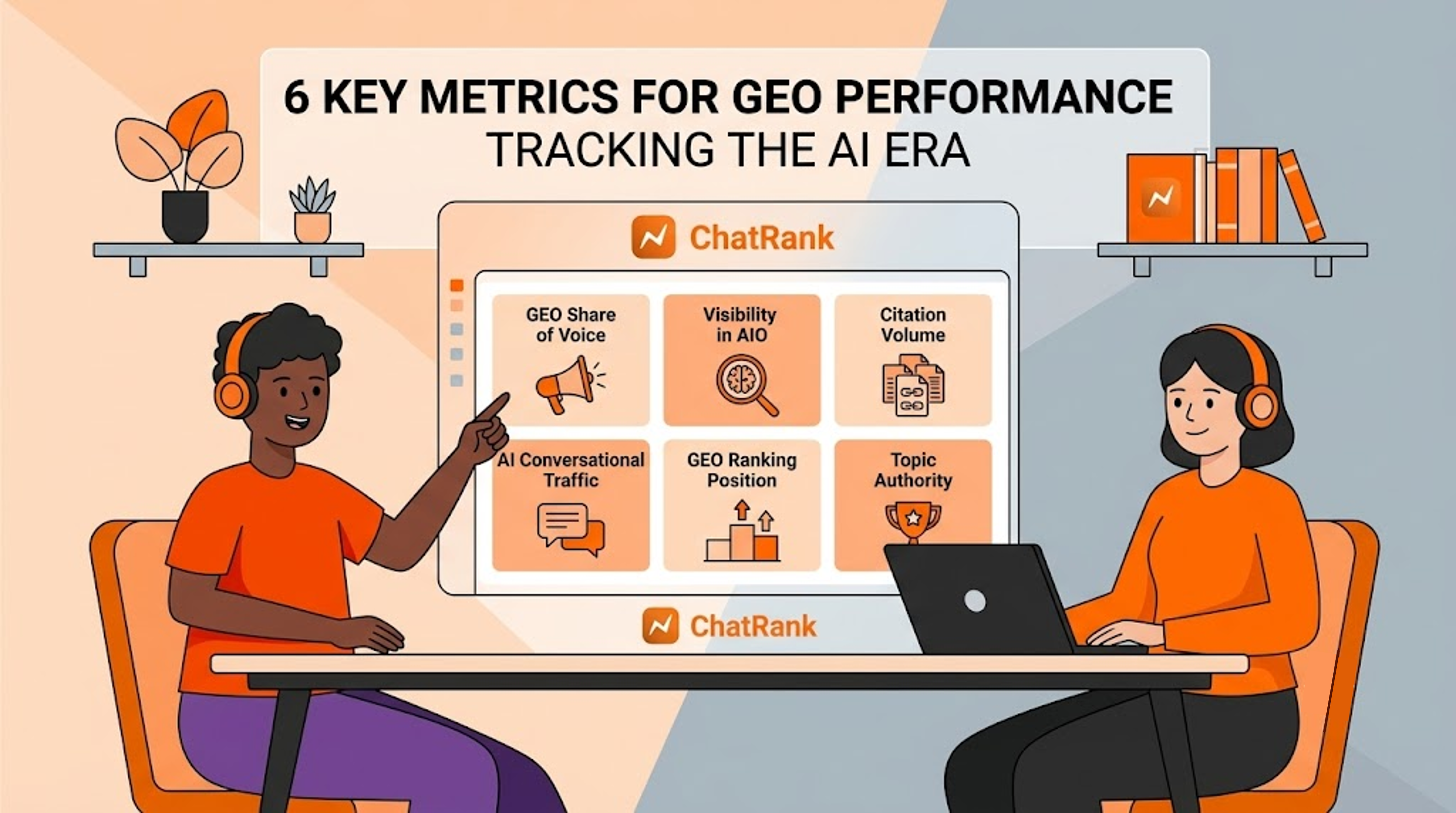
6 Key Metrics for Tracking GEO Performance
Generative Engine Optimization (GEO) requires a new measurement framework: one that tracks influence, authority, and citation frequency inside AI-generated responses, not just rankings on a page. Below are the six core metrics every brand and marketing team should be monitoring—along with exactly how to measure each one, which tools to use, and how to roll it all into a simple monthly reporting workflow.
Metric 1: Visibility Score
What It Is
Your Visibility Score is the percentage of relevant AI-generated answers that mention your brand. Think of it as your "share of the answer box." If you run 50 test prompts related to your industry and your brand appears in 15 of them, your Visibility Score is 30%.
This metric replaces the old concept of "ranking #1" because in AI search, there is no single position—there is presence or absence.
How to Measure It
- Define a prompt matrix of 30–50 questions your target audience would realistically ask AI tools. Include category queries ("best [your product category]"), comparison queries ("X vs. Y"), and pain-point queries ("how do I solve [specific problem]").
- Run those prompts across the major AI engines: ChatGPT, Google AI Mode/Overviews, Perplexity, Gemini, and Claude.
- Record whether your brand is mentioned in each response. Divide the number of mentions by the total prompts to get your score.
- Track it over time—month-over-month trend matters more than any single snapshot.
Tools to Use
ChatRank automates this entire process, monitoring your brand's visibility score across multiple AI engines simultaneously and surfacing exactly which prompts you're winning—and which you're missing. Rather than spending hours on manual spot-checks that yield inconsistent results, ChatRank gives you a centralized, reliable score you can actually report on. Users have seen visibility score improvements of 15–30% within the first month of following ChatRank's recommendations.
Metric 2: Citation Frequency
What It Is
Citation Frequency measures how often your website is explicitly linked or cited as a source in an AI-generated answer. This goes one step beyond a brand mention—it tracks whether the AI is using your content as the authoritative reference for its response.
Being the first cited source in a Perplexity answer or a Google AI Overview is the modern equivalent of ranking #1. It signals that the AI trusts your content enough to point users directly to it.
How to Measure It
Using the same prompt matrix from your Visibility Score work:
- Check which sources are linked below or within each AI response.
- Record every instance where your domain is cited.
- Apply the formula: Citation Frequency = (Answers citing your domain ÷ Total answers tracked) × 100
- A starting benchmark to aim for: 10%+ citation frequency for your most important topic clusters.
Note that citation position also matters. Being cited first (e.g., source [1] in a Perplexity response) generates meaningfully more click-through than appearing fifth.
Tools to Use
ChatRank's automated mentions tracking monitors your citation presence across AI engines and flags which content is being pulled as a source—so you can double down on what's working and fix what isn't. For supplementary manual checks, you can also search key prompts directly in Perplexity, which consistently displays inline source links, making citation tracking straightforward.
Metric 3: Sentiment & Tone
What It Is
Not all mentions are equal. A brand can appear in 80% of AI responses and still be losing ground if the AI consistently frames competitors more favorably. Sentiment and Tone tracking measures the quality of how AI engines describe your brand when they do mention it.
Are you being cited as "the best option for teams that need X"? Or are you being mentioned as a generic afterthought? Is the AI associating your brand with the specific strengths and use cases you want to own?
How to Measure It
When reviewing AI responses during your prompt matrix testing:
- Note the context in which your brand is mentioned. Is it a primary recommendation or a secondary mention?
- Identify the attributes the AI associates with your brand (e.g., "affordable," "enterprise-grade," "easy to use").
- Flag any negative or limiting framing (e.g., "best for beginners only," "limited features").
- Compare your framing to competitors in the same responses.
Over time, look for shifts—positive or negative—in how AI engines characterize your brand as your content strategy evolves.
Tools to Use
ChatRank is purpose-built for this layer of analysis, going beyond simple presence detection to monitor sentiment and tone in AI-generated answers. This is a key differentiator from basic rank-checkers: knowing how you're mentioned is just as important as knowing that you're mentioned. Armed with this data, your team can create content that reinforces the brand narrative you want AI engines to adopt.
Metric 4: Share of Voice (AI SOV)
What It Is
AI Share of Voice (SOV) measures how often your brand is mentioned relative to your competitors across a defined set of industry prompts. It's the AI-era equivalent of traditional SOV—but instead of measuring ad spend or search rankings, you're measuring citation dominance in AI-generated answers.
If five brands are regularly mentioned in responses to your category prompts and your brand appears in 40% of those mentions while your top competitor appears in 35%, you hold the stronger AI SOV position.
How to Measure It
- Run your prompt matrix across AI engines, as described above.
- Record every brand mentioned in each response—not just your own.
- Calculate your brand's share: (Your brand's total mentions ÷ All brand mentions across all responses) × 100.
- Map competitor SOV to understand where you're leading, where you're tied, and where you have ground to gain.
- Segment by topic cluster—you may dominate in one category and be invisible in another.
Tools to Use
ChatRank provides competitive benchmarking data that surfaces your AI SOV relative to key competitors across multiple engines and topic sets. This turns a time-consuming manual audit into an automated, ongoing report. For teams using Ahrefs, their Brand Radar feature offers supplementary SOV data, though it's primarily built for traditional web mentions rather than real-time LLM responses.
Metric 5: AI Referral Traffic (via GA4)
What It Is
While much of GEO's value is in zero-click influence (building brand trust before a user ever visits your site), AI platforms do send measurable referral traffic—and that traffic converts at remarkably high rates. Research shows ChatGPT referral visitors convert at up to 15.9%, compared to roughly 1.76% for Google organic search.
GA4 doesn't track AI traffic by default. It gets scattered across "Referral," "Direct," and "Unassigned" channels, making it effectively invisible without custom configuration.
How to Measure It
Step 1: Create a custom AI Channel Group in GA4
- Go to Admin → Data Display → Channel Groups
- Create a new group called "AI Traffic"
- Add a channel definition using this regex pattern for the Source field:
chatgpt\.com|chat\.openai\.com|perplexity\.ai|claude\.ai|gemini\.google\.com|copilot\.microsoft\.com
- Save and drag the AI channel above Referral in the priority order.
Step 2: Build an Exploration Report
- Go to Explore → Free-form exploration
- Set dimensions to Session Source and Landing Page
- Add metrics: Sessions, Engaged Sessions, Conversions, Engagement Rate
- Apply a filter for your AI sources
Step 3: Analyze what you find
- Which pages are being cited by AI tools?
- How does AI traffic conversion rate compare to organic?
- Which platforms (ChatGPT vs. Perplexity vs. Gemini) send the best quality traffic?
Keep in mind that a significant portion of AI traffic still arrives as "Direct" due to mobile app referrals and privacy-related header stripping—so your measured AI traffic is almost certainly an undercount of actual AI-influenced visits.
Tools to Use
ChatRank's Google Analytics integration connects your AI visibility data with your actual traffic and conversion performance, giving you a complete picture in one place—rather than context-switching between a GEO monitoring tool and GA4. For setting up custom GA4 channel groups, the configurations above are sufficient to get started immediately.
Metric 6: HDYHAU Mentions
What It Is
HDYHAU—"How Did You Hear About Us?"—is your most direct, human-verified signal that AI search is actually influencing purchasing decisions. While every other metric on this list is tracked programmatically, HDYHAU captures real attribution from real customers in their own words.
When someone checks "ChatGPT recommended you" or writes "I found you through an AI search" in your post-purchase survey, that's a ground-truth data point no algorithm can replicate. As AI referral traffic grows, HDYHAU mentions of AI tools are becoming an increasingly important signal in the marketing attribution stack.
How to Measure It
- Add AI-specific options to your HDYHAU survey—if your current survey doesn't include "ChatGPT," "Perplexity," "Google AI," or a general "AI tool/chatbot" option, add them now.
- Deploy the survey post-purchase or post-signup for the highest response rates (30%+ vs. under 5% on homepages).
- Include an open-text follow-up for any "Other" or "AI" response to capture specifics ("Which AI tool?").
- Track month-over-month the percentage of new customers attributing their discovery to AI.
- Cross-reference with your GA4 AI traffic data—a growing gap between HDYHAU AI mentions and measurable GA4 AI referrals signals more zero-click influence, where the AI shaped the decision but the customer arrived through a direct visit.
Tools to Use
Platforms like Fairing, Okendo Surveys, or Typeform are well-suited for HDYHAU deployment. For brands using ChatRank, pairing HDYHAU data with ChatRank's visibility and sentiment monitoring creates a powerful closed loop: you can see when your AI visibility improves and then confirm whether that improvement is actually translating into real customer attribution.
Building a Simple Monthly GEO Reporting Workflow
Tracking these six metrics doesn't require a full-time analyst. Here's a lean monthly workflow that any marketing team can implement:
Week 1: Automated Monitoring Refresh
- Review ChatRank's updated Visibility Score and Citation Frequency data for the prior month.
- Note any significant changes in Sentiment/Tone or Share of Voice compared to the previous month.
- Flag any new competitors entering your top prompt results.
Week 2: GA4 AI Traffic Review
- Pull your AI Referral Traffic report from your custom GA4 channel group.
- Compare AI traffic conversion rate vs. organic search conversion rate.
- Identify which landing pages are receiving the most AI-referred traffic.
- Note any pages receiving AI traffic that lack a clear call-to-action—these are priority optimization targets.
Week 3: HDYHAU Data Review
- Compile HDYHAU responses from the prior month.
- Calculate the percentage of new customers attributing discovery to any AI tool.
- Identify any AI tools mentioned that aren't being tracked in your GA4 setup.
Week 4: Synthesize & Act
- Combine all six metrics into a single monthly GEO scorecard.
- Identify the one or two content gaps or optimization opportunities with the highest potential impact.
- Assign specific content or technical tasks to address them before next month's review.
A simple monthly GEO scorecard might look like this:
| Metric | This Month | Last Month | Trend |
|---|---|---|---|
| Visibility Score | 34% | 28% | Increase |
| Citation Frequency | 12% | 9% | Increase |
| Sentiment (Primary attribute cited) | "Best for X" | "Affordable" | Improved |
| AI Share of Voice | 31% | 27% | Increase |
| AI Referral Sessions (GA4) | 412 | 318 | Increase |
| HDYHAU AI Mentions | 8% of new customers | 5% | Increase |
The Bottom Line
The brands that will dominate AI search over the next several years aren't the ones waiting until AI traffic becomes the majority of their sessions. They're the ones building measurement systems now—while the data is still clean enough to act on—and using those insights to shape content strategy before competitors are even paying attention.
The six metrics above give you everything you need to move from guessing to knowing: whether your GEO efforts are working, which content is being cited, how AI is describing your brand, and whether that visibility is translating into real customer acquisition.
ChatRank makes this entire framework executable from a single platform—combining automated visibility monitoring, sentiment and citation tracking, GA4 integration, and actionable content recommendations so your team can focus on improving your AI presence, not just measuring it.



We’ve been using ChatRank for 34 days, and following their plan, we’ve actually grown over 30% in search visibility


ChatRank helped us go from zero visibility to ranking #2 in a core prompt for our business with only one new blog post!


My business has always come from word of mouth. Now people are actually finding me on ChatGPT!