How AI Models Like ChatGPT, Perplexity, and Gemini Actually Choose Their Sources
You typed a question into ChatGPT or Perplexity. Seconds later, you got a polished answer with a handful of sources cited underneath. Ever wondered why those specific websites made the cut — and yours didn't? It's not random. And it's not purely about who ranks highest on Google.

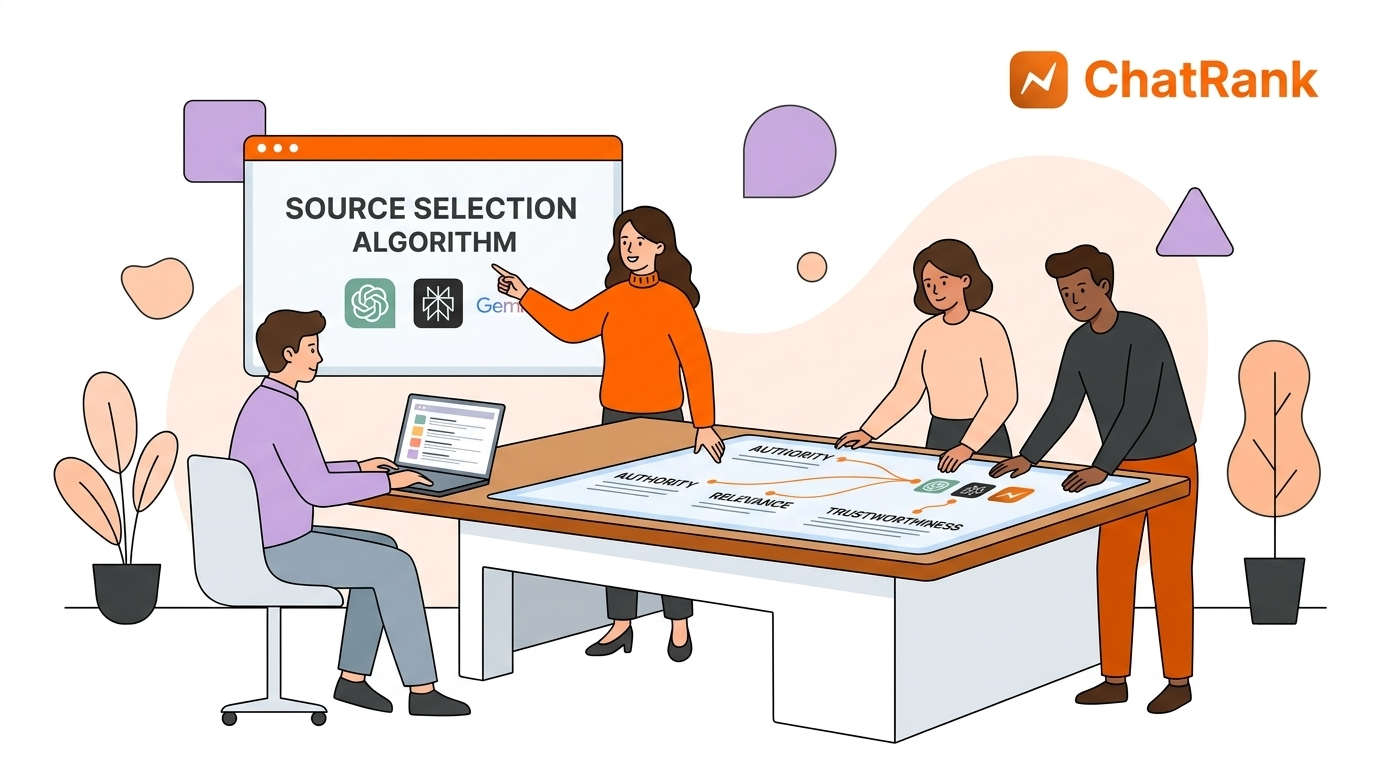
How AI Models Like ChatGPT, Perplexity, and Gemini Actually Choose Their Sources
AI models follow a set of surprisingly consistent signals when deciding which content to pull into their answers. Once you understand those signals, you can start doing something about them. And once you act, you'll want a way to know whether it's working — which is exactly where ChatRank comes in.
Let's walk through the five biggest factors, one at a time.
1. Entity Recognition: Does the AI Know Who You Are?
What it means
Before an AI model can cite you, it has to know you exist as a recognizable thing in the world — not just as a URL, but as an entity: a brand, a person, a product, an organization.
AI systems use a process called Named Entity Recognition (NER) to scan content and identify real-world things. They then connect those mentions to a knowledge base — Google's Knowledge Graph, Wikidata, Wikipedia — to confirm what that thing is. If your brand is well-represented there, the AI can cite you with confidence. If you're ambiguous or inconsistent, it'll skip you.
Think of it like showing your ID at the door. If your name is spelled three different ways across your website, LinkedIn, Google Business Profile, and industry directories, the AI bouncer gets confused and moves on.
A plain-language example
Say your company is called "Apex Digital." If your website says "Apex Digital," your LinkedIn says "Apex Digital LLC," your Google Business Profile says "Apex Digital Marketing," and your Crunchbase says "ApexDigital" — those four mentions might not resolve to the same entity in an AI model's view. You've essentially shown up with four different IDs.
What you can do right now
Standardize your entity information everywhere. Your company name, description, and category should be word-for-word identical across your website, LinkedIn, Google Business Profile, Crunchbase, and any industry directories you're listed in. Add Organization schema markup to your website with sameAs links pointing to your authoritative profiles. If your brand meets notability criteria, a Wikidata entry is one of the strongest entity signals available.
How ChatRank helps you measure it
Once you've cleaned up your entity signals, you need to know if AI models are actually recognizing you correctly. ChatRank's monitoring tracks how AI tools are describing and citing your brand — so you can see in plain language whether the AI's picture of you matches reality, and catch misrepresentations before they compound.
2. RAG vs. Training Data: Where Is the AI Getting Its Information?
What it means
Not all AI answers work the same way under the hood. Understanding the difference determines your strategy.
Training data is what the AI baked into its memory during training. ChatGPT, for example, was trained on a massive snapshot of the web. If your brand was well-represented in that snapshot, you might get mentioned even without a live search — but you can't easily update this, and it has a knowledge cutoff date.
Retrieval-Augmented Generation (RAG) is different. Instead of relying on memory, the AI does a live web search at query time, pulls in the most relevant pages, reads them, and uses that content to build its answer — with citations. Perplexity does this for every single query. ChatGPT does it when web search is enabled (roughly 46% of the time). Gemini draws from Google's live index.
RAG is where most of the optimization opportunity lives, because it responds to changes you make right now.
A plain-language example
Imagine a customer asks ChatGPT: "What's the best tool for tracking AI brand mentions?"
If ChatGPT has web search on, it fires a live query, retrieves recent pages that cover AI monitoring tools, skims them, and synthesizes an answer. The pages that get pulled in and cited are the ones that best answer the question clearly, recently, and with authority. If your page is slow, buried, outdated, or blocked by bots, it doesn't even make the candidate pool.
What you can do right now
Make sure AI crawlers can actually find you. Check your robots.txt to confirm you're not accidentally blocking OAI-SearchBot (ChatGPT), PerplexityBot, ClaudeBot, or Googlebot. Ensure your most important content is in the server-rendered HTML — not loaded exclusively via JavaScript — so AI crawlers can read it. Submit an updated XML sitemap.
How ChatRank helps you measure it
ChatRank monitors your brand's visibility across the major AI tools, so you can see not just if you're being cited but which AI tools are citing you and for which topics. Since each model (ChatGPT, Perplexity, Gemini) uses different retrieval approaches, this cross-platform view is invaluable for knowing where your content is landing.
3. Authority Signals: Does the AI Trust You?
What it means
AI models don't evaluate each page in a vacuum. They look at the broader web footprint surrounding your brand — third-party mentions, reviews, links, community discussions — to decide whether you're a trustworthy source or a wildcard.
This is the AI equivalent of E-E-A-T (Experience, Expertise, Authoritativeness, Trustworthiness), and it works differently from traditional SEO:
- 85% of brand citations in AI responses come from third-party pages, not from your own website (AirOps research).
- Domains with strong profiles on review platforms like G2, Trustpilot, or Capterra are 3x more likely to be cited by ChatGPT than those without (Previsible, 2025).
- Brands with active Reddit and Quora presence show roughly 4x higher citation rates in AI search.
- Branded mentions across the web — even without a hyperlink — contribute to the AI's picture of your authority.
Domain-level backlinks still matter, but they're one signal among many. A site with 300 referring domains that's actively discussed in the right forums can outperform a high-DA site that exists only on its own island.
A plain-language example
Two competing SaaS tools both publish solid blog posts on the same topic. Tool A has a clean website but almost no third-party footprint. Tool B has good content plus genuine reviews on G2, a few Reddit threads where users discuss it, a mention in a relevant industry newsletter, and a quoted expert on their team.
When an AI synthesizes an answer, it's much more likely to cite Tool B — not because its page is necessarily better, but because the broader web confirms it's a legitimate, trusted player.
What you can do right now
Build your third-party authority deliberately. Get listed on relevant review platforms (G2, Capterra, Trustpilot). Pursue earned media in industry publications — even a single well-placed quote or mention adds to your entity footprint. Encourage genuine community engagement on Reddit and LinkedIn around topics where you have expertise. Make sure your authors have visible bylines with credentials, not just a generic "Admin" tag.
How ChatRank helps you measure it
After building up these authority signals, you need to know if they're shifting the needle. ChatRank's monitoring shows your brand's share of voice across AI tools — how often you're being recommended versus competitors — so you can track whether your PR and community efforts are translating into actual AI visibility gains.
4. Content Structure: Can the AI Actually Extract Your Answer?
What it means
AI models don't read your content the way a human does. They scan for passages they can extract, verify, and cite with confidence. Content that's organized for extraction gets cited. Content that buries the answer in a wall of text gets ignored — no matter how good the underlying information is.
Here's what the research shows:
- 44% of all AI citations pull from the first 30% of a piece of content (Growth Memo / Kevin Indig, 2026). If your answer isn't near the top, it likely won't be found.
- BLUF (Bottom Line Up Front) formatted content receives 3–4x more AI citations than traditionally structured content (Mention Network research, 50,000+ content pieces).
- FAQ sections with 40–75 word answers are highly extractable because they mirror the question-answer pattern AI models use.
- Tables increase citation rates by 2.5x compared to prose for comparative data.
- Named, attributed statistics ("According to a 2025 Gartner report...") are dramatically more citable than vague claims ("studies suggest..."). Adding statistics improves AI visibility by up to 22% (Princeton/Georgia Tech GEO study, ACM SIGKDD, 2025).
A plain-language example
Here's an unoptimized opening for a section on content marketing:
"When thinking about how to approach your content strategy, there are several factors to consider. The landscape has evolved significantly..."
Here's the same section, optimized for AI extraction:
"Answer-first formatting increases AI citation rates by 3–4x. AI models extract the first one or two sentences after each heading. If your answer is buried after setup paragraphs, it falls outside the model's extraction window."
The second version can be lifted, quoted, and cited. The first one can't.
What you can do right now
Restructure your most important pages for extraction. Apply these changes:
- Put the core answer or claim in the first sentence after every heading.
- Break dense paragraphs into short, focused blocks of 40–60 words where possible.
- Add a FAQ section at the bottom of key pages, with direct 2–4 sentence answers.
- Replace "studies show" with "According to [Source Name], [Year], [specific figure]."
- Use tables for comparisons and lists for step-by-step processes.
How ChatRank helps you measure it
ChatRank provides content recommendations specifically optimized for AI visibility — showing you exactly which content changes are most likely to improve how your brand appears in AI answers. After making structural changes, its monitoring lets you track whether your citation rate actually improved, so you're not guessing.
5. Freshness: Is Your Content Still Current?
What it means
AI models — especially those using live retrieval like Perplexity — heavily weight recency. This isn't a minor bonus. For Perplexity, freshness accounts for approximately 40% of the ranking signal, and 50% of its citations come from content published in 2025 (PromptAlpha research). Across AI platforms, 76.4% of the most-cited pages were updated within the last 30 days (Digitaloft research).
ChatGPT's 2026 algorithm updates introduced citation velocity as a factor, meaning brands with infrequent recent mentions are actively deprioritized. The message is clear: old content, untouched pages, and stale statistics are a liability in AI search — even if they still rank fine in traditional Google results.
The good news: freshness doesn't require complete rewrites. Updating three to five statistics with current-year data, adding a paragraph addressing a recent development, and refreshing your schema dateModified timestamp is often enough to signal that a page is alive and current.
A plain-language example
You wrote a great guide on email marketing benchmarks in 2022. It's still ranking on page one of Google. But when a user asks Perplexity for email marketing benchmarks today, Perplexity sees that your page hasn't been touched in three years — and it reaches right past you for a competitor who published updated data last month.
Same content quality. Different freshness signal. Completely different AI outcome.
What you can do right now
Establish a content refresh calendar. Identify your top 10–15 most important pages and schedule quarterly reviews. At each review: update statistics with current-year sources, add a short paragraph on any relevant recent developments, and refresh the page's dateModified metadata. For fast-moving topics, monthly updates are worth the investment.
How ChatRank helps you measure it
Freshness improvements should produce faster citation boosts than almost any other optimization — especially on Perplexity, which retrieves live. ChatRank's monitoring gives you a continuous pulse on your AI visibility, so you can see within weeks whether refreshing content is actually driving more citations, and prioritize accordingly.
Putting It All Together: The AI Citation Checklist
Here's a quick-reference summary of the five factors and your action items:
| Factor | What AI Rewards | Your Action |
|---|---|---|
| Entity Recognition | Clear, consistent brand identity across the web | Standardize your name/description everywhere; add schema markup with sameAs links |
| RAG Accessibility | Content AI crawlers can actually find and read | Unblock AI crawlers in robots.txt; ensure key content is server-rendered |
| Authority Signals | Third-party validation: reviews, mentions, community | Get on G2/Trustpilot; earn media mentions; build authentic community presence |
| Content Structure | Direct answers near the top; extractable passages | Use BLUF formatting; add FAQs; replace vague claims with named statistics |
| Freshness | Recently updated, actively maintained content | Refresh key pages quarterly; update stats; touch dateModified metadata |
The Missing Piece: Knowing If Your Efforts Are Working
Here's the uncomfortable truth about AI visibility: you can do everything right and still not know if it's working — because AI-generated answers are non-deterministic. Your citation rate can shift 40–60% between months without a single change to your content, driven by model updates, competitor activity, or retrieval changes.
Manual spot-checking (running queries in Perplexity once in a while) gives you a blurry, inconsistent picture. You need systematic, ongoing monitoring across the AI tools your audience actually uses.
That's what ChatRank is built for.
ChatRank tracks your brand's visibility across ChatGPT, Perplexity, Gemini, and Google AI Overviews — consistently, across the topics that matter to your business. You'll see:
- Where you're being cited (and where you're not)
- How your AI share of voice compares to competitors
- Which content changes moved the needle and which didn't
- Actionable recommendations for what to fix next
For agencies, ChatRank makes it easy to manage visibility across multiple client brands and present the kind of AI search reporting that clients increasingly expect — and that closes deals.
Over 34 days using ChatRank's plan, one user grew their AI search visibility by over 30%. The strategy works. But only if you can measure it.
Frequently Asked Questions
Does my Google ranking affect whether AI tools cite me?
Partially. Google rank correlates with domain authority, which is a signal AI systems use — but only weakly. Research shows that 80% of sources cited by AI platforms don't appear in Google's top results at all, and only 12% of AI-cited sources overlap with Google's top 10 rankings for the same query (Ahrefs, 2026). AI tools evaluate extractability, freshness, and authority independently of where a page ranks.
Is optimization different for ChatGPT vs. Perplexity vs. Gemini?
Yes — and this is important. Only 11% of domains are cited by both ChatGPT and Perplexity (Previsible, 2025). Each platform uses different retrieval logic. Perplexity runs a live web search for every single query and heavily weights freshness. ChatGPT blends training data with selective web search and cites Wikipedia far more often. Gemini draws from Google's own index. A cross-platform monitoring tool like ChatRank is essential for seeing where you stand on each.
How quickly will I see results after making these changes?
Freshness improvements on Perplexity can show results within days, since it retrieves live. ChatGPT's search index typically updates within days to weeks. Structural content changes (FAQs, BLUF formatting) tend to produce citation rate improvements faster than authority-building efforts, which compound over months.
Can a small brand compete with big ones in AI search?
Yes — this is one of the most exciting aspects of GEO. AI tools evaluate topical authority, not just domain size. A niche brand that publishes 10 well-structured, deeply authoritative articles on a specific topic can consistently outperform a large brand with scattered, generic coverage. You don't need to be the biggest. You need to be the clearest, most authoritative source on your specific corner of the world.
Ready to see where your brand stands in AI search right now? Start monitoring with ChatRank



We’ve been using ChatRank for 34 days, and following their plan, we’ve actually grown over 30% in search visibility


ChatRank helped us go from zero visibility to ranking #2 in a core prompt for our business with only one new blog post!


My business has always come from word of mouth. Now people are actually finding me on ChatGPT!