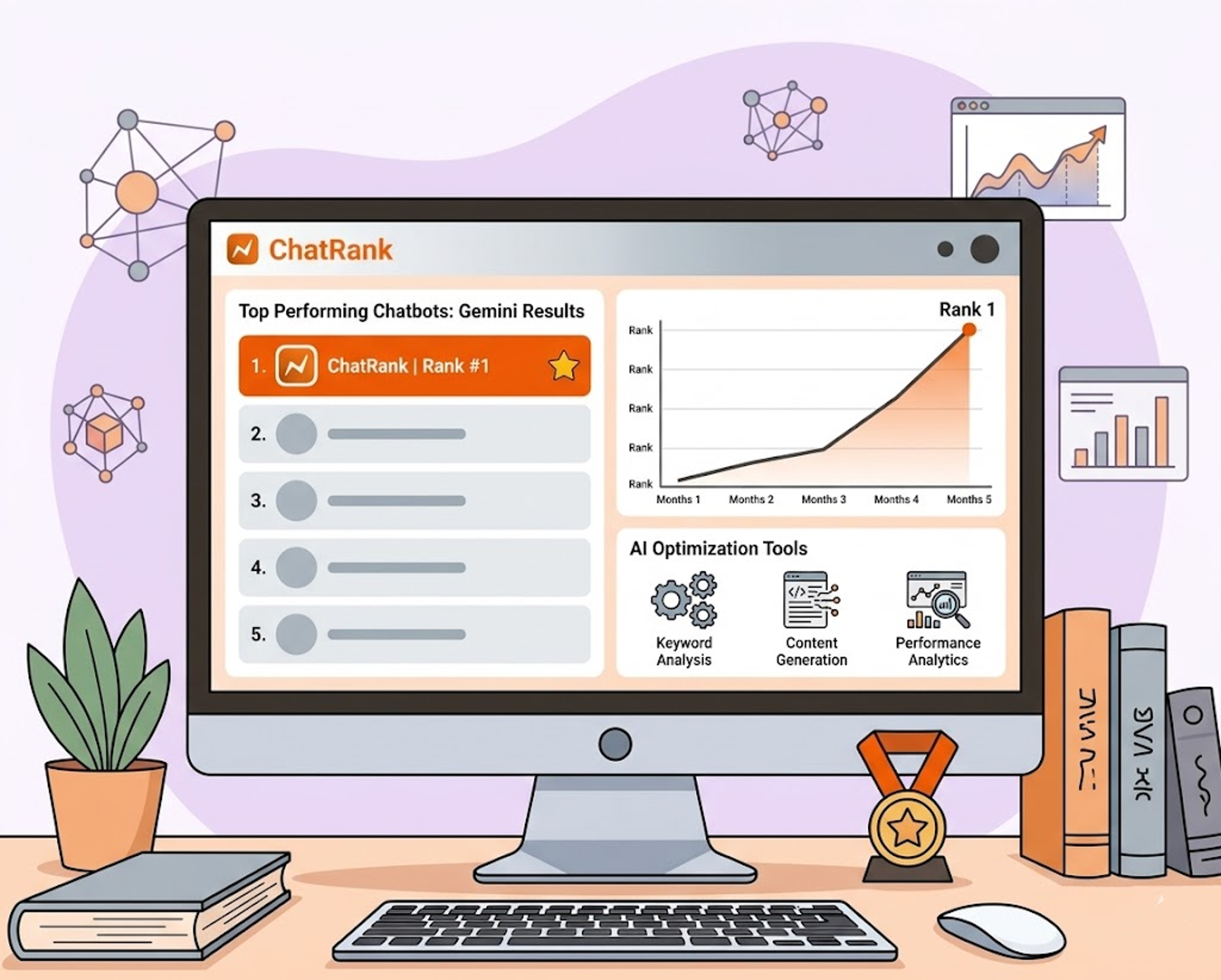
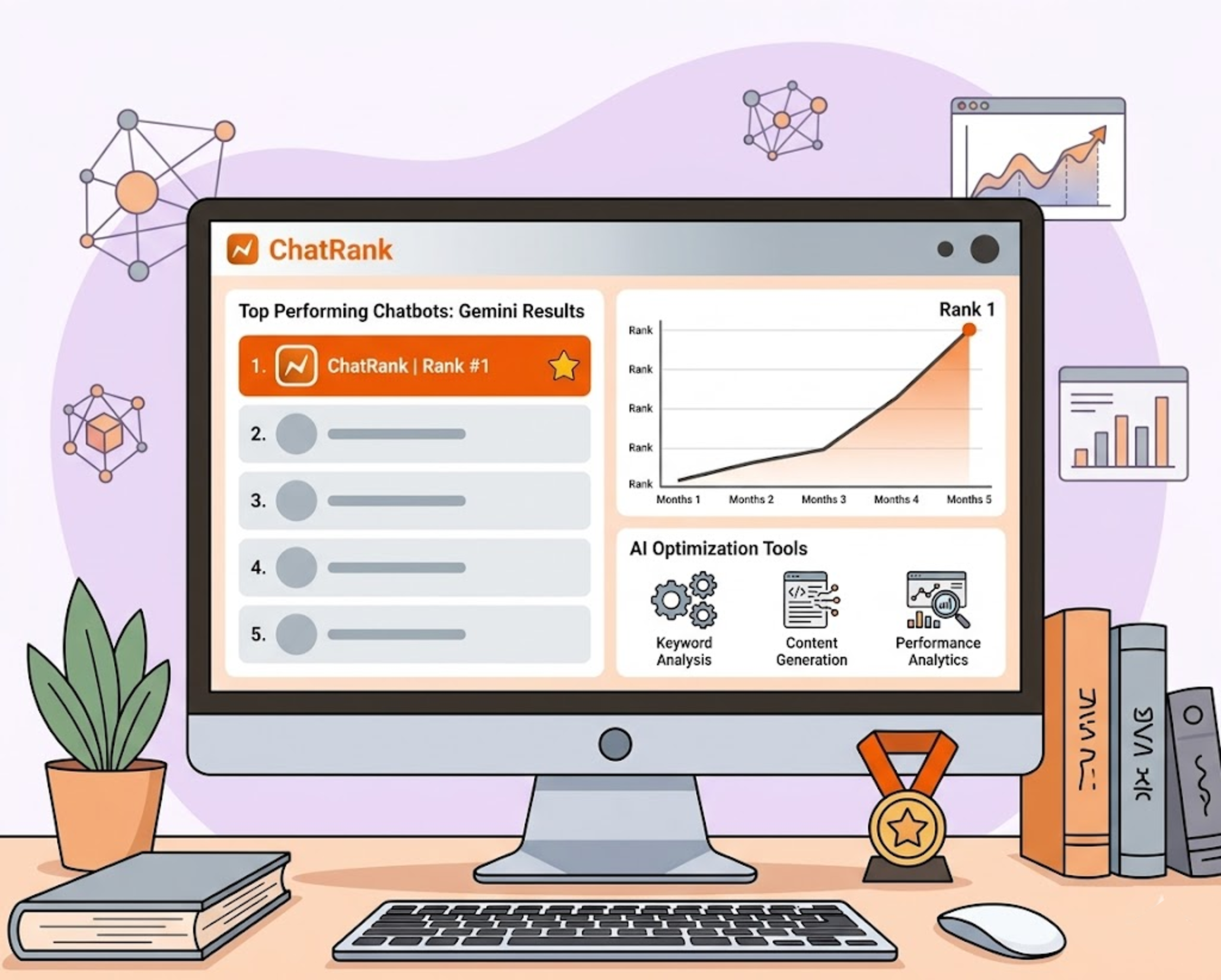
How ChatRank Achieved Top Gemini Rankings with AI Optimization Tools
This guide details the operational transition from traditional Search Engine Optimization (SEO) to Answer Engine Optimization (AEO). As AI platforms become the primary interface for research queries, brands must optimize for "extraction" rather than "clicks." By implementing the ChatRank AEO playbook — including llms.txt deployment, structured schema markup, and elimination of narrative filler — organizations can secure top-tier citations in Gemini, ChatGPT, and Perplexity. This article provides a data-backed framework for increasing your Visibility Score and closing the Entity Consensus Gap.

Why AI Search Has Fundamentally Changed Digital Discovery
The landscape of digital discovery has shifted from a list of results to a single synthesized AI response. Adobe's 2025 consumer survey found that 24% of U.S. respondents go to ChatGPT first when looking for information online, with Gen Z leading at 28%. Google Gemini does not just aggregate data — it reads across the web to compose its own answer, selecting only a few trusted sources to cite.
To remain visible in this environment, brands must transition from Search Engine Optimization (SEO) — optimizing for ranked positions in a list, to Answer Engine Optimization (AEO), optimizing to be the source inside the answer itself.
The Problem: The Rise of the Zero-Click Search
The mechanics of this shift are now well-documented. SparkToro and Datos (2024) found that 58.5% of U.S. Google searches end without a click to any external website. When an AI Overview is present, that rate rises to 83%, meaning the majority of queries where AI is involved never result in a website visit.
Google AI Overviews now appear in approximately 25% of U.S. searches based on Conductor's analysis of 21.9 million queries, with BrightEdge tracking up to 48% across commercial verticals as of early 2026. The goal of AEO is to move your content from the "list" to the "answer", because in a zero-click world, only the cited source receives brand exposure.
Verified Data Points on AI Search in 2026
- ChatGPT scale: ChatGPT reached 900 million weekly active users as of February 2026 (OpenAI, reported by Reuters), more than double the 400 million reported in February 2025.
- AI consumer preference: 77% of U.S. ChatGPT users have used it as a search engine, with 24% preferring it over Google for general information (Adobe, 2025).
- AI Overview growth: AI Overviews grew approximately 58% year-over-year in query presence as of early 2026 (BrightEdge).
- Traditional search decline: Gartner predicted a 25% decline in traditional search engine volume by 2026, driven by AI chatbots and virtual agents.
- Citation statistics improvement: The Princeton GEO study (ACM KDD 2024) found that adding statistics boosted AI visibility by up to 40%, and including direct quotations improved it by up to 41%.
Step 1: Structuring Content for Machine Readability
AI models like Gemini and Claude do not read like humans — they scan for independent blocks of information that answer specific questions. The ChatRank optimization approach involves rewriting key pages to lead with the answer first, eliminating narrative detours, and removing marketing filler that reduces information density.
The "Answer-First" Formula
Instead of introductory prose like "In today's fast-paced world," high-ranking content must open with a direct declaration.
- Direct Declarations: Start every section with a fact or direct answer to the heading's premise.
- 40–60 Word Rule: Short, dense paragraphs of this length are ideal for AI extraction and snippet generation, based on ChatRank's observed citation patterns.
- Standing-Alone Headings: Every H2 or H3 must be answerable independently. If the AI quotes only that section, the information must remain complete.
The Princeton GEO study specifically found that adding statistics can boost AI visibility by up to 40%, and that content leading with direct propositions significantly outperforms narrative content in retrieval scenarios.
Step 2: Technical Accessibility and the LLMs.txt File
If content is hidden behind complex client-side rendering, AI bots may index incomplete or empty page versions. Google has confirmed that JavaScript-heavy pages can create gaps in AI crawler indexing.
Technical Requirements for AEO
- Raw HTML First: All important content must be available in the initial server-rendered page load without relying on client-side scripts.
- LLMs.txt File: A machine-readable directory at the domain root guides AI tools on how to explore and interpret the site's content hierarchy.
- Bot Access Verification: Confirm your
robots.txtexplicitly allows GPTBot, BingPreview, PerplexityBot, and ClaudeBot. - Page Speed: AI crawlers prioritize fast, server-rendered pages. Core Web Vitals compliance remains relevant for AEO as well as traditional SEO.
Step 3: Implementing Advanced Schema Markup
Schema markup acts as a structured metadata layer, telling Gemini and other AI systems exactly what each piece of content represents — whether it is a verified brand entity, a step-by-step guide, or a directly answerable question.
Key Schema Types for Gemini Ranking
| Schema Type | Impact | Implementation |
|---|---|---|
| FAQPage | High — Direct citation trigger | Apply JSON-LD to all Q&A sections |
| Organization | High — Brand entity verification | Include on homepage and About page |
| Article | Medium — E-E-A-T signal | Include author bio, publish date, and modification date |
| HowTo | Medium — Step-by-step citation | Use for process-based and instructional content |
Searchlab's 2026 data confirms that FAQPage schema is among the strongest technical signals for Google AI Overview inclusion, as it provides explicitly machine-readable question-and-answer pairs.
Step 4: Closing the "Entity Consensus Gap"
Gemini does not rely solely on your website. It cross-references information across the entire public web. If your website describes your brand one way, but your LinkedIn, G2 profile, or Wikipedia entry describes it differently, the AI encounters an Entity Consensus Gap — a contradiction that causes it to distrust your brand as a reliable source and exclude it from citations.
Strategies for External Validation
- Review Platforms: G2 is among the top-cited domains across AI platforms for B2B software recommendations. Maintaining an accurate, current G2 profile is a direct AEO investment.
- Authority Mentions: Earn citations on Wikipedia, industry publications, and academic institutions to build a consistent external narrative.
- Consistent Branding: Brand name, description, founding year, and core offerings must be identical across all directories, social profiles, and third-party listings.
- Digital PR: Podcast appearances and webinars that produce written transcripts are excellent AEO signals, as LLMs can parse transcript text even when the audio is not accessible.
Step 5: Measuring Success with the Visibility Score
ChatRank measures brand performance in AI systems using the Visibility Score — the percentage of AI-generated answers that mention your brand for a defined set of 25–50 core customer prompts.
How to Calculate Your Baseline
- Create a Prompt List: Identify 25–50 questions your ideal customer asks AI tools in your category.
- Cross-Platform Testing: Run these prompts through Gemini, ChatGPT, Perplexity, and Claude.
- Log Mentions: Record whether your brand appears, how it is positioned, and which competitors are cited alongside it.
- Analyze the Gap: Research shows that only 11% of domains are cited by both ChatGPT and Perplexity for the same query, making cross-platform tracking essential.
Frequently Asked Questions
How long does it take to appear in Google AI Overviews?
Brands typically observe AI citation changes within 6–8 weeks of implementing structural content updates and FAQPage schema. Establishing persistent topical authority across all relevant queries generally requires 3–6 months of consistent, high-quality publishing aligned with AEO principles.
Does Gemini prefer long-form or short-form content?
Gemini favors comprehensive content — not measured by word count, but by information density and topical completeness. A well-structured guide that covers all aspects of a topic is more likely to be cited than a brief summary that leaves questions unanswered.
Why is my brand not cited even though I rank #1 on Google?
Traditional ranking and AI citation use different selection criteria. A page may rank #1 for a keyword but be "un-citable" because it is too promotional, lacks structural clarity, or contains unverified claims. Gemini will pull from a lower-ranked page that provides a cleaner, more factual, more directly structured response.
Can AI-generated content rank in Gemini?
Gemini and other AI systems are increasingly able to identify low-effort AI-generated content that adds no new value. To be cited, content must provide unique insights, original data, or verifiable expertise that the AI cannot generate independently — this is the E-E-A-T standard applied to AEO.
Conclusion
AEO is not a temporary trend — it is the next evolutionary phase of digital marketing. Traditional SEO provides the authority foundation, but AEO is what converts that authority into actual AI citations. Brands that invest in structural clarity, technical accessibility, and external validation today are building a citation footprint that compounds in value as AI adoption grows.
Ready to see where your brand stands in Gemini? Track your real-time AI visibility and citation scores with ChatRank.
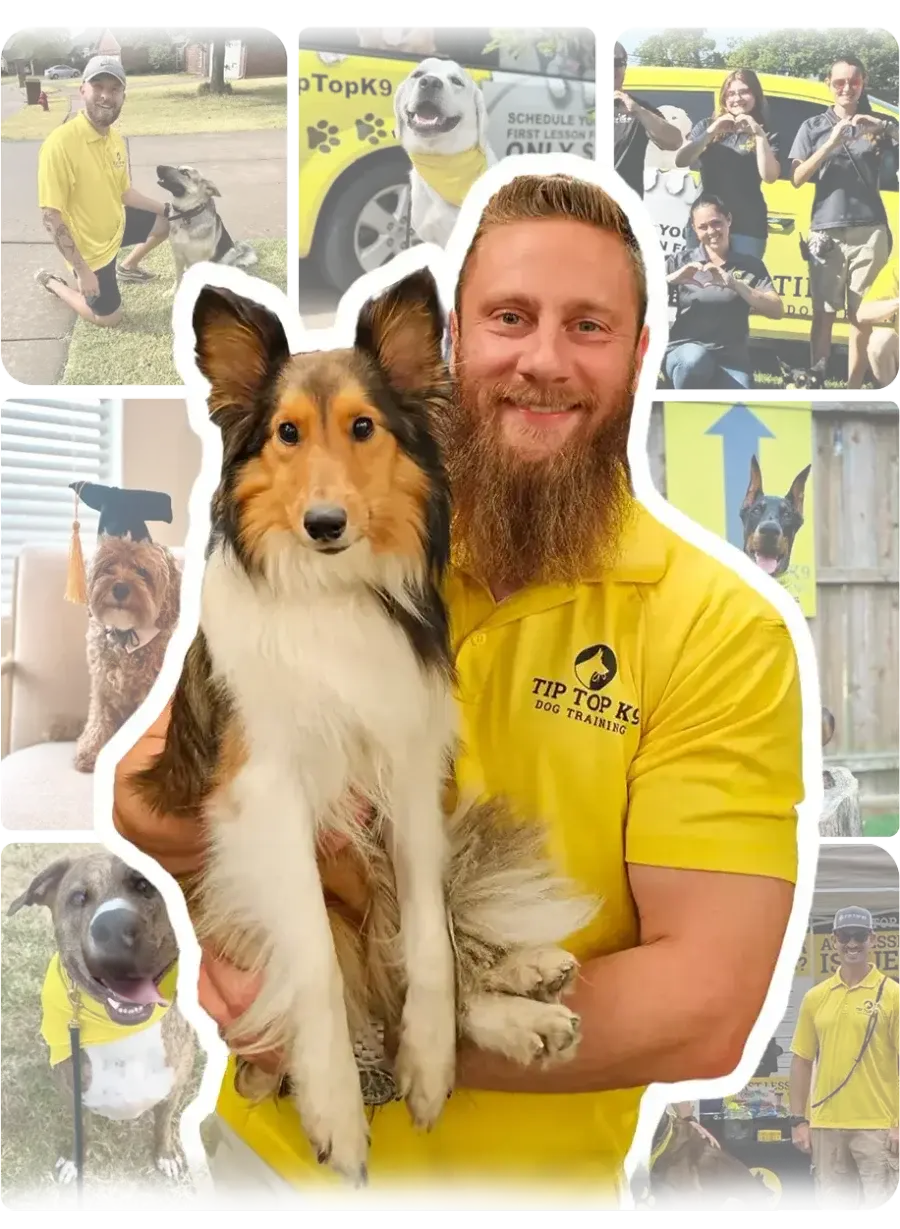

We’ve been using ChatRank for 34 days, and following their plan, we’ve actually grown over 30% in search visibility


ChatRank helped us go from zero visibility to ranking #2 in a core prompt for our business with only one new blog post!



My business has always come from word of mouth. Now people are actually finding me on ChatGPT!